Showing posts with label books. Show all posts

Thursday, September 7, 2017

Summer's end


This is the idyllic time of year. Labor Day is passed and summer is soon to end. The warm (sometimes too warm) days of summer give way to cooler nights and, shortly, to cooler days. These days are like the last few drops of an elixir that has intoxicated us till now. It's like the last rays of light on a warm, beautiful day. You have to just sit and drink it all in.

It's much warmer this year than last. Here in beautiful, bucolic Lynnwood, WA, our high temps are in the mid-80s and the air is very smoky due to the wildfires in the Columbia gorge and elsewhere. By this time last year, high temps were in the 60s and I'd already had a fire or two burning in the hearth.

Yesterday was the anniversary of Grendel's death. This time last year was filled with anguished hope and hopeless despair. I still miss my little man. My heart breaks a little bit every time I think about him. The sharp pain of those terrible six weeks of late summer has subsided, but the sorrow lingers.


I loved that chubby, obstreperous munchkin more than I knew. I love my replacement cow-cat Bogart. He has his own unique personality which endears him to me more each day. I can't help but note the contrasts, however. Grendel was a cool cat, master of every situation. He approached everything with an enviable sangfroid. Bogart is bit more touchy and skittish. He's OK with visitors, but gets a bit agitated if there's commotion. A friend brought her young daughter by a few weeks back and her excitability at meeting Bogart was clearly taking its toll. He withdrew, she followed. I had to back her off in fear that he'd attack her. The window cleaners came by last week and started whumping and bumping their ladders around the house. I had to put Bogey in the windowless master bath to calm him down. He was freaked out and near screeching in fear as strange faces suddenly appeared at the windows. Grendel would just sit at the window and stare them into submission.

I have a week's vacation coming up. I meant to take it in early August, but the demands of work kept me chained to my oar. It will be next week—or the week after that... So, on the plus side, I still have it to look forward to. I'm experiencing what it means to have your cake and not eat it, but the desire to eat the cake is growing. Maybe a week off when the temperatures are cooler and the smoke has cleared is a better option. Painting weather.

Oh no it's not!

Reading

Much of my summer reading focused on The Irish Project. However, I managed to get some reading in that was not project related but pure pleasure. As I mentioned in a post in June, my quest for fish 'n' chips brought me into striking distance of Sea Ocean Book Birth and a few delightful finds amongst its groaning shelves. I've completed The Galleys at Lepanto and Sir Francis Drake. Both were excellent reads. Thomson's bio of Drake was surprisingly rich. The narrative moves along well and the story is exciting from start to end. From the first chapter to the last, you find yourself hanging on in anticipation of the next exploit.

Beeching's book on Lepanto was equally rich. He pulls together so many threads to weave the story that you're entranced by the tapestry. I always wanted to be a historian. It's reading books like these that makes that desire grow stronger (though, I'm not sure if I could ever achieve it). I was able to tie in reading The Galleys at Lepanto with reading chunks of Gunpowder and Galleys. I've had this title for a while and only browsed it. It's a very nice technical work on Mediterranean warfare in the 16th century and allowed for a few excurses into ship details where I wanted a bit more that the narrative provided.

I'm now in the midst of reading Mattingly's The Armada. This is a classic work and is proving to be equal to the first two books. His characterization of Elizabeth is an interesting comparison with how Thomson portrays her in his Drake bio. Thomson saw the Armada as more a response to the depredations of the English corsairs, El Draque chief among them. Mattingly starts by tying it to the tensions between Protestant and Catholic England—and the larger tension between Protestant England and Catholic Spain—and the situation after the execution of Mary Stuart in 1587, the year before the Armada, or rather the year it was intended to be had not Drake preemptively wrecked it in harbor at Cadiz.

History is an opportunity missed if the writer can't tell a compelling tale. I love being able to get details, but they're valuable for reference and become onerous the more pedantic they are. A good story is more to be desired than gold. I've read a lot on the US Civil War, but nothing better than anything by Bruce Catton. He was foremost a master story-teller and my understanding of the Civil War is enriched by his colorful narratives.

Painting

My primary hope for my week off—whenever I manage to take it—is to get a lot of painting done. Mostly on the English and Irish figures I have, but on a few other projects too. I have some new Beyond the Gates of Antares figures that I'd like to get finished, or nearly finished. They're a quick paint and I have most of them started already. I might also like to complete some long-languishing Xyston 1/600th galleys for my Row Well and Live! project. I'm starting to get eager to complete the revisions I noted for it three years ago and play some more. I may offer it on Wargame Vault at some point when I'm satisfied that it will pass muster.

Sunday, April 17, 2016

Peregrination


Back in the day, I used to roam broadly over the landscape of Western Washington. Lately, the idea of getting in my car and driving 100+ miles over the course of a morning and into early afternoon is no longer as feasible as it used to be. I've become something of a homebody, rarely going more than 20 miles distant.

However, on Saturday morning I awoke with wanderlust. I had a desire to revisit some of the old haunts down south, so I got up early (actually, I always get up early because of my ravenous cats who  get increasingly frantic for food as the wee hours get less wee), and headed out to adventure.

Soul Fuel


First stop was 8:00 AM mass at Blessed Sacrament in Seattle. It's not my home parish, but I love this church. Blessed Sacrament (B-Sac, to the in crowd), is an old Gothic revival brick-pile that was founded by the Dominican order in 1908. It looks like a Catholic church ought to look. Alas for the iconoclasm of the 1970s that spurred a wave of architectural nullities that are still with us. I'm not sure what the interior of B-Sac looked like 30 years ago, but they completed a renovation in 2003 after incurring damage in the Nisqually earthquake of 2001. My understanding is that the renovation undid most of the desecrations of the 70s. Although the high altar is gone for good, the sanctuary has been tastefully redone and the statues of the saints are all back in their niches. Daily mass there is less intimate than at my home parish of St. Brendan, but it's a nice getaway every now and then.

Road Fuel

Why isn't there one of these in Lynnwood?
After mass I stopped for a nosh at Eltana Bagels. I love this place. It's inconveniently located down in Seattle in the Fremont district where I used to work, so I don't have a lot of opportunity to get there. However, it's just a short drive across the freeway from Blessed Sacrament, so it was the perfect plan. Eltana makes wood-fired bagels that are like nothing else. When I have the chance, I get a poppy-seed bagel with schmear and lox and a cup of coffee. I also buy a bag of bagels to bring home. I'm toying with the idea of a paleo diet, so I've convinced myself that cave-men ate bagels. Otherwise, what's the use?

Brain Fuel


I lived in Tacoma when I first came to Washington (well, I was born here, so that was the first time, but I'd been away for 27 years). Tacoma Book Center is a magnificent used book dealer nestled right next to the Tacoma Dome. 25 years ago, Tacoma Book Center had a large, large collection of books. Now they have even more. They've built out (and up) more shelf space and filled in a lot of the former pathways that got you around the stacks. I was there last year for the first time in many years as was astounded by the growth in collection and all the new dead-ends.

Just one of many aisles—you could get lost in here
TBC is the kind of place you can spend a day at, but I wasn't planning on being there too long. I managed to amass a pile of books in a short while and decided to get out before my pile got bigger. I was looking for books about the Aztecs, since that's my current hot gaming project. I only bought one, but I got a few serendipitous finds as well. I found a nice hardback edition of the Collins and Lapierre book O Jerusalem! about the battle for the city in 1948. I first read this book in the 70s and have re-read it at some point since. When I went to Jerusalem in '81, it was like the book came alive as I saw all the places mentioned as significant in the fighting; even with a lot of post-1967 renovation, they're all still there. I'm looking forward to reading it again. It's also got me wanting to play the John Hill designed SDC game Jerusalem! again. It's a nice game with an interesting combat/movement system. I have the original zip-lock version of the game. It's been years since I played it, but it remains a favorite in my much-neglected boardgame collection.

What I came to find...
I also found a nifty book which is a horizontal mapping of the Synoptic Gospels. I have a couple books that use a columnar mapping, notably Kurt Aland's classic Synopsis Quattor Evangelium. This book, The Horizontal Line Synopsis of the Gospels, came out in 1975. The author, Reuben Swanson, wanted a better way to see the similarities and differences in the synoptics. Sorting it out in columns is a bit tough on the reader. Swanson spent 10 years mapping the synoptic pericopes with separate sections that use a specific gospel as the main line, rather than basing the comparisons on just one gospel (like Mark). The passages are all in English from the RSV, but in reading the introduction, I discovered that he planned a Greek version of it as well. He only managed to complete one volume, which uses Matthew as the main line of narrative. I went on Amazon immediately and managed to order a used copy for just $8.00.

I passed on a small book on Q, even though I was somewhat intrigued by it. On reflection, I wish I'd picked it up, even though I'm pretty dismissive of the theory and tend toward answers to the synoptic problem that don't use Q as a literary deus ex machina. The biggest problem with the Q theory is that there is zero manuscript evidence for it and zero references to it in early Christian writing. Yet, scholars that write about Q have theorized whole communities based on it and spun off theologies of Q. This book attempts to recreate the Q source by synthesizing and harmonizing the synoptics, along with the obligatory hypothesizing about the role of Q in the early church.


I also found a paperback copy of Hugh Thomas' Conquest: Montezuma, Cortes, and the Fall of Old Mexico. I tend to eschew paperbacks, especially if they're thick tomes: the perfect binding method does not lend itself well to thick books. I passed on it, but it got me wanting to find a hardback copy.

Toy Fuel


After Tacoma Book Center, I went down South Tacoma Way through Historic South Tacoma™ to the Game Matrix. En route, I passed the location of the old Tacoma American Eagles. The location is still vacant after all these years—or at least appears to be. The store name on the awning is painted out and the windows are shuttered. It's sad to see a place that was once a major hub of the Seattle-Tacoma area gaming activity become a wasteland.

I got to the Game Matrix just after it opened for the day. I ran into Dale Mickel and Al Rivers who were waiting for Gary Greiss to show up so they could play some Lion Rampant. We chatted for a while about various things, including our cats (and Dale's dogs). I was tempted to stay and play, but I wanted to complete my wanderings and get home before too late in the day. I picked up some Vallejo Model Color paints and headed back north.

More Brain Fuel


At this point I waffled a bit about what to do. At Eltana bagels that morning, my though was to come back for lunch at the Pacific Inn, which is just down the street from Eltana. I used to go to the PI when I worked in Fremont first at Adobe. It was a favorite after work haunt later when I was a consultant at Sakson and Taylor just around the corner from it. The PI is, to put the best possible face on it, a dive. Everything about it is aged and dodgy. They do, however, pull a mean tap and the fish and chips are the best in the world. Truly. Also, across the street from the PI is Seattle Book Center. This is another old haunt of mine, though it's minuscule compared to the Tacoma Book Center. Sea Ocean Book Berth, a used book store specializing in nautical books, is also there, although, Chris, the owner, now an ancient mariner himself, is not often around much. SOBB had a nice collection of naval military history books, which has been moved to SBC.

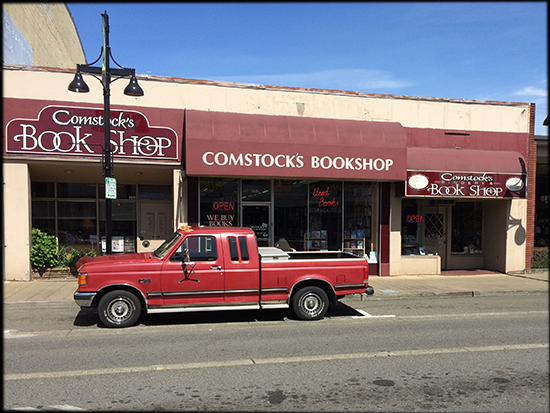
However, to make that trip would route me back home the same way I came and I had stops east of Lake Washington to make. So, I forewent my fish and chips and pint of Manny's at PI and headed to Auburn for a stop at Comstock's Bindery and Bookshop. Comstock's is a great place for used military history books. The owner, David Comstock, is a devotee and has a massive collection of books, mostly WW2 and later, but has special sections for aviation and naval that are terrific. I bet on finding my hardback copy of Conquest there and I was not disappointed. Comstock's is much smaller than TBC, which boasts 500,000 volumes on site, but it has developed into the same crowded space. Passageways between stacks are now blocked up by more shelves and books are stacked behind other stacks. It's a place that rewards patient searching and I've never failed to leave without a stack of books in my arms. But, having found what I came for, I browsed around just briefly and made my single purchase. David Comstock is getting on in years and shows it. He was never young in my experience, having a shock of white hair drawn back in a ponytail 25 years ago, but he looked the eyes of age on Saturday.

On my way out of Auburn, I got off the beaten track after making a wrong turn. I went by Emerald Downs race track and got stuck at a rail crossing while a BNSF train a mile long slowly crawled by. I didn't really mind. It's nice to get onto the off roads once in a while. Most of the valley is a place I drive through on 167, but it has a rural charm that you miss while blasting through at 70 mph on the highway.

A lovely day for trainspotting
I get apprehensive about places like Comstock's, Tacoma Book Center, Seattle Book Center, Sea Ocean Book Berth, etc. The proprietors are all old and aging. I wonder what will become of their bookstores once they've retired or passed away (likely the later, since, unlike old soldiers, old used book dealers never fade away, they just die.) Comstock's ex-wife Anita, who appears to be younger than him, might carry on (she's the co-owner), but she's never had an affinity for the military books. In fact, the store is roughly divided between David's military books (70%)  and Anita's literature and poetry (30%).

Comstock's also once had a feline population. There was always a cat or two lounging about. Anita told me they're all dead now, even though the cat furniture is still there.

Gut Fuel
Having completed my book purchases for the day, I headed north on 167 to I-405, to 520, to Redmond where I stopped in at BJs Brew Pub for a burger, fries, and a black and tan. BJs is a nice chain-style brew pub. The food is good and they have an amazing variety. The beer is also good. I'd had a hankering for a BJs house burger, so it was no loss to go that route rather than the fish and chips at PI.

BJs is in the Redmond Town Center mall, so after lunch I stopped at Uncle's Games to get some deck boxes for my Sun of York cards. I've kept the cards for this game in plastic bags up to now, but Uncles sells a lot of deck boxes for CCGs. I picked up a red box (for the Lancastrians) and a white one (for the Yorkists). I haven't boxed the decks yet, so I'm not sure if they'll fit. There's a lot of cards for that game and they're all sleeved.

Postscript: No, they don't fit. I have twice as many cards as I have box to put them in. I'll have to check out getting either two boxes for each deck or a bigger deck box (which they have).

More Toy Fuel
My final stop of the day was at The Panzer Depot in Kirkland. I've been slowly clearing out the remains of John's stock of The Assualt Group Aztecs and Tlaxcalans. I picked up three packs of Tlaxcalans: a crane banner group, a vine banner group, and some warriors with macahuitals. I chatted with John for a while and then back home around 3:00 to confront the cats, who couldn't get fed fast enough.

I didn't track the mileage, but I must have put on 130 miles round trip as I circumnavigated Lake Washington for the day. It was a nice trip and I'll have to do it again soon. It's been too long since I let the day take me where it will.

Saturday, January 31, 2015

Colleen McCullough, Requiescat in Pacem


I was rooting around Harry Sidebottom's web page earlier this week and was intrigued by his comment that he may have made an enemy for life in Colleen McCullough. In addition to his own literary and scholastic output, Sidebottom has written several book reviews. Apparently, he panned McCullogh's book The October Horse back in 2003. Sadly, you can only access the review if you subscribe online to The Times Literary Review, which I am disinclined to do, so I have no idea what he thought of McCullogh's historical fiction.

I thought it ironic that I should be thinking about Colleen McCullough just a day or two before I heard the news that she died on her little island off Australia, January 29, 2015. She wrote some of the best historical fiction about ancient Rome that I've ever read—no matter what Harry Sidebottom thinks.

I first encountered McCullough's Masters of Rome series at the Elliot Bay Bookstore in Pioneer Square in Seattle around 1992. By that time, the second book in the series, The Grass Crown, was out. Before then, I only knew of her as a writer of The Thorn Birds, which I never had any interest in reading. The mini-series had come out in the early 80s and I had an instinctual dislike for it. For all I know, it could be the best read of my life (though I doubt it), but it seems like a bodice-ripper to me, which is enough reason to avoid it forever.


Because of my aversion to The Thorn Birds, I didn't get into the Masters of Rome series until about 2005, by which time the whole series (except for Antony and Cleopatra) had been completed and the books were available cheap at used books stores (I have the lot). I imagined that the books would be bodice-rippers set in a time before bodices, which didn't turn out to be true.

I'm not sure what finally prompted me to read The First Man in Rome, the initial book in the series, but it took a while to get into it. I read a good chunk, then put it aside for a long while. When I came back to it, I started over from the beginning and read through like I was on rocket fuel. I quickly ran through the whole series as fast as I could find used copies.


The series centers on Julius Caesar, even though he doesn't show up until the end of the first book (and then as a baby). The First Man in Rome develops Caesar's back-story with the rise of Gaius Marius, Caesar's uncle by marriage to his aunt Julia. We're also introduced to Lucius Cornelius Sulla, who is portrayed as another uncle through a likely fictitious marriage to Julilla, the younger of Caesar's aunts. Much of the story deals with the Jugurthine War where Marius finally commands as a consul and is victorious, though Sulla gets the glory for capturing Jugurtha. Marius goes on to to more consulships and defeats the Cimbri at Arausio.

By the second book, The Grass Crown, the friendly relationship between Marius and Sulla is wearing thin. Marius' ambition collides with Sulla's and each, unscrupulous in their own ways, see the clash coming. At Nola in the Social War, Sulla is awarded the rare honor of the corona graminea, the grass crown, which is given to a commander who saves a legion from annihilation. In the war against Mithridates, Sulla is awarded command of the legions, which Marius tries to take from him. Sulla marches on Rome to assert his right to command and then marches east with the legions to defeat Mithradates.

In the third book, Fortunes Favorites, Sulla returns victorious from the East and sets himself up as dictator of Rome. We see the rise of Gnaeus Pompey and Marcus Licinius Crassus and the adventures of a young Julius Caesar.

The fourth book, Caesar's Women, focuses on the political rise of Julius Caesar and ends with the formation of the first triumvirate of Caesar, Pompey, and Crassus.

The fifth book, Caesar, shows Caesar victorious in his Gallic campaigns and goes through the civil war that develops between Caesar and Pompey after Crassus gets himself killed in Parthia. The book ends with Pompey's death in Egypt.


The sixth (and what was intended to be the final) book, The October Horse, starts with Caesar's campaign in Egypt and his dalliance with Cleopatra. It goes through Caesar's murder at the hands of Brutus, Cassius, and the other senate conspirators, and ends with the establishment of Octavian as Caesar's heir and the death of Brutus and Cassius at Philippi.


The characters in the novels are certainly fictionalized, but not to the extent of HBO's Rome or nearly any other fiction work, TV series, or movie on the subject. What I found striking about McCullough's work is that despite the occasional ripped bodice (so to speak) and the often sensual physical descriptions of her characters, the historical depth of the novels is amazing. The first century BC is one of the most well-documented periods of Roman history, so McCullough had a lot to work with when adding texture and verisimilitude to the story. Her research work was so well regarded that Macquarie University awarded her an honorary D.Litt. in 1993.

After The October Horse (the one Sidebottom panned), McCullough called it good. However, she was persuaded after a few years to add a seventh book to the series, Antony and Cleopatra, because fans wanted that story told, even though it is not really part of the story of Julius Caesar (it's more of a bodice-ripping postscript, without an actual bodice).


I confess that I've read nothing else by Colleen McCullough and likely won't—I'm certainly not up for reading The Thorn Birds—although Song of Troy is a maybe. Generally, I don't like retellings of fictional tales; nothing beats The Iliad for telling the story of Troy.

I am curious, though, why Harry Sidebottom panned her. Sidebottom has related how he chose the 3rd century AD as the background to his Warrior of Rome novels because it was so obscure. I get the impression that he didn't want to fictionalize characters that could easily be researched by readers who would see the discrepancies between his fictionalization and the historical record. (Take for example, the HUGE discrepancies between the characters in HBO's Rome and the real ones—or even those characters as portrayed by McCullough in her novels.)

In addition to her work as an author, McCullough was a neuroscientist earlier in her life, but gave that up after her writing career proved successful.

So long, Colleen, and thanks for all the books. Thanks, too, for softening my heart towards historical fiction in general. Your fiction inspired me to learn more about the facts.

Monday, September 1, 2014

The Books of Summer


Summer is ending, but the summer reading goes on. I always have a lot on my plate when it comes to reading. My eyes are bigger than my brain. (Most things are bigger than my brain.) There are stacks of books in various places all over my house because I'm often reading multiple books at the same time and I have nowhere to put them all. Even when I'm not in the middle of a book, the shelves are full to groaning and my iPad is stuffed full of ebooks for my Kindle and Nook apps. A lot of what I read are weighty (sometimes ponderous) academic tomes on history, theology, archaeology, grammar, politics (God forgive me), or the more high-brow kind of literature, poetry, essays, etc. So every now and then, I need some literary roughage to clear out the system.

This roughage takes the form of books that don't cause me to stop every other paragraph and ponder the deeper meaning of the world. Instead, they are just pure reading pleasure. I can fly through page after page and stay up late into the night (too late, perhaps) trying to get in just one more chapter, page, paragraph...

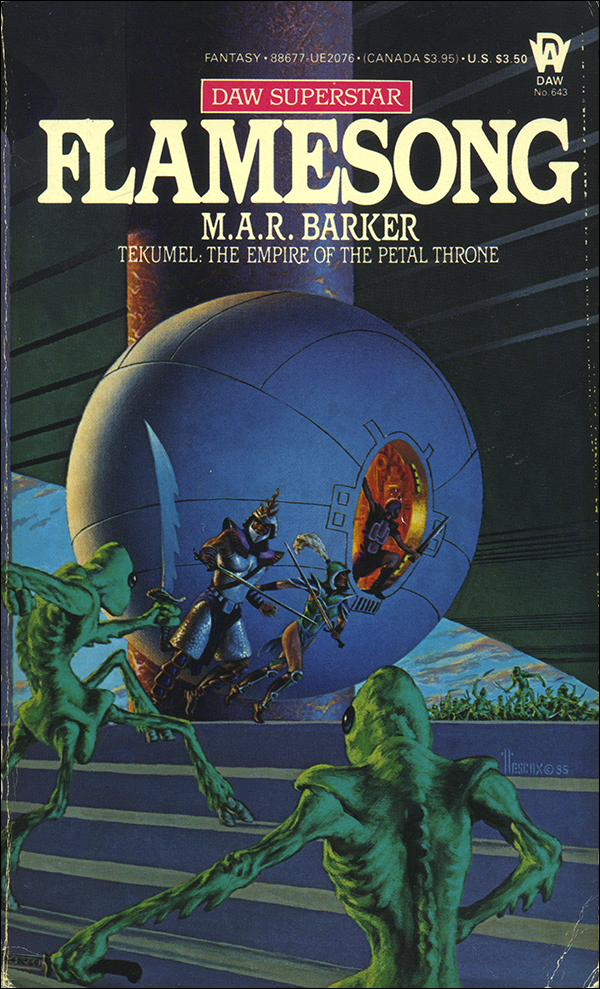
My most recent cerebral colon-blow came from M.A.R. Barker's long out of print Tékumel: The Empire of the Petal Throne novels The Man of Gold and Flamesong.


Greg Maggard (a.k.a. El Grego of the many blogs) got me intrigued with the world of Tékumel from postings on his blog The Pewter-Pixel Wars. I remember Tékumel from the 1970s when M.A.R. Barker published the RPG Empire of the Petal Throne. I never played the game, but I liked the figures produced for it by Ral Partha Miniatures. They looked like Meso-Americans gone wild. In fact, my friend Ron Towler and I considered them as possible ersatz Mayans for a gaming project we were thinking about (and never did). No one made Mayan figures in the 70s—in fact, I don't think anyone makes them now.

Barker first published Empire of the Petal Throne through TSR in 1975. Nine years and much EPT stuff later, he published The Man of Gold, the first of what would be five novels set in Tékumel, whose most powerful kingdom is Tsolyánu, the Empire of the Petal Throne.

Tékumel is a devolved world. The planet had been terraformed to some degree by space-faring hi-tech humans long ago, but a cosmic catastrophe had cut its solar system off from the rest of the universe. Only the planet's sun and two moons provide light; the skies are devoid of stars. Since the catastrophe, the world has descended into a roughly 1st c. technology, even then many resources are unavailable. Iron is very rare and most weapons and armor are made from the very tough hides of an indigenous animal, the chlen-beast. In this world of low technology, working bits from the ancient world before the catastrophe remain and are highly sought after. The world also contains "magic" in the sense that some people are able to tap into power from the "Planes Beyond."

There are also several non-human races on Tékumel. Some are indigenous and inimical to humans and other races, others were brought to the planet by humans in the time before the catastrophe.

The Man of Gold is the story of a young low-level priest named Harsan who gets caught up in the search for an ancient object which the few ancient texts refer to as "The man of gold." He alone posses the ability to find it and use it, but he's contending with unscrupulous elements from within and outside Tsolyánu who want to use the man of gold to gain power for themselves.


Hot on the heels of The Man of Gold, I managed to find a used copy of Flamesong, Barker's second Tékumel novel. I finished it just this morning. Like Man of Gold, Flamesong is a page-turner. The Flamesong of the book's title is a destructive weapon that comes from the gods. Trinesh, a hereksa (a commander of 100 men) in a Tsolyáni legion, gets caught up with characters from the enemy kingdom of Yan Kor and haphazardly travels with them around the kingdoms of Tékumel in tunnel cars (a remnant of the pre-catastophe technology) as both allies and rivals through the various situations they find themselves in. In the end, Flamesong is thwarted and things more or less settle into the status quo ante.

Barker is often compared to J.R.R. Tolkien (by Barker fans, incidentally, not by Tolkien fans). Both wrote novels set in fantasy worlds whose verisimilitude was achieved by creating a depository of history and culture—including creating whole languages—outside the novels, and then drawing on that depository for the breadth and depth required for meaningfully describing the worlds they created. Tolkien broadly modeled his work on the Northern European Dark Age. Barker modeled his on India/Pakistan and, to a lesser extent, pre-columbian Meso-America. Both were philologists and professors. Both told gripping stories. However, the comparisons end pretty much there.

I thoroughly enjoyed Barker's novels as fast-paced swords 'n' sorcery adventure tales. However, there isn't anything deep in them. One of the things that strikes me about Barker's books is that they read a lot like you'd expect a post-mortem of an RPG session to read if you gave it some good literary flourishes. This isn't accidental. Barker's novels followed his RPG by almost a decade. The world of Tékumel was created not as the background of a novel, but as the background of a role-playing game. Barker wrote numerous background booklets for Empire of the Petal Throne in the late 70s and early 80s.

Tolkien, on the other hand, was the inspiration for Dungeons and Dragons, although he had nothing to do with the game and died the year before it was published. Tolkien's inspiration for Middle Earth had much more to do with his own world view, which was profoundly Catholic. Tolkien wrote that Lord of the Rings was "a fundamentally religious and Catholic work." Although Lord of the Rings was never allegorical (Tolkien disliked allegory), it did express deep Catholic ideas in the world Tolkien created and in his characters.

Barker was a convert to Islam in the 1950s (the initials M.A.R. stand for his Muslim name, Muhammad Abd-al-Rahman), but I'm hard-pressed to see anything Islamic in his themes, characters, and in the world-view expressed in his books. In an interesting contrast to Tolkien, Barker is quite profuse in his descriptions of religion and sex in Tékumel. Tolkien never mentions either about Middle Earth. Instead, Tolkien's work speaks of faith and love.

I could go on—and if you're still with me at this point, thanks for hanging in there—but I can sum up the distinctions between Barker and Tolkien thus: Barker writes a great story but, unlike Tolkien, never rises to the level of great literature. For literature to be great it has to show us what is true, what is good, and what is beautiful. Tolkien scores high on all three and Lord of the Rings is considered by readers to be one of the greatest literary works of the 20th century or even of the last millennium. Barker's novels are rather obscure and appeal to a niche audience. Nevertheless, if you can find a copy of Man of Gold or Flamesong, buy it and enjoy it.


Earlier in the summer, I got around to reading C.S. Lewis' space trilogy. Although I'm a fan of Lewis' writing, I'd never had much interest in the space trilogy before, but I read something that referred to the series quite favorably, so I was interested enough to get a hardback set of all three: Out of the Silent Planet, Perelandra, and That Hideous Strength.

I burned through the first two volumes very quickly. Perelandra wore me out, not because it was tedious—to the contrary, it was riveting—but because the depiction of evil in the book was deep and disturbing.  I know this is a departure from my commitment to literary roughage, so I've put the third novel, That Hideous Strength, on hold.


I've posted earlier of my love for H. Beam Piper's book Lord Kalvan of Otherwhen. I picked up a copy of John F. Carr's biography of Piper last week. So far I've just nibbled at it, but with Flamesong finished, I'm about to dive in more deeply. Piper is a fascinating and enigmatic character. He's a bit obscure in the sci-fi genre except to his devotees (such as my humble self). He might have been one of the greats if not for the fact that he killed himself in 1964, pretty much right on the cusp of wider success.

Carr's book tries to uncover the mysteries of Piper, who seemed to be very active in his lifetime in obscuring any real knowledge about himself. It's almost as much a detective work as a biography because so much of what Piper told others about himself turns out to be untrue, so there are only snippets of letters and personal remembrances to go by. He destroyed much of his unfinished work, which is a pity perhaps. He was embarrassed by his juvenilia (so to speak), which is why he burned it.

He never made much money as a writer and lived far beyond his means and put up a false front in regard to his financial well-being. He amassed an impressive collection of antique firearms, which he loaned to the local historical society. Even when in dire financial straits, he was too proud to take back the collection and sell it for the money he needed to live. Instead, he shot pigeons on his roof and ate them to avoid starvation until another advance or royalty check came his way. The experience made him vow to never let himself starve like that again, which must have been a factor in his suicide.


I also have a recently acquired copy of Federation, a collection of Piper's short stories for his Future History series. The last story in the book, "When in the Course," has only been published here. It uses a similar setting as Kalvan, including the names and characters of the people in Hostigos, except there is no Calvin Morrison and no Paratime Police. Instead, the story involves interplanetary settlers, who side with Prince Ptosphes and Hostigos against Styphon's House and its allies.

"When in the Course" was only discovered among Piper's papers some 16 years after his death. It's his original conception of the story of the "Gunpowder God" that was reworked and published as Lord Kalvan of Otherwhen. It makes one wonder what other gems he had that went up in flames. He was working on a novel about the great Spanish Renaissance general Gonzalo de Cordoba, The Great Captain. It's a great shame that that work was unfinished and lost.

I started "When in the Course" a while ago, and then switched to re-reading Kalvan, which I liked better. I need to settle back and get through "When in the Course." I'm sure I'll find it rewarding.

Postscript 9/2/14

I finished "When in the Course" this morning. It definitely doesn't have the same feel as Kalvan. I can see why it was re-worked into the Paratime series. Piper had been serializing the story in Analog magazine when he died.


Apparently, publishing Kalvan posthumously while the serialization in Analog was still in progress was a sticky issue.

Saturday, January 11, 2014

Naughty and nice (or My Christmas vacation)


I had two weeks off over the Christmas-New Year's holidays this year. Going into it, I giddily imagined all kinds of productive activity. The aftermath is a more sober reflection on the best intentions going awry. Nothing bad happened, but much of what I intended came to nought. It was, however, a welcome time off. I think that staycations are the most relaxing time a person can have away from work. I can't say that I came back to work on Monday eagerly, but I did feel content that I had been away long enough to feel prepared for going into the lion's den of work backlog and email pile-up.

What follows is my list of the naughty and nice I did on my Christmas staycation.

Nice
On the nice list:

Resumption of painting - I'm back upstairs in the wee painting nook tucked into the closet in my den. I forgot how much nicer it is to paint on my painting table.


It was a serendipitous find at Fred Meyer about a dozen years ago. It's supposed to be a kitchen utility table and has a stainless steel top. It fits perfectly in the closet, so I can close it up and have it all out of site when I'm not painting. (However, the general clutter of my den makes closing the closet doors impossible. See the naughty list below.) When I sit at the table, the surface is about the level of my sternum, which makes it very comfortable to paint. I can support myself on the table to get better brush control without having to lean in too far. The past year of painting on the dining table was tiring. I couldn't do it for long before neck and back strain drove me to the couch to be buried under cats and thus immobilized for further painting efforts.

The lighting is also much, much better. I can actually see what I'm painting.

With a bit of music playing in the background, I've been able to sit and paint for extended periods without tiring. It nicely addresses my cat problems, too. When I painted on the dining table, Rhiannon would come up on the chair next to me and start head-butting my brush arm. (Look close at some of my figures and you'll see some wild brush strokes...) Maebh regarded the dining table as her personal playground and my work was often interrupted by a fluffy little Manx jumping up and landing in the midst of my work with her characteristic "brrrrt!" which I interpret as "Brace yourself, biped! Maebh the Merciless is here!" When I paint upstairs, the munchkins just lounge about on the settee. Perhaps the music lulls them.

D.A.N.G - Dave Schueler hosted another Dave's Annual Naval Game. This event is a highlight of the holidays and I may have missed it once in the dozen or so years Dave and his wife have been hosting it.This year's mini-campaign was Operation Landcrab, the US campaign to re-take the Aleutians in May 1943.


I was on the Japanese side. We had one glorious small action that looked to be a total loss for Dai Nippon. We lost a heavy cruiser and light cruiser from American gunfire, but the US players got too eager and pursued us right into several spreads of 24" torpedoes and two of their three heavy cruisers went down hard. The Long Lance struck! (Actually, they were type 90 torpedoes, but that's close enough to the type 93.)

The second action was much bigger and looked to be less favorable to the Japanese forces. The battlewagons came out, but the superannuated Japanese dreadnoughts were getting shellacked by the less superannuated American dreadnoughts. The socializing, campaign dallying, etc. took its toll on our time and we were unable to finish the last battle. We had a lot of long lances in the water (actual type 93s this time), but the American tactic was to keep away and rely on radar-guided gunfire to shoot us to bits. Dave rolled an ersatz resolution on our torpedo attacks that decided a bit of damage on the American BBs. However, we also figured on the Japanese losing or having badly damaged the BBs we had in action.

In the end, we figured that the Japanese gave the US a bit more trouble than they did historically, but that driving the Japanese off of Attu and Kiska was a foregone conclusion in any case.

Battlegroup Overlord - I had a chance to play in a Battlegroup Overlord game run by Chris Craft. BGO is Chris' latest WW2 skirmish crush. He pitted his American paratroopers against the Hun in a game featuring a lot of very close terrain.


Hedgerows abounded and it was pretty difficult to get fields of fire. Despite it being a very bad day for American tanks, the Germans lost. I was a Hun commanding a platoon of landsers. We took out a tank and shot up a squad of paras, but we took a lot of fire in return. I think I had a bit more than a large squad by game's end.

I couldn't help comparing it to Bolt Action, which is what I play a lot of. In the end, it was a toss-up for me. Each has its own way of accounting for the randomness of command and control. The effect of shooting is pretty much the same. However, BGO's rules about pinning create more command friction for unpinning. Also, the battle rating system in BGO makes for a more logical end point for a game. Essentially, each unit has a battle rating, the aggregate of these ratings is the battegroup's battle rating (BR). As events occur, like losing a unit or attempting to unpinning a unit, one side has to blindly pull a battle counter numbered 1 to 5 and set it aside. As soon as the the number of pulled battle counters equals or exceeds your battle rating, you lose—regardless of other circumstances on the game table. For example, we shot up the American armor and had two Tiger Is and two StuG IIIs remaining (having lost only one StugG III), yet lost because our infantry was shot up.

I have the earlier set of rules in the series, Battlegroup Kursk, which I intend to use with my vast number of Eastern Front minis in 15mm.

Monolith Designs/Graven Images 40mm Prehistoric Europe - I broke down and finally ordered figures from this range after salivating over them for a few years.


The term "prehistoric" has to be understood in context. These aren't cave-men. They're actually modeled after the European Late Bronze Age (ca. 1300-700 BC). When I was in Copenhagen in 2000, I had a chance to spend several hours in the National Museum and look at artifacts from this era, including some Bronze Age helmets and weapons.

The range was designed and sculpted by the late Jim Bowen, who passed away unexpectedly earlier in 2013. Steve Mussared, who runs Monolith Designs, produces the range and still has more of Jim's masters to put into production this year, so I expect to be be buying more soon. They're not cheap. A pack of four figures runs 10.99 GBP, but they're BIG.

At this point, I'm still waiting for them to arrive. They shipped from Monolith in the UK on Dec 20 and are caught in the devil's trifecta of the Royal Mail, the US Postal Service, and the Polar Vortex of Doom, which shut down airports and embarrassed Al Gore (just kidding, nothing embarrasses Algore). I am hoping each day now to see a little something in the mail...

I'll use them for skirmish gaming (of which more anon). I've recently discovered the Song of Blades and Heroes rules from Ganesha Games in Italy, which look like the front-runner for rules of choice.

Naughty
So much for niceness. The naughty is as follows:

The garage from hell - It haunts me. It taunts me. It calls me names and questions my legitimacy. Still, I can't bring myself to clean it. With two whole weeks off (apart from family commitments and game days), I resolved to spend a little time each day cleaning the garage and before long, voilà, a clean garage where I can once again park my nice car rather than leave it outside to suffer from the elements. Alas. It didn't happen. As I write this from the den in my townhouse, two floors above the garage, I can hear it titter and scoff. I will have the last laugh, though. Maybe this year...

Reading - I always expect to read more than I do. I have a number of books that I've partially read. I tend to read sporadically from this book and that as the mood strikes. It's probably hell for retention, but I always seem to have more that I want to read than I have time for.

I got very little read, but did manage to get through Bronze Age Warfare by Richard Osgood et al. This book was a chance find at Half Price Books a while back. Now that I'm getting psyched for the 40mm prehistorical europeanoids project, the book is a welcome resource, even though much of the evidence available comes from the Aegean, which saw a higher level of civilization that Northern Europe. Thank goodness for the bogs, which have given up several treasures (and near-intact corpses) from this period in European prehistory.

Still being slowly ploughed through are several books on the Wars of the Roses and Alexander Rose's fascinating Kings in the North about the Percy family in British history.


Eating - OK. I was a pig. With time on my hands, I cooked. Having cooked, I ate. I was also cruelly tempted by a host of Christmas goodies. Surprisingly, I gained less weight than I feared, but at 219 lbs., I am a few pounds above my best weight of last year.

Painting - Although I got back to painting in my den, it took me until after New Year's to do it. I can rationalize that until then I was busy with holiday activities, blah, blah, blah. Really, though, I was too busy eating and lazing (i.e., not painting, not reading, not cleaning the garage). As I posted earlier, I have resolved to do better this year—and so far have done.

No Tannenbaum, no Tannenbaum - I haven't put up a Christmas tree for a few years now. It's not from lack of desire. I used to get a tree delivered each year from the nursery down the street, but they went out of business and I haven't had a tree since. It's pretty much impossible to schlep a tree with my 350z. That leaves me with the option of borrowing a car or finding somewhere else that delivers, which I haven't.


Maybe next year when I can claim more nice than naughty.

Tuesday, July 17, 2012

Adventures Real and Imagined

Since my Enfilade! posting in May, my life has not been a formless, airless void apart from writing galley rules. There have been a few adventures:

I Do Know the Way to San Jose

In mid-June, I made an impromtu visit to the town where I grew up. I spent 21 years in San Jose  (1965–1986), which ties my current sojourn in Seattle (1991–2012) for the longest place I've lived. I breakfast most Saturdays with Rick Martinez, whom I've known for 35 years (since 1977!). Rick has been up here for about 10 years or so, but he makes regular trips down to San Jose. With another trip pending, he suggested I go down too and join in a gaming weekend with old friends. It took me just a second to ask myself, "Why not?" I booked my travel the next day (through Expedia.com of course) and champed at the bit waiting for the weekend to come.

The last time I was in San Jose was 2009 when I drove down in my 350z with my then-GF Lorrin for a birthday week trip. It was 107 degrees. This time it was much cooler at a mere 97 degrees. I alway enjoy my trips to San Jose, but it's a strange feeling to "come home" to a place that has changed so much in the intervening years—and keeps changing. I have fond memories of my life in San Jose and more than a few places with which I have happy associations just don't exist any more.

The gaming group included old friends Wolfgang Blum and Al Tilley. I had seen Wolf more recently when he came up here to visit Rick a few years back. I hadn't seen Al since maybe 1981. We used to game Judge Fernandez' square ancients in Al's garage every Wednesday for years. I met Al through Rick who dragged me to the game back when I was 17. For a man of 80+ years, he was as sharp and amusing as ever. Seeing him again reminded me of how much I enjoyed his company.  Several other people were there, a few of whom I'd met perhaps once many years ago when Rick still lived in San Jose and I was visiting. Their names were familiar to me, however, because Rick often talks about them (and one cannot forget a name like Ix Nixon). After several hours of gaming on Saturday, we had dinner at By-Th'-Bucket on Stevens Creek. It's odd that as old as it is, I still think of it as the "new" By-Th'-Bucket since I recall the old one so well from former days. I had an amazing Kobe flat iron steak with a brandy creme sauce. I wanted to lick the plate.

The trip ended all too soon. Rick was staying another day, so on Sunday we had breakfast at the Original Pancake House. It was crowded (Father's Day), had no air-conditioning, and our order took forever. I ordered Swedish pancakes, which faithful readers of this blog will know I love. However, these ones came unrolled, so I had to dish out my lingonberries onto the crepe and roll my own like a blunt. But the taste was great.

I made a last stop at Game Kastle near the airport to buy out the last of their Xyston 1:600th scale galleys. Next stop: drop of the rental car and grind through the misery of airport security and check-in. I managed to upgrade to first class on the way down, but the return flight had no availability, so I was stuck in coach, way back at the the butt-end of the plane. While waiting for my flight, I had lunch at Original Joe's in the airport. It's not the same at eating at OJ's downtown. For one thing, the menu is truncated, but the ambiance is also lacking. Next time I'm in San Jose, I'll manage to make it downtown and get the delicious veal piccata—even though I feel a little guilty eating baby cow; maybe I'll have the chicken piccata instead.

Even though I was sick the entire time, I loved every minute of being "home." San Jose in the 60s and 70s was a fantastic place to grow up. Even now, in its bustling Silicon Valley incarnation, I would love to return to live there. I could use a little endless sunshine. Perhaps some day...

More Sidebottom

I preordered Harry Sidebottom's latest Warrior of Rome book, The Wolves of the North, from Amazon UK earlier this year. It arrived last weekend and I pitched right into it. Sidebottom's books are rich with the culture and history of the classical world. The narrative is fast-paced and suspenseful.

Sidebottom's last few novels have taken the main character, Ballista, out of the mainstream of the Roman world and into its backwaters. The previous volume, The Caspian Gates, was set in the remotest part of Asia Minor. The Wolves of the North is set in the Russian steppe where Ballista, in disgrace because of an action—briefly assuming the purple—that should have cost him his life, is sent by the emperor Gallienus, an otherwise old friend from before Gallienus was emperor, to coax the nomadic Herul to ally themselves with Rome. All the while, a psychotic murderer among Ballista's traveling companions is leaving a trail of the mutilated corpses of slaves and eunuchs (who've already been mutilated enough, one would think).

I'm about half-way through. I would be farther along if I wasn't reading so much about ancient galleys these days.

The Mac and i

I've been a Mac user since I started writing papers at school using Tim Cole's Macintosh 128k with its hifalutin' external floppy disk drive (one-sided). I bought my own Mac, a Mac Plus with a 20 MB external hard drive, in 1988. I couldn't imagine then using 20 MB of disk space for anything.

When I started working at Aldus in 1991, I used my lighting-fast Macintosh II at work for my computing needs, mostly publishing The Citadel, our NHMGS newsletter, and the NHMGS web site. That arrangement lasted until 1998 when I bought an iMac G3 so I could fiddle around at home and access this newfangled Internet thing from my living room.

Two years later, I went wild and got a PowerMac G4 with a massive two-ton 21-inch Apple Studio Display CRT monitor as my main screen and a 17-inch Apple Studio Display CRT monitor as a secondary for the innumerable palettes in Photoshop and other graphic tools. I felt like the ultimate power user.

Six years later, the 17-inch monitor had gone poof, so I was down to one monitor (the BIG one) and the once-powerful G4 was limping along barely running the newest software. So I bought a white polycarbonate Intel Core 2 Duo 24-inch iMac in 2006. It, too, made me feel like I needed a license to fly just to use it. By now, software applications with lots of palettes had settled down into a more manageable UI so that you didn't need a second monitor to accommodate them. The 24-inch flat panel screen of the iMac was spacious enough to accommodate any application's interface and all the clutter from a separate CPU and monitor was gone. The gleaming white all-in-one iMac seemed almost futuristic with its non-intrusive presence in my workspace—like something out of the Jetsons. I felt that at any minute Rosey the robot maid would roll in and ask me if I wanted tea.

But time marches on and the future is always ahead. After six years, my beloved iMac was showing its age. I had to upgrade to its maximum RAM configuration of 4 GB just to run OS X Lion. I had been using the Adobe CS3 suite, but last year I started a subscription to CS5.5, which has now transformed to an Adobe Creative Cloud subscription. After installing the CS6 applications, I discovered to my chagrin that they don't run well on my iMac.

So this weekend I resolved to replace my beloved iMac with a new iMac. I'd seen the 27-inch iMac in various Apple Stores around town and wanted one (Look! A shiny thing!). I just couldn't justify it until recently. Perhaps seeking a justification was a subliminal impulse to upgrade to CS6. I walked into the Apple Store on Saturday afternoon and 20 minutes later was stuffing a HUGE box into the back of my 350z, which Nissan never intended for haulage beyond a few groceries. I couldn't close the hatch all the way, but by driving slowly (hard for me to do) I made the few blocks to my house without incident.

I bought the top of the line stock configuration for the 27-inch iMac. I seem to get a good six years out of computers and getting more than I need now means having as much as I need later when OS X Sabre-tooth Tiger (or whatever Apple calls their OS version in four years—even now OS X Mountain Lion is pending release—they must eventually run out of eponymous felidae, mustn't they?) and Adobe CS12 are the current versions. I also had the store install an additional 8 GB of RAM for a total of 12. That's enough to be getting on with. If I really need it, I can upgrade to a total 32 GB. (It's unsettling, though, to think that years from now we'll look back and laugh at 32 GB of RAM the way I look back and laugh at 20 MB of disk space.)

Once I got the new iMac home and out of the box, the fun started. The apple migration assistant let me wirelessly transfer everything from my old iMac to the new one, but it took 10+ hours. I was asleep in bed when it finished. However, I was thoroughly impressed with the result. I had to reinstall Office 2011 for Mac and run an upgrade patch on the reinstalled Outlook, but otherwise it was as if I were on the old computer, except faster and with a bigger screen.

Then came the tangle of readjusting peripherals. Why are there so many cords and cables? When someone invents wireless electricity (apart from lightning) I'll be over the moon. The migration didn't migrate the content on my LaCie 500 GB external drive, which contains all the files for my projects like Pike & Periwig and Row Well and Live! I thought I'd just hook it up, pull its contents onto my capacious 1 TB internal drive and presto! However, the Firewire connection that worked with the old iMac doesn't work with the new. The new iMac has Firewire 800 and two slots for Thunderbolt. Fortunately, it also has four USB 2.0 slots. I had to rummage around in the garage to find a USB cable from my bag of forgotten 'puter bits, but I was able to get everything transferred.

It seemed like a bit of fuss to go to the new from the old, but I'm back in business for at least six years.


The Great Couscous Caper

Incredible as it seems, I had a five-pound bag of Israeli couscous stolen from my doorstep. I like the large grain style of couscous much better than the more common Moroccan style. I used to be able to buy it in bulk from Whole Foods, but they discontinued it. They have a dozen variations of the Moroccan style in bulk, but no Israeli. You can buy it in smaller packages at a lot of places, including Whole Foods, but because I eat it in bulk, I want to buy it in bulk.

I found that Amazon.com sells it in five-pound bags for $12.00. I bought a bag a while ago, but now I'm out. I ordered another bag last weekend and it should have come by now. I checked my order on Amazon.com and the tracking showed it to have been delivered on Wednesday and left by Fed Ex on my doorstep. Only it wasn't there. I didn't get home until about 9:00 PM that night, so I can only assume that some ass in my neighborhood took it. They probably thought that a package from Amazon was something cool. A Kindle maybe. They probably feel foolish for having stolen a big bag of Middle Eastern pasta pellets. Serves 'em right. But it doesn't get my couscous back.

Fed Ex isn't going to replace it for me. I could order another, but I'm more than a little put off by the fact that someone stole a package from my front doorstep. I think instead that I'll look around beautiful bucolic suburban Lynnwood for someplace that sells it in bulk.

Another thought is to save up a week's worth of cat box scoopings, box them, Fed-Ex it to myself, and then wait for the same jerk to steal it. He might find getting desiccated cat poo even more disappointing than the couscous he scored in his last crime.

Pneumatic Woes

I've had the desk chair in my office for probably 10 years. It's high-backed, black leather-ish with arm rests. Like all chairs of its type, it has a pneumatic column coming up from the wheeled base that lets you adjust the seat height. I normally keep it jacked up all the way. Suddenly today the chair keeps popping down a bit as I'm sitting on it. I'm now about eight inches lower than when I started writing this section and I have to reach up to type.

I think it's time for a new chair.

Thursday, November 25, 2010

Lord Kalvan of Otherwhen


I just finished re-reading my beat-up copy of H. Beam Piper's wonderful sci-fi novel Lord Kalvan of Otherwhen. I think we all have a few books in our lives that we read again and again for the sheer pleasure of having a familiar tale unfold for us. And even though we know it all so well, each re-reading is like the first reading all over again. Kalvan is one of those books for me. I've probably read it 20 times since I bought my first copy and it never gets old.

It was Piper's last book. For reasons still unclear, he committed suicide in November 1964, just before Lord Kalvan was published. Speculation is that Piper assumed that his career was heading downhill and that he would never lift himself out of his financial problems. Ironically, Lord Kalvan was his biggest, albeit posthumous, success. He died without knowing the extent of his influence on the genre.

Lord Kalvan's story falls within a familiar theme where a seeming everyman becomes unstuck from his old life by events outside his control and finds a destiny he never imagined possible. Lord Kalvan is the last of the paratime series that started with the short story "He walked around the horses," which appeared in the Magazine Astounding Science Fiction in 1948. Piper had a fascination with the idea of parallel worlds where alternate probabilities worked themselves out. It was a theme he used in several short stories and novels. Most of Piper's work is available online as free e-books.

The story's protagonist, Calvin Morrison, is a Pennsylvania State Trooper who gets accidentally sucked into a paratemporal conveyor while he is apprehending a holed-up prison escapee. After a shoot-out with the conveyor operator, he's ejected to what appears to be the same spot he was before but different. Where there was only scrub, there is now primeval forrest, but other landmarks are correct. He stumbles on a farmstead whose humble inhabitants are clearly not from any part of Pennsylvania's history. He eventually convinces himself that he has been transported to a far-distant future where mankind has bootsrapped itself back up to roughly 16th century technology after being blasted back to the stone age in a nuclear holocaust. However, he is really on a alternate probability timeline (Fourth-Level: Aryan-Transpacific) where the Aryan migrations that went south and west to populate Europe and India before the Bronze Age instead turned east, sailed across the Bering Strait, and populated the Americas.

Morrison has wound up in a princedom called Hostigos, whose capital Tarr-Hostigos occupies what is Bellefonte, PA on Morrison's own timeline. He finds himself in the middle of an enemy raid that reaches his hosts' farmstead. He springs to action and, with his state-issue .38 special, helps to repel the attack and begins a counterattack. However, in the confusion of the fight, he is accidentally shot by Princess Rylla, the daughter of Hostigos' ruling Prince Ptosphes, but saved from death by his badge, which blunts the bullet's effect. This detail is an interesting story glitch because the Pennsylvania State Police do not and never have worn badges. I guess the alternate would be the old Bible in the breast pocket trick, but Calvin Morrison is described as an agnostic.

Badly wounded, Morrison is taken to the castle and nursed back to health by Princess Rylla and the priests of the god Dralm, a sort of kinder, gentler Zeus. Rylla teaches him the local language and Morrison, obviously a fish out of water, is able to explain himself as someone sent there by sorcery. Xentos, the high priest Dralm, declares that he was sent by the gods to help Hostigos. Morrison soon learns that Hostigos is beset by its neighbors at the direction of an evil theocracy called Styphon's House.

In the meantime, the Paratime Police, whose job is to protect the secret of paratemporal travel, track Morrison down to kill him if he's deemed to be a threat to the secret. Verkan Vall, the special assistant to the Paratime Police Chief, takes on the job himself. Coming into Hostigos as a free trader from outside the kingdom, he determines that Morrison's misunderstanding of what happened to him and his cover story in Hostigos pose no problem. Vall befriends Morrison, who has now been raised to the peerage as Lord Kalvan by Prince Ptosphes and betrothed to Princess Rylla. Vall admires Kalvan's character and helps him in his fight.

Kalvan is able to greatly improve Hostigos' military situation, but he remains initially unaware of its real problem: it hasn't enough gunpowder to defend itself when its enemies attack. He soon learns that Styphon's House is the sole maker and provider of gunpowder—called fireseed—in all the kingdoms. Only Styphon's highest priests know the secret and Hostigos is under the ban. It's then that Kalvan drops a bomb and reveals that he can make fireseed and proceeds to do so, making a better product than Styphon's.

Kalvan starts major gunpowder production in Hostigos, but also works to let the secret of gunpowder out of the bag so that anyone can make it, thus weakening the control Styphon's House has over the kingdoms. Kalvan sees Styphon's House as the real enemy and vows to destroy it. Styphon's House reacts by stepping up the pressure on Hostigos and urging its minions, the neighboring princedoms of Nostor and Sask, to attack sooner than they planned.

The war that follows is fought on two fronts. Kalvan smashes a two-pronged attack by Nostor and then prepares for a second war against Sask. The decisive battle against Sask is based on the Battle of Barnet in 1471, where Yorkist and Lancastrians fought a confused battle in the fog unaware that each had outflanked the other.

When the wars conclude, Kalvan is raised up as a Great King ruling the princes of Hostigos, Nostor, Sask, and a few minor states—and of course, he marries the princess Rylla, too. The book ends with the knowledge that the wars against Nostor and Sask are only the beginning of a longer fight to overthrow Styphon's House.

I became aware of Lord Kalvan back in the late 70s when I was all into Pike & Shot wargaming. I bought a set of miniatures rules called Down Styphon! that were written by Mike Gilbert and published by Fantasy Games Unlimited. These are still available (or, rather, again available) for just $4.00 directly from FGU. The rules referred to the novel and included an advert for purchasing the book from Ace Books for $1.50 plus 35¢ shipping. I thought I had been cured of responding to adverts after enough misadventures in my younger days with the schlock products that were the staple of the end sheets of every comic book (sea monkeys, X-ray glasses, etc.). But sending away for the book was the best hunch I ever took, especially since I had never been a sci-fi fan before, or really much since.


A few years ago, I acquired a copy of Roland Green and John F. Carr's 1985 novel Great Kings' War, which extends the story to the next phase of Kalvan's war against Styphon's House. Green and Carr have since written another two novels in the series, Siege of Tarr-Hostigos and Kalvan Kingmaker. I haven't read either. Great King's War was a good read, but it hasn't held me like Lord Kalvan. I've re-read it maybe once before, but now I've pitched into it again.


I've always wanted to game the world of Lord Kalvan. There are enough suitable Pike & Shot rules around, including Down Styphon! However, the descriptions of the troops in Lord Kalvan make getting their exact look very hard to do with the available figures. The men are described as looking part medieval and part 16th–17th century with chain mail, plate mail, high-combed morions, and a kind of unvisored sallet.

The Hostigos troops have a lot of crossbows and what firearms they have are a kind of flintlock with an action that works in reverse. I've always thought that a reverse flintlock was an odd thing for Piper to create in his story. I own a flintlock musket, so I'm familiar with how they throw a spark beyond the frizzen. If the action is reversed, the spark from the flint striking the frizzen goes into the shooter's eye. Piper was a gun nut; he ought to have known that.

The Down Styphon! rules announced a figure line to be created especially for Lord Kalvan's world based on specifications provided by Mike Gilbert. They don't seem to have ever been produced. The rules themselves are fairly straightforward and use mechanics that were standard for the 70s, and very typical of FGU games in particular. I am toying with these rules as yet another project. I have some 30 Years' War figures, but perhaps an intervention is needed instead...