Wednesday, February 11, 2015

KGC Blitz: Adapting PanzerBlitz situations to miniatures


I played my first game of Avalon Hill's PanzerBlitz when I was a lad of 10. My friend Richard's older brother went off to the army in 1970 leaving behind his brand-new copy of the just-released game. For Richard and me, being the kind of boys who liked tanks 'n' stuff, PanzerBlitz was nirvana. The counters had silhouettes representing specific tanks: T-34s, SU-100s, Panzer IVs, Tigers. For boys who liked tanks 'n' stuff, Tiger tanks were the apogee of our enthusiasm. A game of tactical armored combat on the Eastern Front 1941-45, could it get better than this? Even the box art was cool.


I played PanzerBlitz with Richard for the next year until he moved away, taking his copy of PanzerBlitz with him (but he left me his dog, Sparky, who was with us for the next 14 years). I got my own copy of the game, the revised 1971 edition, and continued to play it with other friends for years after that. Of the many games from my youth, few remain. Pride of place for those is my much-worn copy of PanzerBlitz. I even bought two more copies on eBay. One of which is the 1970 first printing with the glossy colored reverse sides of the counters: black for Germans and red for Russians.

All these years later—despite some glaring design flaws, such as "PanzerBush"—PanzerBlitz remains one of my favorite games even though it's been more than 30 years since I last played it with someone. (Also, you can easily adopt the opportunity fire and spotting rules from Avalon Hill's later games Panzer Leader and The Arab-Israeli Wars to fix the design flaws.)

Fast forward to now. I game with a group of people at The Panzer Depot in Kirkland, WA. One of the games we've play a lot is Kampfgruppe Commander II (KGC) using 15mm models and figures. KGC is a later development of the evolutionary strain of tactical WW2 rules that started with the "standard unit" concept in Wargamer's Digest magazine in the 1970s. WD had some rules in mind that never got published, but the standard unit concept was best exemplified in Frank Chadwick's Command Decision (CD) from 1986. Unlike most earlier WW2 rules, CD doesn't represent the tanks, guns, and troops at 1:1. In CD, each gun and tank model represents a platoon-sized unit (the standard unit). Infantry, mounted three to a base, also represent platoons. This is pretty much the same representation used for PanzerBlitz, except that in PanzerBlitz Russians units are company sized.

KGC uses the same representation as CD with the exception that Russian units are represented one level up to account for the smaller size of Russian platoons and the lower degree of tactical flexibility of Russian forces. For example, in CD the basic maneuver element for Russians is a company represented by two tank models or two stands of infantry. In KGC, the basic Russian maneuver element is a battalion of four tank models or four stands of infantry. In addition, mortar batteries and machine-gun companies attached to Russian infantry battalions are not represented as separate units, but just factored into the infantry fire value (at just +1 for all range bands). This difference matters for the conversion, as I'll address below.

Because the representational scale of KGC and PanzerBlitz are so similar, it naturally occurred to me that adapting PanzerBlitz to KGC would make for some good game scenarios. PanzerBlitz has 12 "situations" that represent distinct actions involving forces that could equal several battalions in size. My thinking has been that the situations in PanzerBlitz can be mined to create interesting scenarios for KGC.

In miniature gaming, being free-form in structure, scenarios are the key to enjoyment. Most of our KGC games have involved large forces in set-piece battles, such as the attack/defense of a position. We've played several games set in Normandy with scenarios drawn from Operation Epsom. Monty had pretty much all the tactical finesse of Douglas Haig and the Normandy battles in June-July 1944 were about as close to the Battle of the Somme as any other WW2 battles ever came (except maybe Kursk): a terrible expenditure of blood for gains measured in yards. The gist being that even though our games are played on a 60 sq. ft. table, the focus mostly comes down to an area about 12 sq. ft. where one side is advancing against an objective and moves forward no more than about 24" during an afternoon of gaming. What I want to do is get to games that involve smaller forces that allow greater flow. My whole PanzerBlitz adaptation idea, which has been kicking around in my brain for some years, is now a catalyst for this goal.

Conversion issues
Adapting the PanzerBlitz scenarios is not without its snags, however. There are several conversion issues that need to be addressed and some trial-and-error to go through in order to get things right.

Mapboard
One of the first conversion issues to address is the how the game boards in PanzerBlitz can be recreated on the tabletop. We use the extended scale in KGC, which comes to one inch = 66 yards (or 1.5" = 100 yards). In PanzerBlitz, one hex represents 250 meters (flat to flat). The conversion is that every hex is 4" on the tabletop. The three boards in PanzerBlitz are geomorphic. One board comes out to a table space of 3.4' x 10.8'. Most configurations in the PanzerBlitz situations require 10.2' x 10.8' of table space, which is about 40 sq. ft. larger than the space we typically use. In some situations, the board configuration is end on end, which means that we need a table that is 3.4' wide by 32.6' long. We don't have that kind of room.


Instead, we use tables that are 5' x 10' or 6' x 8'. (6' is the maximum width practically possible. The 3' stretch to get to the middle of the table is a strain as it is, given the middle-aged bellies we all sport.) To design the table space, you have to look at the configuration for a given situation and then mark out the salient features to use. This requires an elastic interpretation of the mapboard features. Some things have to be thrown out or morphed with other features. In short, the mapboard configuration should be an inspiration for the tabletop layout rather than a template to be followed exactly.

If you don't want to be inspired on a situation-by-situation basis, you can design modular tabletop sections based on the three boards and then configure them for the scenarios.

Unit sizes

German units translate very well at 1 counter from PanzerBlitz equals one tank model, gun model, or stand of infantry. Russian tank and infantry counters in PanzerBlitz represent companies for the same reasons mentioned above, although gun counters still represent a single battery, just like the Germans. The problem for converting Russian counters to KGC units, if you use the KGC organization for Russians, is that you wind up with four tank models or infantry stands for every three PanzerBlitz counters, which greatly reduces the effectiveness of a Russian force. In addition, because Russian battalions abstract battalion mortars, you need to leave off the Russian mortars when you convert. This significantly reduces the firepower of the Russian side.


It also poses a problem for Russian formations. A PanzerBlitz situation that calls for nine counters of Russian rifles, which is typical, equates to a Soviet rifle regiment. In KGC organization, that's a single formation of three four-stand infantry units plus regimental assets like a 45mm AT gun, 76mm infantry gun, and the regimental 120mm mortar battery. This organization puts too many eggs in one basket.

In KGC, a unit is 1 to 4 stands. A formation is 1 to 4 units. All the units of a formation need to stay within the command radius of the formation commander (8" to 15"). When a unit is attacked, a failed morale result can effectively put that unit out of action for a few turns, meaning that multiple stands are affected. The command/control structure in KGC is in stark contrast to PanzerBlitz where any counter can act independently and is usually attacked separately.

Adopting the CD organization for the Russians, addresses some of this issue. With the CD organization, the rifle regiment (represented by nine counters in PanzerBlitz) is now three formations. Each formation is three units of two rifle stands, plus MG assets, and an 82-mm mortar unit. Also, the regimental assets can be made available. The result is more tactical flexibility, more resilience, and more firepower.

Scenarios
The scenarios in PanzerBlitz are the main reason I got interested in the project. However, most scenarios provide a challenge when it comes to converting them to KGC. The forces for each side often come down to a collection of unit counters that don't conform to historical TO&Es. This is especially true for the Germans.

In most PanzerBlitz situations, the Russian forces conform pretty well to historical TO&Es and usually fit nicely into KGC formations. For example, in Situation 6, the Russians have the following:


Using the CD organization for the Russians, this works out pretty easily to,
  • Four battalions of T-34cs (three two-stand units in each)
  • Two SMG battalions (three two-stand units in each, plus an MG asset per battalion)
  • A two-company recon infantry battalion (or split up into four recon infantry assets)
  • Two batteries of 45mm AT guns (or two assets assigned to the SMG battalions)
  • A tank destroyer regiment of SU-85s (two two-stand units)
  • An assault gun regiment of SU-152s (two two-stand units)
  • Two batteries on 76.2mm "crash-boom" guns (or used as off-board artillery)
For the same situation, the Germans have the following:


This is a hodge-podge and nothing translates easily to KGC formations. However, it was typical for the Germans to use kampfgruppe in many situations rather than the regulation TO&Es. To make sense of the situation's forces, you have to create ersatz formations with the mix you have. For example, you could give the Germans the following:
  • A panzer kampfgruppe with a two-stand PzIV company and a one-stand Panther company
  • An infantry kampfgruppe with one three-stand infantry company and a 120mm mortar (you could also add an MG asset)
  • An antitank kampfgruppe with two 75mm Pak 40 batteries and a single Jagdpanzer IV stand
  • A Flak panzergruppe with an 88mm battery and a quad 20mm battery
  • Wespe and Hummel as off-board artillery batteries
Of course, the question is whether this provides adequate play balance.

Historical inaccuracies
The situations in PanzerBlitz are genericized scenarios based on historical actions adapted to a somewhat fixed mapboard using a limited counter set. There are bound to be inaccuracies. The game is said to represent the Eastern Front from 1941 to 1945, but the situations mostly fall into the range of mid-1943 to mid-1944. As you research the situations—being an adult boy who likes tanks 'n' stuff with access to a lot more data—you realize that the game designers fudged a lot.

For example, Situation 10 is Prokhorovka, the climactic armor clash of the 2nd SS Panzer Corps in the southern salient at Kursk in July 1943. The Germans have a lot of Panzer IVHs and Panthers. In fact, the SS panzer troops had no Panthers at Kursk and the mainstay of their tank strength was the Panzer IIIN. In the same situation, the Soviets have SU-85s, which weren't available until later in 1943. In other situations, the Soviets have T-34/85s and the Germans have Jagdpanzer IV/L70s in 1943 scenarios, when neither of these AFVs were available at the time.

For any situation, you have to clean up the innacuracies, which may mean replacing some units with others that match the time frame or historical organization better.

Rules systems and play balance
Of course the rules systems also play a part in balancing the games. Between PanzerBlitz and KGC, the play balance of units is different. PanzerBlitz uses basic factors for attack and defense strengths, which are modified according to the rules' Weapons Effectiveness Chart. KGC uses to-hit and armor penetration values at various ranges and an AFV's defense against antitank fire is based on its armor value. In some cases, this means that some tanks are nearly invulnerable to some AT guns and some tank vs. tank encounters can be wildly lopsided despite a great numerical disparity.

For example, the Panther was probably the best AFV of WW2 (it says so in the designers notes for PanzerBlitz). The 75/L70 gun could slice through the best Soviet armor and the Panther's armor could bounce most shots from Soviet 76.2mm and 85mm AT guns except at close range.

In PanzerBlitz, the Panther has an attack value of 16 and a defense value of 12. The T-34c has an attack value of 12 and a defense of 9. This means that at a six-hex range, three T-34c counters firing together at a Panther counter have a 3:1 attack, which has a good chance of disrupting or destroying the Panther.

In KGC, it's not that easy. At the same range band (6 hexes = 24"), the 76/L42 gun of the T-34c has a 20% chance to even hit. The KGC equivalent of the three counters would be four stands, using KGC organization, or six stands, using CD organization. This means either four D10s or six D10s needing "2s" to hit. One hit may be possible, two lucky, three luckier, and four or more highly unlikely. But the number of hits is just a start. The penetration value of the 76/L42 at 24" range is a 6. The Panther's frontal armor value is 14. This is no penetration; however, KGC still gives any attacker a long-shot chance by making the maximum defense roll a "9." So, any unmodified defense roll of "10" counts as a hit. (I've grumbled about that a few times.)

By comparison, in KGC, the 75/L70 gun of the Panther has a 50% chance to hit and a 13 penetration value at the 24" range band. Against the T-34c's frontal armor of 9, this is an automatic penetration (no defense roll). In fact, even at the Panther's maximum range of 36", any hit is an automatic penetration against a T-34c.

All this means that in KGC, a single Panther has a good chance of standing off an entire battalion of T-34s, but not so much in PanzerBlitz. In some PanzerBlitz situations, there are up to 12 Panthers. In KGC, a force like that is nearly invincible.

As you convert the forces in any PanzerBlitz scenario, you may think there will be a huge disparity in numbers against one side or the other (though usually in favor of the Russians). You can address this disparity with the formation ratings, something that KGC advertises as one of it's strengths.


Postscript
This is one of the many draft blog posts I've had languishing for a long while in cyber-limbo. I had to post this because I spent so much time on it and I'd hate to see it never see the light of the Interwebs. It still has relevance to WW2 gaming on an operational scale; however, I must disclose that I sold off all my painted 15mm WW2 minis at Enfilade! 2014. I can't say that I regret having done it, but it makes completing and posting this article a bit poignant.

I still have a lot of unpainted figures (as in a lot) and models in boxes. If I don't sell them, there's a chance I'll revisit KGC or some other operational-level rules set, like Battlegoup Panzergrenadier from Partizan Press. I've had a copy for many years, though I've only played them once. There is also a second edition out. BGPG may make some of the scenario translation issues easier. I could also just bathtub the scenarios and do a 1:1 translation of units for stands for something like BGPG or Crossfire.

Monday, February 9, 2015

Restitutor Orbis: Rethinking My 3rd c. Romans


Back somewhere in the dawn of time (2005, I think), I started a 28mm ancients project with Kevin Smyth in an attempt to get some WRG ancients play going. Kevin and I managed to have a few games and Bill Stewart and I ran a few games also in 2010, but it never caught on (alas) and my predilection for the WRG rules has caused the local gentry to regarded me as being dangerously insane.

I had been painting some of the excellent 28mm A&A 3rd century Romans. I also have a bucket o' unpainted A&A Sassanid Persians. The project has languished for quite a while. Kevin long since sold off the army he painted for the project. I attempted to do the same with mine at our recent Drumbeat event, but I got no buyers. I'm starting to see that as a good thing and I'm wondering what next to do to restore the world of my Middle Imperial Romans.

Why the 3rd century?

The 3rd century is an intriguing period. It's the background of Harry Sidebottom's excellent Warrior of Rome series and his new Throne of the Caesars series. Rome fought pretty much everyone in this period, especially itself, as rival emperors and break-away allies caused all kinds of trouble. The empire neared collapse and might have broken up except for the brief, but salutary, efforts of Aurelian.

Like most of his predecessors, Aurelian was murdered. A corrupt official, fearing retribution, used forged documents to snooker some officers of the Praetorian Guard to kill him in 275. He may have been briefly succeeded by his wife, Ulpia Severina. In any case, the Senate put Tacitus on the throne, but a year later, Tacitus went crazy and died (or was assassinated—or went crazy and was assassinated) and Florianus came to the throne; in a matter of months, Florianus was murdered by his own troops and Probus became emperor; Probus hung on to the crown for six years, but then he was assassinated by the Praetorian Guard and the army proclaimed Carus emperor; Carus was, apparently, struck by lightning within a year and succeeded by his brother Numerian; Numerian was assassinated and succeeded by Carinus, who was Carus' son. There wasn't a lot of job security in wearing the purple. Finally, in 284, Carinus was defeated and killed by Diocletian, who established the dominate and reigned for two decades, bringing in a degree of stability.

3rd c. Romans dominating the lesser peoples
So, things started, slowly, to get better for the empire and it was due largely to Aurelian's work in reuniting the fragments. For defeating a Alemmanic invasion, a Gothic invasion, and restoring the western empire, Aurelian was named Germanicus Maximus and Gothicus Maximus. For defeating Zenobia's rebellion, he was named Parthicus Maximus and Restitutor Orientis (Restorer of the East); shortly after that, he was named by the senate Restitutor Orbis, Restorer of the World.

Back to the minis

So, back to restoring the orbis for my wee, near-orphaned legionarii. I'll have to re-base them, it seems, which I am loath to do. I'm not quite sure how I'll re-base them, that will depend on what I want to do with them. Maybe one clue to what I'm thinking is that I placed an order for a lot of single-figure bases from Litko, which arrived just this weekend.

Lion Rampant

I've given some thought to adapting Daniel Mersey's excellent Lion Rampant skirmish rules (Osprey) for playing ancients. The mechanics of the rules are simple enough and it's just a matter of fiddling with the types Mersey defines for Medievals in Lion Rampant. Cataphracts, for example, would be like mounted men-at-arms, legionaries would be like foot sergeants, lanciarii like bidowers, etc. There may need to be some creative variations to capture the full flavor of the troop types in this period, although Lion Rampant does have some variations already that would work for things like Sassanid Asvārān (mounted sergeants with bows, basically).

I have a lot of figures, especially foot, so the project would require a lot of single-based figures. I'm not against that, and as I've noted, I have a lot of Litko bases coming. Single basing the figures would also give me a lot of options for skirmish gaming. It's tempting. There's also the issue that I have many more figures than I need for a Lion Rampant project. I have enough legionaries painted to make four 12-figure units, plus auxilia, plus several cavalry units, plus bowmen, lanciarii, and dromedaries. That doesn't touch the mass of unpainted stuff...

Hail Caesar!

I've played a few games of Hail Caesar from Warlord Games. I like it pretty much, but Warlord's offerings like Hail Caesar, Black Powder, and Pike & Shotte typically require buckets of figures and I would need to buy more cavalry from A&A in order to flesh out my Roman units. I have a lot of unpainted Sassanid cavalry, but at 12 figures per unit, I have only enough for maybe four units of clibanarii and one of cataphracts. I also have a couple elephants and a lot of dismal levy spearmen.

Because Hail Caesar has somewhat agnostic basing requirements, it's likely that any multi-figure basing I use for HC will work for most other rules that use multi-figure basing, except WRG, and skirmish gaming, and Field of Glory. One clever thought would be to mount them for Field of Glory. The bases would easily work for Hail Caesar as well. But that might be too clever. Any multi-figure basing tends to lock you into games that require it. If I want to get away from projects that require a lot of figures, I have to eschew multi-figure basing.

Damn the torpedoes, full WRG ahead!

I could also just stay the course and get enough Sassanids painted and based for WRG to play a game against my Romans. That way I wouldn't need to re-base anything (which is a happy thought). This course of action might only confirm my insanity with those already inclined toward that opinion—I might even think myself insane. In my own defense, I wouldn't have to re-base anything, as I mentioned (there must be some sanity in that). I also wouldn't have to buy more figures.

Various skirmish projects

This sort of ties in with Lion Rampant. As individually-mounted figures, I can use them for any of the skirmish games I favor. The bases for infantry are 25mm x 30mm and for cavalry are 25mm x 50mm. These are the same sizes I use for the figures I have mounted for De Bellis Velitum.

The number of figures I have is a bit much for "true skirmish" gaming, which I define in my post Solitary, poor, nasty, brutish, and short: The skirmish game (part un)—part deux is coming, I promise. However, having figures to spare gives me the option to use the non-standard mountings required by some skirmish rules, such as the diamond-shaped bases for infantry figures in Milgamex' Sword and Spear.

I can also modify some other "false skirmish" type rules, Like Pig Wars, that use larger numbers of single-mounted figures. For all I know, Saga may come up with a variant that applies to the Later Roman Empire, which would be ironic since I just sold my copy of the rules.

Sell 'em

There's also staying the course and selling them later in the year at Enfilade! between painted and unpainted figures, I might get $1000.00 for the lot, which is a lot to sink into other projects.

Whither now?

At this point, every option is just a potentiality. I have about 150 25mm x 30mm bases and maybe 70 25mm x 50mm bases to work with. I also have boxes of Litko bases to use for multi-figure basing. I have yet to decide which way to go, but some day soon, I may just start popping my wee legionarii off their custom bases and putting them on some other basing. Stay tuned.

Saturday, January 31, 2015

Colleen McCullough, Requiescat in Pacem


I was rooting around Harry Sidebottom's web page earlier this week and was intrigued by his comment that he may have made an enemy for life in Colleen McCullough. In addition to his own literary and scholastic output, Sidebottom has written several book reviews. Apparently, he panned McCullogh's book The October Horse back in 2003. Sadly, you can only access the review if you subscribe online to The Times Literary Review, which I am disinclined to do, so I have no idea what he thought of McCullogh's historical fiction.

I thought it ironic that I should be thinking about Colleen McCullough just a day or two before I heard the news that she died on her little island off Australia, January 29, 2015. She wrote some of the best historical fiction about ancient Rome that I've ever read—no matter what Harry Sidebottom thinks.

I first encountered McCullough's Masters of Rome series at the Elliot Bay Bookstore in Pioneer Square in Seattle around 1992. By that time, the second book in the series, The Grass Crown, was out. Before then, I only knew of her as a writer of The Thorn Birds, which I never had any interest in reading. The mini-series had come out in the early 80s and I had an instinctual dislike for it. For all I know, it could be the best read of my life (though I doubt it), but it seems like a bodice-ripper to me, which is enough reason to avoid it forever.


Because of my aversion to The Thorn Birds, I didn't get into the Masters of Rome series until about 2005, by which time the whole series (except for Antony and Cleopatra) had been completed and the books were available cheap at used books stores (I have the lot). I imagined that the books would be bodice-rippers set in a time before bodices, which didn't turn out to be true.

I'm not sure what finally prompted me to read The First Man in Rome, the initial book in the series, but it took a while to get into it. I read a good chunk, then put it aside for a long while. When I came back to it, I started over from the beginning and read through like I was on rocket fuel. I quickly ran through the whole series as fast as I could find used copies.


The series centers on Julius Caesar, even though he doesn't show up until the end of the first book (and then as a baby). The First Man in Rome develops Caesar's back-story with the rise of Gaius Marius, Caesar's uncle by marriage to his aunt Julia. We're also introduced to Lucius Cornelius Sulla, who is portrayed as another uncle through a likely fictitious marriage to Julilla, the younger of Caesar's aunts. Much of the story deals with the Jugurthine War where Marius finally commands as a consul and is victorious, though Sulla gets the glory for capturing Jugurtha. Marius goes on to to more consulships and defeats the Cimbri at Arausio.

By the second book, The Grass Crown, the friendly relationship between Marius and Sulla is wearing thin. Marius' ambition collides with Sulla's and each, unscrupulous in their own ways, see the clash coming. At Nola in the Social War, Sulla is awarded the rare honor of the corona graminea, the grass crown, which is given to a commander who saves a legion from annihilation. In the war against Mithridates, Sulla is awarded command of the legions, which Marius tries to take from him. Sulla marches on Rome to assert his right to command and then marches east with the legions to defeat Mithradates.

In the third book, Fortunes Favorites, Sulla returns victorious from the East and sets himself up as dictator of Rome. We see the rise of Gnaeus Pompey and Marcus Licinius Crassus and the adventures of a young Julius Caesar.

The fourth book, Caesar's Women, focuses on the political rise of Julius Caesar and ends with the formation of the first triumvirate of Caesar, Pompey, and Crassus.

The fifth book, Caesar, shows Caesar victorious in his Gallic campaigns and goes through the civil war that develops between Caesar and Pompey after Crassus gets himself killed in Parthia. The book ends with Pompey's death in Egypt.


The sixth (and what was intended to be the final) book, The October Horse, starts with Caesar's campaign in Egypt and his dalliance with Cleopatra. It goes through Caesar's murder at the hands of Brutus, Cassius, and the other senate conspirators, and ends with the establishment of Octavian as Caesar's heir and the death of Brutus and Cassius at Philippi.


The characters in the novels are certainly fictionalized, but not to the extent of HBO's Rome or nearly any other fiction work, TV series, or movie on the subject. What I found striking about McCullough's work is that despite the occasional ripped bodice (so to speak) and the often sensual physical descriptions of her characters, the historical depth of the novels is amazing. The first century BC is one of the most well-documented periods of Roman history, so McCullough had a lot to work with when adding texture and verisimilitude to the story. Her research work was so well regarded that Macquarie University awarded her an honorary D.Litt. in 1993.

After The October Horse (the one Sidebottom panned), McCullough called it good. However, she was persuaded after a few years to add a seventh book to the series, Antony and Cleopatra, because fans wanted that story told, even though it is not really part of the story of Julius Caesar (it's more of a bodice-ripping postscript, without an actual bodice).


I confess that I've read nothing else by Colleen McCullough and likely won't—I'm certainly not up for reading The Thorn Birds—although Song of Troy is a maybe. Generally, I don't like retellings of fictional tales; nothing beats The Iliad for telling the story of Troy.

I am curious, though, why Harry Sidebottom panned her. Sidebottom has related how he chose the 3rd century AD as the background to his Warrior of Rome novels because it was so obscure. I get the impression that he didn't want to fictionalize characters that could easily be researched by readers who would see the discrepancies between his fictionalization and the historical record. (Take for example, the HUGE discrepancies between the characters in HBO's Rome and the real ones—or even those characters as portrayed by McCullough in her novels.)

In addition to her work as an author, McCullough was a neuroscientist earlier in her life, but gave that up after her writing career proved successful.

So long, Colleen, and thanks for all the books. Thanks, too, for softening my heart towards historical fiction in general. Your fiction inspired me to learn more about the facts.

Wednesday, January 28, 2015

Morituri Te Salutant


I'm sort of wandering back into to gladiator gaming. Phil Bardsley and I started a project years ago using the excellent Foundry line of figures. We bought the lot together and divvied them up between us. The packaging for the Foundry line is awkward—any given pack contains figures you want and figures you don't. For example, in a pack with a nice thracian figure, you get stuck with a dwarf dimachaerus and a female samnite. It's not that I'm anti-dwarf or anti-woman, I just want to build a familia of gladiators without having to pick up a bunch of novelty acts (at $3.00 a figure!) just to get the other figures I want.

That situation is better with the excellent Crusader Miniatures range. Figures come four in a pack and are complementary, i.e., you don't get a pack with a thracian, a samnite, a secutor, and Bibulus the spectator making rude gestures.

West Wind also offers a line of 25mm gladiators for its Gladiator Wars rules (which, apparently, suck). It's a good line, though not as nice as Foundry or Crusader, but it does offer more types like charioteers and mounted gladiators. (Crusader has a pack of mounted, but no chariots.)

Many years ago, I sold my painted Foundry figures. I have a few unpainted and partially-painted figures, but they're mostly those novelty types: dwarves and women. That might make for an interesting match-up, but I need some of the more standard types: murmilliones, thraeces, secutores, retiarii, etc. So I started the hunt for new figures.

All the figure lines mentioned above are 25/28mm. After my 40mm prehistorical Europeanoids project, I'm quite taken with using larger figures for games that require only a few figures on the table. Enter Jugula. This is a new game system from Gripping Beast that comes with a new—and growing—line of 35mm figures. Nominally 35mm, that is. Comparing them to my 40mm Sash and Saber ACW and my 40mm Monolith/Graven Images Prehistoric Europe figures, they're every bit as big—in fact, they're bigger than the Sash and Saber figures.

At this point, there are just four figures and an "extras" pack with more weapons, helmets/heads, shields, etc. The figures are cast as a torso with arms 'n' legs. The left hand is a fist meant to attach a shield to; the right hand is a socket so you can attach a variety of hands grasping weapons: various swords, spears, axes, maces, tridents, daggers. The head is a post on which you can place one of several helmet types or bare heads (only one, for two-headed gladiators you'll have to wait for the figure from Foundry; two-headed female dwarf gladiators could follow soon after that).

This arrangement gives you some means of getting some variety from the same figure, but it's limited. The armor and weaponry of a specific historical gladiator type is pretty well known. Each torso's arm and leg protection conforms, more or less, to a type. For example, there is a torso that is intended as a retiarius, so converting it to something else would be a bit of a fudge. The main thing that identifies it as a retiarius is the manica (arm guard), but it's only just a shoulder protector of the left arm while the right arm is fully protected and the right leg has a greave. He's a little over-armored for an actual retiarius.

Retiarius (on the left) vs. a secutor
Retiarii typically wore only a leather or metal arm guard on their left arm, with a large metal shoulder guard. Otherwise, they were unarmored: no helmet, no shield, no greaves.

Retiarius shoulder guard
Their weapons were a trident and a net. They used the latter to ensnare an opponent and then stabbed him with the trident. Their usual opponent was a secutor, whose helmet was streamlined to minimize getting entangled in the retiarius' net.

Because I can, I fiddled a bit with the extra bits and made the following gladiators from pack 1: A secutor (the figure in the individual pack was meant to be a murmillo), a thracian with a wickedly curving sword, a velite with a tight metal helmet and a spiked mace, and a retiarius (pretty much as intended).

Pack 2 extends the gladiator types available to include a scissor, a sagittarius, a provocator, and a dimachaerus. I have it, but haven't started it yet. Soon. The first batch is near completion. I'll post pics when they're done.

Rules: Habet, Hoc Habet!

The rules I'll use are Habet, Hoc Habet! from Flagship Games. I played them some years ago with my 28mm Foundry figures and found them to be a nice balance of detail and playability.

I once had a copy of the rules, but it disappeared, or I sold it, or I lost it, or it's on my bookshelf and I've missed it the last umpteen times I looked, or it's in a box in the garage waiting to surprise me. This is a familiar scenario, which leads in many cases to multiple copies of rules and books. Flagship Games has gone away, but you can still get copies of Habet, Hoc habet! from Scale Creep Miniatures for a mere $25.00. That's a steal in these days of expensive over-produced rules sets and the ever-enticing buy-the-basic-rules-for-a-lot-of-money-and-then-buy-lots-of-supplements-and-specialty-cards-dice-etc-for-much-much-more approach.

There are a few others out there that were in the running. I have a copy of FGU's Gladiators. They offer some nice detail, but perhaps too much. They're also needlessly complex in some ways. I like old-school miniatures rules for the most part, but I think that too many have Rube Goldberg mechanics, i.e., over-complication of a simple process. I think I once had a copy of Rudis by Tabletop Games. I know that Habet, Hoc Habet! was the last rules set we used, but Rudis may have been what we started with. I likely sold them with my painted figures in days past.

There's also Jugula, the game for which the nice 35/40mm figures are produced. These rules are from the same designer as Saga. Like Saga, it has the potential to be a buy-the-basic-rules-etc. kind of thing. You need a grid map to play it on, special counters, and special cards in addition to the rules, which are about $30.00. You need a deck of cards per player, which limits hosting a multiplayer game to however many card decks you want to buy at $11.00 a deck. The deluxe game mat is about $40.00, the counters are $11.00—and you'll need more than one set for multiplayer games. That's about $125.00 for enough rules 'n' stuff to play a four-player game, which doesn't take in the cost for the figures, which are $8.00 a piece for the Gripping Beast 35/40mm figures. I already spent a lot on Saga stuff without yet buying the figures for an army. I'm not getting sucked in Jugula. Also, from what I've seen the rules don't really provide much detail.

 HHH is pretty straightforward. One of the things I like best about it is that it doesn't require a hex or square grid to play on, which seems to be a feature of most other gladiator rules.

The play is move/counter-move. A single deck of standard playing cards is used to determine the player's actions and play order. There are four classes of fighter, from novice (gladius fodder) to champion. The better the fighter, the more cards are dealt: 1 for novice, 2 for fighter, 3 for warrior, 4 for champion. Aces and Jokers are special cards. If dealt to a player, an additional card is dealt, so the player always has the correct number of action cards. The order of action is by card rank and suite, e.g. king of spades/hearts/clubs/diamonds on down.

Each card lets a player perform an action like move, fight, rest, etc. Aces let you interrupt another player's action and can be played anytime. Jokers let you call for the re-roll of any die result.

Fighting is a match up between an attack strength based on the gladiator's physiology and weapon skill vs. the opponent's physiology and defensive skill. If a hit is made, the weapon effectiveness strikes against the defensive armor and hit points assigned to a particular area (legs, arms, torso, head). As soon as hits add up to the critical amount, the gladiator is gone.

Fights can be 1:1 or in groups, so it's a fair bet that it can work as a multiplayer convention game—if I have enough figures painted.

Filthy lucre!

Back when our first gladiator project was alive, I kept looking for ways to incorporate betting into the game-play. The only Roman coins I found were from, I think, RAFM, but they were simple cast lead and would need to be cleaned up and painted and then would wind up chipping when used.

One of the inspirations for getting back into gladiator gaming is a Kickstarter campaign I joined last year for The Best Damn Metal Gaming Coins Ever! I kicked in $100.00 for several sets of the Roman coins and several of the smaller single Roman coins.


I should have 500+ coins coming, which is enough to be getting on with. The finished coins have been delivered from the manufacturer in China. They're still pending delivery to us. The last update from the campaign indicates that fulfilling orders will complete by February sometime.

Monday, January 26, 2015

Khalkin Gol: Sabres on the Steppe


Way back in the August of '14, Phil Bardsley got the clever idea to play a Bolt Action game based on the Battle of Khalkin Gol between the Russians and the Japanese in 1939. He'd just picked up three of the newly-released Warlord Games BT-7 models and wanted to use them in a game. Bill Stewart, Dick Larsen, Jerry "Banzai!" Tyer, and I already had a lot of Japanese infantry, tanks, and heavy weapons. In addition, Bill had buckets of Russians, including a lot of Cossack cavalry from the Coppelstone Back of Beyond range. So we though, why not?

It took a while to get going and we had to cancel once, but we finally got to rumble on the Mongolian steppe one Saturday. The game was at The Panzer Depot in Kirkland, WA.

Jerry, Dick, and I were the Japanese. Bill, Phil, and Bob "Mad Ivan" Mackler, pony-killer of the steppe, were the Russians.

I laid out the terrain: hills, a mostly dry riverbed (using my excellent Wizard Kraft river bits), and scrub. Bill and Phil gave me much grief over the scrub. However, we needed something to break up the bleakness of the table and to provide the micro-contours that troops in a skirmish game need for cover to distinguish between totally completely open terrain and some bits of concealment and protection in what appears otherwise to be a vast open space. I need point out, too, that both Phil and Bill deployed in and stayed in the scrub the entire game. I feel vindicated.

The key terrain piece was a ramshackle wooden bridge across the dry riverbed that both the Russian and Japanese high commands had deemed "must hold." The Japanese deployed first no closer than 12" to the bridge. The Russians followed deploying no closer than 18" to an enemy unit or 12" to the bridge.

I was on the left with a reinforced Japanese platoon of three 12-man squads, two MMGs, a sniper team, a flamethrower team, and a light AT gun. Jerry was on the right with a similar command, but with no flamethrower and a wee 70mm mountain gun in place of the AT gun. Dick, the Japanese Patton, was in the center with five tanks: two Type 97 Chi-Ha and three Type 95 Ha-Go.

Facing me (on the Russian right), Phil had his three BT-7s and a reinforced platoon of three 9-man squads, one MMG, and a medium mortar. Bob was in the center with three squads of Cossack cavalry and a Putilov horse-gun, Bill had the Russian left opposite Jerry with three squads, an MMG, and a mortar.

The Russians deployed, tanks 'n' horses
Our games tend to have lots of units and the command dice bag is bulging on turn one and grows less bulging with each passing turn. I chose the never-fail brown command dice. For some reason, in every game we play, the brown dice are the first several dice pulled. Turn 1 was no exception.

I started out by putting a 37mm AT round into of one of Phil's tanks. I managed to penetrate and start a fire, but the uncharacteristically phlegmatic Russians just put it out and went on fighting. I laid down some fire on Phil's MMG and managed to knock out two of its three crew and suppress it.

My advance across the dry river
Before the game, Jerry recalled how in his last Bolt Action game running a Japanese force against an SS platoon with all the trimmings (assault rifles, chain saws, etc.), he simply used the Banzai rule to get into contact and won big. Units in Bolt Action need to roll an order test (morale, basically) when they're given a command while pinned. Each pin marker counts as -1 on the dice roll, so once a unit gets a few pins racked up against it, it becomes increasingly harder to get them to do anything. The Banzai rule for the Japanese lets them ignore any pins if the order given to the unit is Run and they move towards a visible enemy. Stormed at by shot and shell, the Japanese keep on coming, until they win or until they're all gone.

I've always considered the Banzai rule to be a mixed bag. If a Japanese unit is pinned down to a point of near-immobility, the rule lets a Japanese player make the most of a bad situation by just charging in. Moving at 12" per turn on a Run order, they're likely to make contact within a couple turns and, assuming they have enough figures remaining to make an effect, they can cause a lot of damage. The Banzai rule also requires fighting to the death, i.e., they don't go away after losing a round of close combat; like the tough fighters rule, they keep fighting until they're all gone or until their opponents lose. In my experience, as both Japanese and opposing player, it's dicey. They'll take a lot of fire going in and may be too shot up to pull it off. I have failed spectacularly to make a Banzai attack work and have foiled a few with sheer gunfire.

I'm also a bit uncertain about some of the fine points of the rule. As long as the Japanese player gives a Run command to the unit, it can move without taking a command check even if it has one or more pins on it. But how does that work if the unit is going through rough terrain. You can't give a Run order to a unit in or moving through rough terrain, but an exception allows it if the unit will make contact. So, is it OK to give a run order to a unit to move through rough terrain against an opponent that is more than 6" away?

In any case, Jerry went into the game expecting to be able to Banzai! to victory. It turned out to be glorious, but fell somewhat short of victory.

He launched his platoons towards Bill's positions and kept a steady advance all the while racking up pins (and losses) from Bill's fire. Jerry's right-hand platoon managed to get into contact with just a few figures remaining. Bill was able to wipe them out easily losing only a couple figures himself.

Two against too many
Jerry's middle platoon, attempted to attack Bill's "Festung Schrubben" position, but got sidetracked. He managed to shoot off an attack by Bob's Cossacks, but eventually succumbed to fire.

Jerry's left-hand platoon got war-Macklered. Jerry gave it a Run order that put it within 18" of  of one of "Mad Ivan" Mackler's squadrons. He had no option to fire defensively and "Mad Ivan" came in rolling three dice per Cossack (i.e., 24 dice!). Jerry's Banzai Buddies got Ginsu-ed by the Cossack sabres.

When banzai isn't fun any more
Meanwhile, in the center, Dick's tanks sparred with Phil's BT-7s and with the Cossacks. The Japanese tanks all had two MMGs per vehicle, so they could throw a lot of fire against soft targets. The tank battles were mostly desultory. One of Phil's tanks was immobilized early on and later destroyed. However, many of the shots were misses, bounced off, or did only superficial damage. Bob's horse-gun popped away at Dick's tanks as well, but to no success.

One of Dick's tanks got a bit close to the Cossacks, apparently thinking it was immune to men on horses. "Mad Ivan" answered the challenge and came galloping up. It was a long-shot from the start. Already shackled with a few pins from machine-gun fire, "Mad Ivan" passed his morale check to charge tanks and came on across the bridge with sabres flailing. He rolled for his penetration modifier and score a bunch of pluses. However, because troops without AT grenades can't do more than superficial damage, he couldn't knock it out outright, but he did set it on fire (we assumed that every Cossack had a bottle or two of Vodka to make ersatz molotov cocktails). Dick failed his morale and the tankers bailed out, presumably to the tender mercies of the surrounding Cossacks.

Sabres on steel
The Cossacks' glory was short-lived. Dick's remaining tanks opened fire with their MMGs and the Cossacks went reeling back. By the end of the game, Bob had exactly three horsemen left, one of whom was his company commander.

Back on my end of the table, I chipped away at Phil's infantry and plinked useless shots at his tanks with my single AT gun. Phil kept up a lively fire on the AT gun with his mortar, but failed to hit after several attempts. I managed to Banzai! away one Russian squad, though it left my attacking squad much reduced and in the open where it hung on in tatters, having been badly shot up.

My other two squads, one mostly intact and one untouched, worked away on Phil's remaining foot troops uphill and burrowed in the scrub. By game's end, I was encircling his MMG, a much-reduced squad, and mortar. These and two of his three tanks were all that were left. I was moving my flamethrower team up to attack the tanks, but we called the game before then.

Bardsley's last stand
Dick managed to take and hold the bridge with his remaining Chi-Ha. He'd taken out one of Phil's tanks and kept the other two occupied. He'd also pretty much laid waste the Cossacks. Despite "Mad Ivan" Mackler's unexpected success against one tank, cavalry versus tanks is generally not a good idea.

Larson-san takes the bridge
We only completed four turns, but it was enough to call a decision. Bob had covered himself with glory, but got all his ponies killed. Phil was holding precariously to the scrub, Bill was in better shape, but may have seen things turn for the worse in another two turns.

Bill holds to the end—good thing he had scrub for cover!
Dick had lost one tank and held the bridge, I had lost the equivalent of one infantry squad, but was in good position to un-scrub Phil.  Jerry was almost non-existent. He'd banzai-ed! forward and got the worst of it. His wee 70mm pop-gun and company commander was all he had left. With mandatory seppuko after his losses, we'll have to take that down to just the wee pop-gun.

Lonely on the steppe - Jerry's last remaining unit
Postscript

This is one of those posts that I mentioned earlier were in perma-draft state. I started this just after we played the game. Now, months later, I've finished and posted it (my New Year resolutions in action!), although I've forgotten now much of how the real game actually went.

Friday, January 23, 2015

To 2015 with Love and Digression...


It takes a new year (and a few weeks after that) to pull me out of my blogging lethargy, but here I am. Another milestone, a new blog post.

I made a lot of resolutions last year, so no new year post would be right without a bit of retrospective.

So, how did 2014 go?

As to 2014's resolutions. Well, that was then.

Eat better - I am eating less pizza. That's better, I think.  I'm not jonesing for Chinese take-out. I am, however, eating a lot of delicious Beecher's Mac & Cheese and frozen Lasagna. I like pie, so sue me. I have gotten into the groove of not buying a big lunch. Instead, I get some frozen meals and eat those at work. I did lose some weight and then gained some back, but overall there is less of me being acted upon by the Earth's gravitational pull than there was 12 months ago.

Digression: I first encountered Beecher's at the Sea-Tac airport where they have a small cafe. The only other Beecher's cafe in the world is at Pike Place in Seattle. It's delicious. You can get it frozen almost anywhere, I think. For a while, I was in love with Whole Foods mac 'n' cheese. For a while after that, I was hooked on the Mac and Cheezola (made with Gorganzola cheese) from Metropolitan Market (which also has ready-made deviled eggs!). But Beecher's takes the prize. It's rich and creamy and has a wonderful tang to it.

Blog more - I have been reminded recently that my resolution to blog more in 2014 was a hollow promise. All too true. My last published post in 2014 was September! Two-thirds of my blogging last year was in January. After that, not a single new post until July and two posts in August. I do have several unfinished posts for 2014 to my credit (or is it my shame?). I start 'em, but I tend to write long rambling posts with lots of pictures and digressions, so I don't finish 'em. Being a writer for a living can be taxing when it comes to writing for fun. I much prefer the latter, but by day's end I'm all worded out. The last thing I want to do is sit at my computer and type. I get so far into a digression that I digress right off into a new draft post, from which I then digress...

Paint more - I have not painted more, but I have painted. My 40mm prehistoricalistic Europeanoids were a big project that I finished entirely. Entirely. I haven't one unpainted or half-painted figure left. Even the chariot is done. I also managed a few more 28mm WW2 figures, but the bulk of that work was done in 2013. Other than that, I have a lot of things started and in the works (which is a familiar refrain). Also, even though I've been not diagnosed as having ADD, the enticing shininess of new things often leads to old things languishing. I have a lot of half-painted figures. Maybe clearing the dining table was a mistake...

Watch TV less - I gave up TV for Lent. For 40 days and 40 nights (and a few weeks beyond that) I eschewed the vidiocy to which I am all too easily prone. I thought I might wean myself off TV entirely, but that didn't happen. I almost gave up TV for Advent as well, but that didn't happen either. I may have to wait until my antique Sony Trinitron goes kaput. The inertia that keeps me from buying a new TV (one of them new-fangled flat things) may just be the trick to kick the habit. Until then, I may get a bit dumber.


Read more - Yes! I have read a lot more this year. I featured that in the last blog of 2014. It was all I could do during Lent, anyway. As usual, I'm reading several books at once. I find that when reading I get diverted towards another book that gets addressed or whose subject is mentioned in the book I'm reading. I have typically spent more than two hours a day reading. I can feel the brain enlarging despite still watching TV. I hope it's not encephalitis.

Exercise - I renewed my gym membership. What more do you want? I watched TV less, but I read more. Both involve sitting. If I could sit and exercise...

Spend less - Getting better. Not really budgeting still, but spending more time looking at where the money goes and buying less of the things I typically buy (like blowing a lot of money on eating out, ordering pizza, etc.).

Declutter - I have done some. I took a hard look at gaming projects that I haven't done anything with for a while and sold them off. Gone are my painted 15mm WW2 figures. I have, however, many more unpainted WW2 figures than I ever had painted. At our recent Drumbeat game day, I tried selling my beloved 3rd c. Romans along with my mass of unpainted Sassanids. I got no buyers. That may not be too bad. I have mixed feelings about parting with them. I'll need to re-base them (ugh!) to do anything else with them, but I may go with an adaptation of the Lion Rampant skirmish rules that came out last year (yes, I have an unfinished blog post about that—two, in fact). I'm also not averse to painting more Romans. I have another 80 figures or so that are unfinished and they are beautiful castings—but I digress...

Blame the cats less - As if.

What else?

So, other unplanned, unresolved events in 2014 were leaving Expedia and finally becoming a Catholic.

Adios, Expedia - I'm at AT&T now. I got fed up with management issues after some changes and re-org at Expedia. I almost got a job at Google down in California, but stayed here in the cold, wet Pacific Northwest instead. AT&T feels temporary, so I might wind up somewhere else this year, but we'll see. There are a lot of advantages to being at AT&T. It's closer, the hours are better, the pay is a tad higher, I can fit in daily mass (see below). I miss a lot about Expedia, but if I go back there, it won't be where I left from. I am, alas, far from retiring.


I, Papist - After 35 years a Protestant, I stopped protesting and swam the Tiber.


It wasn't a Jesuit plot, I assure you, and having a degree in theology and further graduate studies at seminary beyond that, it was more than the smells 'n' bells that drew me in. It took a lot of study (which accounts for a lot of my reading last year). If M. Luther is right, I might have just imperiled my immortal soul, so I needed to be sure I wouldn't.


I also had to go through RCIA—apparently the Church won't take just anybody. RCIA typically takes a year, but I joined the class in February, which is towards the end and just a few months before my confirmation, which took place on Divine Mercy Sunday (April 27). Having a theology degree can hasten the process—even if it's Protestant theology. George Wallace infamously said about the Democrat/Republican divide that "there ain't a dime's worth of difference between 'em." So, somewhat, with Christianity; the DNA of Catholicism and Protestantism is about 95% compatible. Of course that 5% delta is fraught with controversies. It entails some of the big 'ologies, like ecclesiology and soteriology. There's also the Eucharist, confession, Marian devotion, prayers to the saints, etc.

As another Protestant convert to Catholicism noted, there's a well-worn path taken by Tiber-swimmers: You start with reading C.S. Lewis, move on to G.K. Chesterton, and before you know it, you're in the water dog-paddling towards the Vatican. So it goes.

What's in store for 2015?

Much, I presume, but mostly staying the course:

Paint more - I have many projects in the works and I want to stick with them. As I mentioned above, I am—perhaps serendipitously—still in possession of my 3rd c. Romans. There may be a project in there, about which I will blog. No, really, I will...

Watch TV less - If I manage to succumb less to the allure of mindless eye-candy, I'm pretty sure that will generate more time for reading and painting. That's the plan, at least. Lent is coming soon. Ash Wednesday is February 18. No TV after that until Easter.

More digression: The few TV shows I watch on Amazon Prime (I don't have cable) are Justified and Grimm. The unwatched episodes will pile up after Ash Wednesday, so I'll have some Easter season binge watching to indulge in. This is the last season for Justified. However, I re-watch a lot of the shows I buy on Amazon Prime, so the temptation will be always there.

Blog more - I'll try. I'll start with publishing the blogs that are in draft limbo.

Exercise - I renewed my gym membership. What more do you want?

Declutter - It's on the list. I've kind of given up on being more of a board-gamer. I don't have space for them and I don't play what I have. I see a game-purge coming sometime this year. I purged a lot of clothes earlier and I'm planning another purge. I haven't yet gotten ruthless about purging, but I really want to. I suspect that I would never miss half the stuff I have sitting around taking up space (apart from the cats; I'd miss the cats).

Read more - That's my one good one, so far. I'm spending an hour or so in the morning and at night reading. This cuts into my painting time. I can watch TV and paint, but so far I haven't found a way to paint and read at the same time. With the cats, it's hard to do either.

Blame the cats less - I'll try.

Spend less - Getting there. Focusing on existing projects will reduce money spent on buying more figures, rules, etc.

Eat better - I've got delicious Beecher's Mac & Cheese on the menu tonight and a frozen lasagna in the freezer. I don't, however, have dessert planned. That must count for something.

So, hello 2015. I expect good things from you. Don't let me down.

Monday, September 1, 2014

The Books of Summer


Summer is ending, but the summer reading goes on. I always have a lot on my plate when it comes to reading. My eyes are bigger than my brain. (Most things are bigger than my brain.) There are stacks of books in various places all over my house because I'm often reading multiple books at the same time and I have nowhere to put them all. Even when I'm not in the middle of a book, the shelves are full to groaning and my iPad is stuffed full of ebooks for my Kindle and Nook apps. A lot of what I read are weighty (sometimes ponderous) academic tomes on history, theology, archaeology, grammar, politics (God forgive me), or the more high-brow kind of literature, poetry, essays, etc. So every now and then, I need some literary roughage to clear out the system.

This roughage takes the form of books that don't cause me to stop every other paragraph and ponder the deeper meaning of the world. Instead, they are just pure reading pleasure. I can fly through page after page and stay up late into the night (too late, perhaps) trying to get in just one more chapter, page, paragraph...

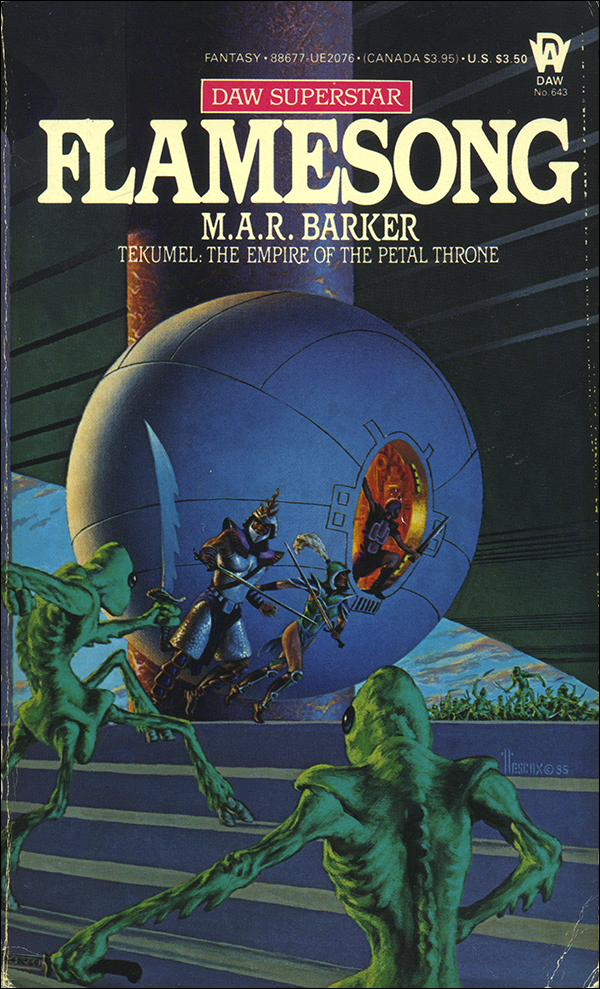
My most recent cerebral colon-blow came from M.A.R. Barker's long out of print Tékumel: The Empire of the Petal Throne novels The Man of Gold and Flamesong.


Greg Maggard (a.k.a. El Grego of the many blogs) got me intrigued with the world of Tékumel from postings on his blog The Pewter-Pixel Wars. I remember Tékumel from the 1970s when M.A.R. Barker published the RPG Empire of the Petal Throne. I never played the game, but I liked the figures produced for it by Ral Partha Miniatures. They looked like Meso-Americans gone wild. In fact, my friend Ron Towler and I considered them as possible ersatz Mayans for a gaming project we were thinking about (and never did). No one made Mayan figures in the 70s—in fact, I don't think anyone makes them now.

Barker first published Empire of the Petal Throne through TSR in 1975. Nine years and much EPT stuff later, he published The Man of Gold, the first of what would be five novels set in Tékumel, whose most powerful kingdom is Tsolyánu, the Empire of the Petal Throne.

Tékumel is a devolved world. The planet had been terraformed to some degree by space-faring hi-tech humans long ago, but a cosmic catastrophe had cut its solar system off from the rest of the universe. Only the planet's sun and two moons provide light; the skies are devoid of stars. Since the catastrophe, the world has descended into a roughly 1st c. technology, even then many resources are unavailable. Iron is very rare and most weapons and armor are made from the very tough hides of an indigenous animal, the chlen-beast. In this world of low technology, working bits from the ancient world before the catastrophe remain and are highly sought after. The world also contains "magic" in the sense that some people are able to tap into power from the "Planes Beyond."

There are also several non-human races on Tékumel. Some are indigenous and inimical to humans and other races, others were brought to the planet by humans in the time before the catastrophe.

The Man of Gold is the story of a young low-level priest named Harsan who gets caught up in the search for an ancient object which the few ancient texts refer to as "The man of gold." He alone posses the ability to find it and use it, but he's contending with unscrupulous elements from within and outside Tsolyánu who want to use the man of gold to gain power for themselves.


Hot on the heels of The Man of Gold, I managed to find a used copy of Flamesong, Barker's second Tékumel novel. I finished it just this morning. Like Man of Gold, Flamesong is a page-turner. The Flamesong of the book's title is a destructive weapon that comes from the gods. Trinesh, a hereksa (a commander of 100 men) in a Tsolyáni legion, gets caught up with characters from the enemy kingdom of Yan Kor and haphazardly travels with them around the kingdoms of Tékumel in tunnel cars (a remnant of the pre-catastophe technology) as both allies and rivals through the various situations they find themselves in. In the end, Flamesong is thwarted and things more or less settle into the status quo ante.

Barker is often compared to J.R.R. Tolkien (by Barker fans, incidentally, not by Tolkien fans). Both wrote novels set in fantasy worlds whose verisimilitude was achieved by creating a depository of history and culture—including creating whole languages—outside the novels, and then drawing on that depository for the breadth and depth required for meaningfully describing the worlds they created. Tolkien broadly modeled his work on the Northern European Dark Age. Barker modeled his on India/Pakistan and, to a lesser extent, pre-columbian Meso-America. Both were philologists and professors. Both told gripping stories. However, the comparisons end pretty much there.

I thoroughly enjoyed Barker's novels as fast-paced swords 'n' sorcery adventure tales. However, there isn't anything deep in them. One of the things that strikes me about Barker's books is that they read a lot like you'd expect a post-mortem of an RPG session to read if you gave it some good literary flourishes. This isn't accidental. Barker's novels followed his RPG by almost a decade. The world of Tékumel was created not as the background of a novel, but as the background of a role-playing game. Barker wrote numerous background booklets for Empire of the Petal Throne in the late 70s and early 80s.

Tolkien, on the other hand, was the inspiration for Dungeons and Dragons, although he had nothing to do with the game and died the year before it was published. Tolkien's inspiration for Middle Earth had much more to do with his own world view, which was profoundly Catholic. Tolkien wrote that Lord of the Rings was "a fundamentally religious and Catholic work." Although Lord of the Rings was never allegorical (Tolkien disliked allegory), it did express deep Catholic ideas in the world Tolkien created and in his characters.

Barker was a convert to Islam in the 1950s (the initials M.A.R. stand for his Muslim name, Muhammad Abd-al-Rahman), but I'm hard-pressed to see anything Islamic in his themes, characters, and in the world-view expressed in his books. In an interesting contrast to Tolkien, Barker is quite profuse in his descriptions of religion and sex in Tékumel. Tolkien never mentions either about Middle Earth. Instead, Tolkien's work speaks of faith and love.

I could go on—and if you're still with me at this point, thanks for hanging in there—but I can sum up the distinctions between Barker and Tolkien thus: Barker writes a great story but, unlike Tolkien, never rises to the level of great literature. For literature to be great it has to show us what is true, what is good, and what is beautiful. Tolkien scores high on all three and Lord of the Rings is considered by readers to be one of the greatest literary works of the 20th century or even of the last millennium. Barker's novels are rather obscure and appeal to a niche audience. Nevertheless, if you can find a copy of Man of Gold or Flamesong, buy it and enjoy it.


Earlier in the summer, I got around to reading C.S. Lewis' space trilogy. Although I'm a fan of Lewis' writing, I'd never had much interest in the space trilogy before, but I read something that referred to the series quite favorably, so I was interested enough to get a hardback set of all three: Out of the Silent Planet, Perelandra, and That Hideous Strength.

I burned through the first two volumes very quickly. Perelandra wore me out, not because it was tedious—to the contrary, it was riveting—but because the depiction of evil in the book was deep and disturbing.  I know this is a departure from my commitment to literary roughage, so I've put the third novel, That Hideous Strength, on hold.


I've posted earlier of my love for H. Beam Piper's book Lord Kalvan of Otherwhen. I picked up a copy of John F. Carr's biography of Piper last week. So far I've just nibbled at it, but with Flamesong finished, I'm about to dive in more deeply. Piper is a fascinating and enigmatic character. He's a bit obscure in the sci-fi genre except to his devotees (such as my humble self). He might have been one of the greats if not for the fact that he killed himself in 1964, pretty much right on the cusp of wider success.

Carr's book tries to uncover the mysteries of Piper, who seemed to be very active in his lifetime in obscuring any real knowledge about himself. It's almost as much a detective work as a biography because so much of what Piper told others about himself turns out to be untrue, so there are only snippets of letters and personal remembrances to go by. He destroyed much of his unfinished work, which is a pity perhaps. He was embarrassed by his juvenilia (so to speak), which is why he burned it.

He never made much money as a writer and lived far beyond his means and put up a false front in regard to his financial well-being. He amassed an impressive collection of antique firearms, which he loaned to the local historical society. Even when in dire financial straits, he was too proud to take back the collection and sell it for the money he needed to live. Instead, he shot pigeons on his roof and ate them to avoid starvation until another advance or royalty check came his way. The experience made him vow to never let himself starve like that again, which must have been a factor in his suicide.


I also have a recently acquired copy of Federation, a collection of Piper's short stories for his Future History series. The last story in the book, "When in the Course," has only been published here. It uses a similar setting as Kalvan, including the names and characters of the people in Hostigos, except there is no Calvin Morrison and no Paratime Police. Instead, the story involves interplanetary settlers, who side with Prince Ptosphes and Hostigos against Styphon's House and its allies.

"When in the Course" was only discovered among Piper's papers some 16 years after his death. It's his original conception of the story of the "Gunpowder God" that was reworked and published as Lord Kalvan of Otherwhen. It makes one wonder what other gems he had that went up in flames. He was working on a novel about the great Spanish Renaissance general Gonzalo de Cordoba, The Great Captain. It's a great shame that that work was unfinished and lost.

I started "When in the Course" a while ago, and then switched to re-reading Kalvan, which I liked better. I need to settle back and get through "When in the Course." I'm sure I'll find it rewarding.

Postscript 9/2/14

I finished "When in the Course" this morning. It definitely doesn't have the same feel as Kalvan. I can see why it was re-worked into the Paratime series. Piper had been serializing the story in Analog magazine when he died.


Apparently, publishing Kalvan posthumously while the serialization in Analog was still in progress was a sticky issue.