Monday, September 6, 2010

Action on the narrow seas


We played a Labor Day game at The Panzer Depot on Monday. I rummaged through my storage, dusted off my old 1:1250th scale coastal forces models, re-read my Action Stations rules, fiddled about with InDesign to create the ships charts, etc. and then put on a game.

The scenario was a German coastal convoy off Norway in 1943 attacked by a mixed force of British gunboats and torpedo boats.

The Germans had four tramp streamers of roughly 400-ton to 1200-ton size escorted by two VP-boats (vorpostenboot), two KFKs (kriegsfischkutter), and a single MFP (Marine Artillerie-Fährpram).

Attacking them were three Denny SGBs (steam gunboats), Two Fairmile D MGBs (motor gunboats), and one Fairmile D MTB (motor torpedo boat).

The Game started with the Germans forces strung out in convoy using markers to keep their identity from the British. The British had the option to enter the board under way or to lie in wait with their motors off and make a crash start when the enemy hove into sight. They opted to try the old ploy of launching a gunboat attack on one side and then launching the torpedo boats a turn or two later after the enemy was focused on the gunboat attack.

Accordingly, Ken Kissling started things off by crash-starting his pair of Fairmile D MGBs to attack to starboard (that's nautical for "right") of the German convoy. He immediately started mixing it up with Chris Craft's kriegsfischkutter. Chris, as his luck usually has it, rolled two "1s" to get two hits on Ken's leading MGB with his 37mm autocannon. Ken, as his luck had it, got the worst possible damage result. Half his force was now damaged and burning wildly.

Chris' wee KFK shooting it out with Ken's MGBs (the yellow is illuminated area)

Meanwhile, Mark X. got his Fairmile D MTB and SGB into action on the rear port side of the convoy. He got results right off against John Kennedy's VP-boat, hitting it with his foreward 2-pdr pom-pom and setting it afire.

John's VP-boat burns. Soon to be the least of its trouble.

The hits didn't put it out of the fight and John gave back a few hits on Mark. However, Mark launched two torpedoes from one of his MTBs and one struck John's VP-boat and blew it up. The other torpedo ran on and a few turns later missed my large tramp steamer. (My first lucky break.)

Steve Puffenberger brought the last british group into action, which was two of the SGBs. He launched a single fish from one towards Mark Serafin's MFP.

Torpedo headed straight for Mark's MFP

Having hit nothing with its pair of 88s and 20mm cannon, Mark regretted that his ship would go down without doing anything. However, the fish missed and ran on (fatefully). Mark's MFP had several more turns in which to hit nothing.

My ships, the tramp steamers with green gun crews, shot only a few times—to no effect—and then went silent. Their size made them impervious to most hits from the small guns carried by the British boats. However, their one weapon mount seemed to be a shot magnet. The first hit every one took, knocked out its gun. From then on, the only rolling I did was to determine hit damage on my ships (which was never much, anyway).

Ken's floating torch kept at it. The fires were partially put out and then restarted a few times and it was several turns until the fires were out. With minimal floatation left, and running low on working armament, Ken kept at it until his boat went under. He put Chris' KFK's engines out of action, but Chris got them restarted and kept on fighting. However, the maximum speed of the KFK is 6 knots, while, even damaged, Ken's remaining MGB was going much faster.

Rather than stay and shoot it out with Chris' 37mm autocannon and 20mm flakvierling, Ken started moving towards my two leading steamers. Peppered with 2-pdr pom-pom, HMG, and LMG fire, my first ship shrugged most of it off (except for those weapon hits).

At close quarters

However, my lead ship was a smaller class and not so impervious to small-caliber cannon. I started taking hull hits and a couple of machinery hits that stopped me in the water. Steve got into the action as well. Having shot off all his fish, Steve moved in close to my ships to try and hurt them with his surface fire. At one point, lacking anything else, he got close enough for me to get a serious shot with rifles and pistols (possibly even hand grenades). Of course I missed.

Mark X. still had a MTB with two fish and he manouvered his boat towards aft of the convoy and fired off a single torpedo towards Mark Serafin's steamer. Mark turned his ship to present his narrow stern (a harder shot), but the torpedo struck anyway. Loaded with ammunition, the ship took even more damage than normal (8 D10s), but was still afloat after the explosion. This was the only steamer hit seriously in the game.

Finally, the fish from the spread that missed Mark's MFP had run on until, near the other side of the table, it ran into Chris' KFK. The torpedo was set to run shallow, but even with the minuses for ship size and shallow draft, the torpedo hit and blew the KFK to bits.

We called the game a German win. Even though we lost two ships (well, boats), the British failed to sink a single merchant ship—even though Mark's steamer was certainly in dire straights. Also, the British lost one gunboat and all but one of the remaining gunboats were pretty shot up. Two of the SGBs were nearly sinking, Ken's remaining MGB had one hull box left.

I haven't played Action stations since D.A.N.G. in January and it was nice to get back to it. Before D.A.N.G., I hadn't played in years. It got me digging out all of the unfinished models I have, including more Fairmile Ds, more S-boats and R-boats, and some larger ships, like British Hunt class DEs and German M35 minesweepers.

The ships we used were Hallmark Figurehead 1:1250th scale coastal forces range. Phil Bardsley and I jumped right on this range when it came out and we finished several models. I also augmented my Hallmark ships with some Navis-Neptun models of larger ships. However, Hallmark has added several larger ships and expanded to include Italian, Russian, Japanese, and American coastal vessels.

This game was the second naval game I've done recently. Last week, Ken ran a General Quarters 3 game as a foretaste of our incipient Solomons campaign. I'm digging out my unpainted packs of GHQ Micronauts and filling out the holes in our US and Japanese navies (basically, lots of Yugumo class DDs).

Sunday, July 18, 2010

La Bataille de Mont St. Mackler


We had another game of Black Powder this weekend at The Panzer Depot in Kirkland, WA. We played the "Battle of San Miguel" scenario from the rules book, substituting Napoleonic troops for the Isabelinos and Carlists.

Bob "Fox of the Steppe" Mackler commanded his Russians, Mike Lombardy and Bill "The meat Grinder" Stewart commanded Austrians, consisting of BIG battalions of regular infantry and un-big battalions of militia, supported by a battery of 4-pounders and a couple squadrons of light cavalry.

General Mackler, the Fox of the Steppe, blessed by 
his priest and genuflected to by his toady

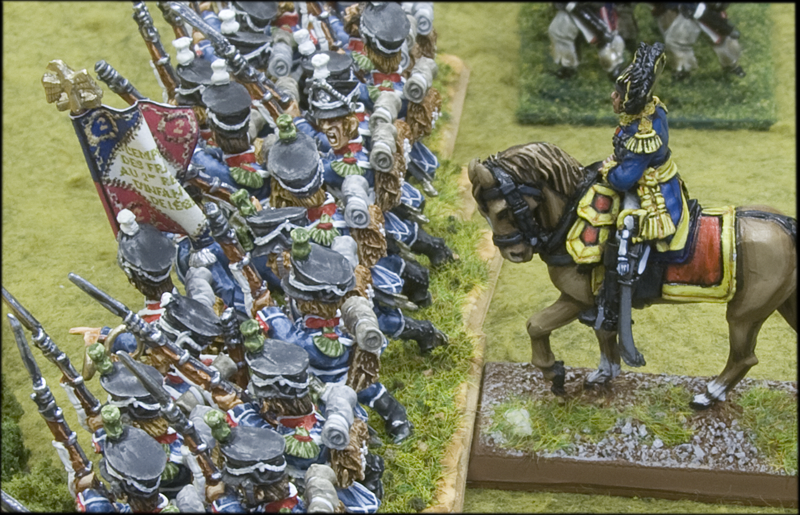
Dick Larsen commanded the French forces, with Rich Knapton, Brett Hendrickson, and me as sub-commanders. My own command consisted of a battalion of line infantry, a battalion of légère, and a battalion of Frenchmen in Bearskins (Français dans les bonnets à poils) who were my corps d'elite. I also had a squadron of light cavalry (even if the figures -looked- like carabiniers à cheval) and a battery of guns.

The victory conditions for the game were to take and hold the hilltop town in the center of the board, which we dubbed Mont St. Mackler for our game. The Russo-Austrians had the advantage in gaining the town first because their set-up put them close to it and the French needed to ford a river—while annoyed by mad monks—to get to grips.

Brett's brigade crosses the ford while mad monks inveigh and plot

Once across the stream, we formed up and prepared to launch our gallant battalions against the sausage-eating Austrians and God-knows-what-eating Russians.

En avant! The French advance

I formed my command into a fine example of ordre mixte with the guns limbered in the center and my cavalry on my left. My plan—and I had one—was to advance across the stream, sweep the Austrian verlorene haufe, commanded by Bill, from the small hill by the town, unlimber my battery there, and then support my further advance against the Austrians.

First contact: The French 1er brigade meets the Austrian advance force on the hill

As I was fording the stream, Bill attempted to charge his cavalry at me, but he failed his command roll. Mike sent him another cavalry unit in support, which Bill deployed on his right. On my turn, I moved up to close range with Bill's cavalry and shot them up with my légère, leaving them shaken and disordered. My cavalry charged into the cavalry on Bill's right and beat them badly enough to allow me a post-mêlée sweeping advance, which I used to smack into Bill's shaken cavalry in front of my légère.  That combat also swept away the other cavalry leaving Bill with only a militia battalion to hold the hill.

And then there were none - French light cavalry (despite wearing
carabiniers' bearskins) after sweeping the Austrian cavalry from the field

Meanwhile, Dick and Brett advanced their battalions towards the town, while Rich held the French right wing with two cavalry units against Bob's advancing Cosaques.

Russian foot and French horse square off

On the next Austro-Russian turn, Mike advanced his Austrian line battalions alongside the town, which he occupied with another battalion, and sent his battery and another militia unit up to support Bill. One of Mike's BIG battalions used it's first fire to get a debilitating five hits on Brett's leading battalion. Unmasked by the rout of their cavalry, Bill's Austrian militia shot my légère and disordered it.

The Austrian horde carelessly tramples the peasants' fields

On my next turn, I charged my line and elite battalions in column of attack through the légère and into Bill's militia, which broke.

Force de frappe! My two columns go in

Brett advanced a battalion in line through his disordered lead battalion and smacked into Mike's Austrians beside the town. But the Austrians held and sent the battalion back in disarray.

French Ligne in mêlée with a column in support

In the aftermath defeating the militia in front of me, I pushed forward the Français dans les bonnets à poils in hopes of further discomfiting les Autrichiens, which I did by beating the next militia unit in turn.

A successful advance, only militia stands between me and Vienna!

In the center, Bill and Brett continued to battle with the foe. Brett's battalion in attack column, which had taken one hit from the mad monks of the monastery as it forded the stream, was been poised and ready to spring into the Austrian battalion to his front, but got forced back by a break test. Every turn thereafter he wound up being disordered by Austrian fire, which prevented him from giving the unit orders to charge in again. There it sat for the rest of the game, unable to retreat or advance due to persistent disorder. It did, however, manage a few lucky sixes when shooting its one die at Mike's BIG battalion.

On my part of the field, the attacking battalions were getting a bit high on stamina hits. By chasing off the militia, my two columns had unmasked the Austrian battery, which proceeded to pour shot and shell at me until I formed line in order to fire back.

French colonnes d'attaque getting whiffed with Austrian grapeshot

Rich withdrew his cavalry in the face of Bob's advance, although he remained enough of a threat to make Bob form one of his battalions in square as a hedge against an attack on his flank.

Russians squared

Bob threw his other battalions against Dick's brigade and they mixed it up for several turns. At one point, the Fox of the Steppe made a successful flank attack with his cavalry against one of Dick's battalions, which cause it to retire to lick its wounds.

Dick's infantry getting warmacklered by the Fox of the Steppe

While I was trying to get my attack back on track, the mad monks came out of their monastery and started nipping at my rear echelon, namely, the guns. Still limbered and waiting their chance to form on the hill I had captured, they started taking lucky shots from the monks, who, though apparently armed only with scripture, were having an effect. I spent several turns unable to move the guns because they had been disordered.

As Brother Maynard quotes from The Book of Armaments, his brother monks 
lob holy hand grenades at my feckless limbered artillery (mon artillerie sans feck)

Also on my part of the field, Mike kept feeding Bill units to get killed, but the task was taking its toll on my battalions. The elite Français dans les bonnets à poils and the légère were shaken. I put all my battalions into line and started trading shots with the enemy. A telling fusilade from the Austrian line finally resulted in my severely failing a break test and the elites went away, but not without having covered themselves avec la gloire. Au revoir, bonnets à poils, au revoir mes enfants.

Still harassed by the mad monks, at one point, I attempted to move my cavalry around and chase them off. However, after being able to retreat the guns from the monks on an initiative move, I turned the cavalry back around to bring it into support of my remaining battalions.

I continued to trade fire with the enemy and eventually shot the Austrian 4-pounders into a shaken state and managed to keep them disordered as well. This consistent success in shooting, finally induced Bill to attempt to "cool" me by touching defiling my dice. It worked for one roll (against his guns), but my next shot at Mike's troops resulted in three sixes. Maybe the dice work better after defilement. Brett and I were both shooting at Mike's foremost battalion and even if BIG, we managed to keep it shaken and/or disordered by numerous hits—which kept Mike's commander busy rallying it back from shaken status.

Mes enfants at game's end

On the French right, Rich brought his squadrons into the fray, but was eventually forced back by Russian infantry, now commanded by John Kennedy while the Fox of the Steppe took a break.

Exhausted - Dick's infantry and Rich's cavalry on the French right
after having fought the Austrians and Cosaques to a standstill

Finally, we called the game for the Austro-Russian side. They had taken and kept Mont St. Mackler and with many of our units shaken, we decided that the French had little hope of taking it themselves. I'd managed to take out five Austrian units, while losing only les bonnets à poils. My worst damage seemed to come from those unruly monks. We didn't take the town, but we had the monastery and would soon set ourselves to punishing those contumacious monks.

The Archduke Mike surveys the field of battle after successfully holding his position 
and wonders whatever became of all those units he sent to General Stewart

Further deep thoughts on Black Powder

My second game with Black Powder went very smoothly. I mostly knew the rules by then and the turns played quickly, despite the large number of units on the board.

One thing I noticed is that elite units are just OK, if that. Their one advantage is being able to roll off disorder at the start of their turn, which enables them to take initiative or receive orders instead of sitting around—if they pass the test. On the other hand, the BIG battalions of the Austrians got +1 dice on shooting and +2 dice in hand to hand combat, much more tangible benefits just from being bigger, not necessarily better. My Français dans les bonnets à poils succeeded because I rolled good dice (until Bill defiled them), not because the unit had significant intrinsic advantages as an elite. (I never got disordered, so the unit's one advantage was moot.) The militia units I fought were just as good as I was at shooting, hand to hand, stamina, and break tests.

However, as one reviewer wrote of Black Powder, you have to see the rules more as a toolkit of game mechanics that you can use to build different unit characteristics. It's this ability to customize that enables the kind of chrome that makes games more interesting. So, we might have made militia units a minus at one or more of the characteristics that define a unit's abilities. For example, they might have been stamina 2 instead of 3 or fought hand to hand with -1 or -2 dice. Or, the elites could have had stamina 4 and/or fought hand to hand with +2 dice.

After two games, I am very happy with the rules and look forward to more. I've got the 1914 project under way and am pondering moving closer into the gravitational pull of the Black Hole of Wargaming (i.e., Napoleonics).

Monday, July 12, 2010

Back in the saddle again

This is a bit delayed, but I thought I'd mention that I am working again. I returned to eating my bread by the sweat of my brow about two weeks ago. Ironically, I'm back at my old company in a different group and loving it. I'm in the same building I used to be in, so I'm getting a lot of "where'd you go?" and "glad you're back" from a lot of old coworkers. I'm actually a contractor and not full time, but I'm looking for an opportunity...

To celebrate my return to the ranks of the gainfully employed, here's a little wrap-up of summer vacation as seen through the eyes of my great, chubby cowcat Grendel:


Sunday, July 11, 2010

Things will get out of hand. That is why we have orders.


I played my first game of Black Powder on Saturday. I'd seen it played a few times and so had a little familiarity with it, but otherwise I learned (or not) as I played. On the experience of one play, I must say that I like them and bought the rules. I'm up to my neck in partially-finished/nearly-punted projects, mostly ancients, so I can't think of what I'll do with them yet, but the year 1914 is stuck in my mind...

On the painting table (for some time now)

Saturday's game preceded that watershed year by about half a century. We played a version of the "Fighting retreat at El Perez" scenario from the rules that we modified for the American Civil War. The town of El Perez was instead a piney forest, the French forces were Union infantry, and the retreating British were Confederate infantry.

Confederates were me, John Kennedy, and Rich Knapton. Union were Steve Puffenberger, Bob Mackler, Brett Hendrickson, and Bill Stewart. All the beautifully painted figures and terrain were provided by Bill. He and Bob were going to set up early, except that Bob had a perfect odyssey getting from Tukwila to Kirkland that involved highway closures, crowded alternate routes choked by road incidents, the trial of securing a Dick's Deluxe in the midst of the Wallingford street fair, etc. Not that set up was a huge undertaking. I watched and kibitzed as Bill set up and can say that for me the experience was fairly effortless.

My brigade deployed with Rich's l'enfants perdue beyond

John's brigade had the task of chasing the small Union garrison out of a wee hamlet on the other side of a bridge. To accomplish this, he had three infantry regiments and a battery of guns. Bill, commanding the garrison, had a single small unit.

Rich's and my orders were to withdraw towards the town and get our troops across the bridge. Getting our force across the bridge and off the board were our victory conditions for the game. John was overall commander and gave Rich and I explicit orders, apparently. Of course, being impetuous by nature, our troops saw the bluebellies come on, sang a few verses of The Bonnie Blue Flag, and pitched into the fight. From there, things went pear-shaped fast.

Bob, playing the role of a Buckeye pol looking for enough glory to propel him to a senate seat in the next elections, came on the board in column of attack heading straight for Rich's position in the center of the board. Rich, not wanting to wait for it, lead his troops out against Bob only to find his troops exposed. His lead regiment suffered a flank attack and got beat up.

Rich's infantry getting flank-smacked by would-be Senator Bob's troops

It held on a bit longer, but eventually became shaken by losses and failed a break test that had it routing from the field. Rich's remaining units continued to fight on against Bob's attack, but were outnumbered and fighting for life.

The blue tide begins to overwhelm the gray center

In support of Rich's attack, I moved up my line against Steve's advancing Yankee aggressors. The result was several turns of exchanging shots at short range. Eventually I lost my guns due to a failed break test and took the opportunity to fall back and reform my line and continue to engage Steve's—and Bob's—troops with long-range fire.

My brigade muzzle-to-muzzle with the hated Yankees

This brilliant tactical maneuver had the down side of leaving Rich entirely unsupported in an advanced position, but some things can't be helped. Beset 2:1 in hand-to-hand combat and pummeled by flanking artillery fire, Rich's lone remaining unit succumbed, which was all to the good as far as Rich was concerned since it was past lunch time and he was peckish.

Rich's last stand

John, bemoaning our insubordiantion, carried on with his task of brushing away the token garrison that blocked our retreat. This proved a more difficult undertaking than at first apparent. Beset by shot, shell, grape, and minie-balls, Bill's skeleton force hung on grimly and beat the odds for multiple break tests, meanwhile giving out better than it took.

Bill stands firm like Horatius at the bridge

As John beat his head against Bill's dogged defense, Brett advanced his brigade up the road to force John to turn and make a rear-guard stand. This forced John to form a shaken line of two regiments against Brett, who eventually wore him down. Meanwhile, John lost the infantry unit attacking Bill to a failed break test. The Confederate escape route was still closed.

Brett's brigade advances down the road

With only his shaken guns facing Bill's garrison, John rolled lucky boxcars on shooting and Bill's garrison, after many turms of holding firm, finally dispersed due to a failed break test. The escape rout was now open, but there were many fewer Confederates left to take it.

I tried moving my brigade back and towards the bridge on successive turns, but Steve was close on my retreat. I lost my unit of sharpshooters and was left with only my three infantry regiments. John's two shaken regiments facing Brett finally broke and dispersed. All that was left on the field were my three regiments, who were looking like they were about to be cut off. That was that for the game.

End game: my brigade standing against a field of Blue

Post mortem

I liked Black Powder. The mechanisms are simple and certainly don't provide a simulation of 18th-19th century warfare, but they play very well. I have always thought that success in a game depends on its ability to abstract enough of the detail so as to not bog down play, but without sacrificing a feel for the period. Black Powder might be accused of being generic, but the rules are very open to being modified ad hoc to represent a particular area.

I like the command rules and the means of indicating unit status that obviates removing figures or stands. The rules themselves are well produced, entertaining, and well written (but being a technical writer by trade, I always have a jaundiced eye when reading rules and I have learned to stifle my quibbles over correct pronouns, the uses of "that" and "which," and the occasional typo).

Another perspective is that while the rules, which cover warfare from matchlock smoothbore muskets to the era of bolt-action rifles, represent changes in firepower by changes in the range, but not in changes in firepower. They remind me a lot of a set of locally-produced rules called Brigadier! that I played in my youth. Like Black Powder, Brigadier! was suitable for games from 1700 to 1914. However, firepower was modeled much differently and the punch from a unit of rifled muskets was much different than what a unit of flintlock muskets could produce. The changes in firepower had the effect of modifying the tactics you used in the game. I suspect that Black Powder will play for 1914 much like it will play for 1758, except for longer ranges. But that remains to be seen. I think the machine-gun rules will be a significant difference.

Saturday, June 26, 2010

De Bellis Velitum


Last night, John Kennedy and I played a few trial games of De Bellis Velitum (DBV), Phil Barker's never-published set of ancients skirmish rules. He wrote a draft of them in 1991 to go along with De Bellis Antiquitatis (DBA), his quick-play ancients miniatures rules. Although he never published them, he has made them available online as an HTML page.

I've been intrigued by these rules for a long time. I copied the text from the web page and put it into Adobe InDesign for formatting. I planned to simply format the text into a booklet that I could print out and play with. However, the project sat for several years until just last week when I revived it and completed the formatting (along with minimal changes) and printed a copy to play with.

I only have 16 figures painted and mounted at this point. Several years back I started another project using Foundry's exquisite World of the Greeks figures. These figures, sculpted by Steve Saleh, are some of the best that Foundry has ever produced. I have a lot of them, but not enough for a conventional army. I had planned on doing a grid-based wargame using them (and still may) on singly-mounted on 30mm x 30mm bases. I got the first 16 done and based with another 24 or so partially painted. Fortunately, I painted all the light troops first, so we had a true skirmishing force—although the rules allow for heavier troops.

Peltasts fight it out in hand-to-hand combat

The forces we played with were a single sub-unit each. I just divided what I had and produced two equal forces of four peltasts and four slingers each. John had set up the tables at The Panzer Depot for a Flames of War tournament, so we just used terrain that was there (albeit more suitable for WW2 than for ancient skirmish).

It took three games to really get the feel of the rules. By game three we were not only playing correctly, but exercising a little more finesse in how we used our troops. We had to flip through the rules on several occasions and there were a lot of "Aha!" moments when we discovered how we were misplaying something. There were also several "hmmm" moments as we pondered the turgid, labored, nearly impenetrable writing of Phil Barker, esq.

Slingers open fire

DBV uses similar mechanisms to DBA, but with some significant departures. As in DBA, troop types are genericized into a few main categories: knights, cavalry, blades, spearmen, peltasts, shooters, skirmishers. (The rules also mention elephants and chariots, but there seems to be a lack of any specific mechanisms for using them.) As in DBA, you roll a pip die for each sub-unit and you move troops singly or in groups with varying pip costs per type of move. Unlike DBA, shooting costs pips. Figures can aid in shooting and in hand-to-hand combat. Although each sub-unit, and the force as a whole, has a leader, there is no command radius. Leaders get a +1 in combat and are also a liability in that, when they die, your sub-unit becomes demoralized and all combats have a -4 modifier for your troops. It sucks to lose the leader.

The combat outcomes are less of a rock-paper-scissors arrangement than in DBA. Results are based solely on the degree of difference in the die rolls. There are no quick-kills. The greatest degree of difference, 5 or more, results in the loser fleeing, while lesser differences might mean recoil, disablement, or the big sleep. Disablement is interesting in that the figures are removed from play, but not dead unless your side loses the game, in which case they are considered to be chased down and dispatched to the Elysian Fields by the victors. If you win, you don't count your disabled losses as lost.

Face-off and missile exchange before the clash

John took a dislike to the regimented feel of figures required to be in base-to-base side contact in order to form groups. He thought it was too much like DBA and less like a skirmish game. I didn't share his disapprobation. The skirmish games I've played also use base to base contact to indicate groups or figures who are supporting each other in combat.

At first (because we were playing it wrong) we thought that it cost too many pips to do anything, but once we corrected ourselves, the pip costs seemed reasonable. I like that you can't do everything in a bound and some bounds you can do very little. It makes for a better ebb and flow of initiative.

The games played well, despite our initial confusion. Victory went to whoever killed or disabled four opposing figures, and it took a while of shooting, moving, and fighting to achieve that. Like DBA, a game might end right away or become an interesting chess match, depending on the players, terrain, and troop types engaged. The one heroic figure—every game needs a hero—was my naked guy with a rock. He survived every game, faced off superior forces, and even killed a peltast in hand-to-hand combat, no mean feat for someone who's bollocks naked and armed only with a rock.

Don't mess with naked guy with a rock

I've read other criticisms online about DBV that I don't see as valid after having played it. The criticism that it's not bloody enough isn't true. There's no wholesale slaughter of wee tin men, but you lose figures quickly enough. Another criticism about "zone of control" for light horse doesn't really make sense. The rule forbids any troop to cross in front of an enemy figure within that figure's move distance. Light horse move 20 paces (20 cm) and so exert a fairly long no-crossing zone. That works for me. The rules seems intended to keep players from ignoring enemy in front of them. I've played too many skirmish games where players can move their troops around higgledy-piggledy with no regard for the threat from an enemy.

After our initial playtest, I feel pretty good about proceeding with the project. I've got a lot more Greek figures to paint so we'll have some different troop types in our next game like Spartan and Athenian hoplites, cavalry, and buck-nekkid javelin-throwers (to complement the buck-nekkid slingers I already have). I've also got several packs of Steve Saleh's excellent Foundry Thracians

My dilemma now is how to proceed with basing them. The figures we used last night are on 30mm x 30mm bases. I planned to use 30mm x 40mm deep for the foot because I want a larger base. Phil's rules call for 20mm x 30mm, which is just enough to accommodate the figures footprint, but not the "overhang" of arms and weapons. Even 30mm x 30mm left the peltast's spears poking out fore and aft, which made it awkward to line them up in column (required for making march moves). Now, after beginning to base figures on the 30mm x 40mm bases, I'm worring that there's too much base. I think that after completing the base with all its flocking and such that they'll look good. Otherwise, I'll have to pry 20+ figures off the 30mm x 40mm Litko bases and redo them. I hate rebasing—but I'll have to do it for the 30mm x 30mm guys if I stick with 30mm x 40mm as planned. What to do?

I'm also planning an English-language version of the rules. The Barkerese is just too opaque in some places and can benefit from simplification and clarity. Those long, turgid, unpunctuated sentences enumerating several conditions would do better as bulleted lists. I'll also do a quick cheat-sheet to prevent having to flip through the rules time and again. 

Another need is to flesh out some home rules for elephants and chariots. In DBA, elephants are their own entity while chariots can be either knights or cavalry, depending on the type of chariot. I think I can do the same for chariots in DBV, but the larger base is problematic (as it is for elephants). The 60mm frontage means that two foot or horse figures can be in frontal contact, plus an overlap on either or both sides. That's very un-DBx and if you apply a -1 for each figure beyond the first in hand-to-hand combat with you, an elephant or chariot could be swarmed and start combat with a -3. But maybe that's not a bad thing...

I think the rules promise to be fun and will reward further devotion. I look forward to painting more figures and expanding the theatre of war from ancient Greece to the Punic Wars. Also, Steve Saleh has a new company called Gorgon Studios. So far he's done Spartans (which will augment his already excellent figures done for Foundry) and early Etruscans, which look very nice. I assume these fit well with the big 28s he did for Foundry. I hope he does early Romans and other Italian states as well.

Thursday, June 24, 2010

Making NOOKie

I fully entered the age of digital literature yesterday when I bought a Nook e-book reader. It was an impulsive buy, but I had been thinking about it for a while—although not specifically about a Nook. Lorrin has a Kindle and on a drive home from Tacoma yesterday, my sister and I discussed getting a Kindle because the price had just come down. It was just happenstance that I walked into my local Barnes & Noble and saw the Nook salesperson in her booth right inside the front door.

I had to stop and see what Nook was all about because the last I noticed it was in the Fall when it still hadn't been released. I was very impressed with its features. I've done some online research about comparisons between Nook and Kindle and I can't see a huge difference.

Nook uses Google's Android OS and the software can be easily updated online. Kindle's OS is hard-coded and the only way to upgrade is to buy a new Kindle. Nook has expandable memory, Kindle does not. Nook can be serviced at any Barnes & Noble store, Kindles need to be mailed to Amazon to get serviced (I've done it already with Lorrin's Kindle after she learned that Kindles don't bounce).

The clincher was that if I bought a Kindle, I would have to order it online and wait for it to arrive. I could walk home RIGHT NOW with the Nook. Sold. I tried to enlist my sister in getting a Nook for herself, so she'll go to B&N to look as soon as she can—if she doesn't order a Kindle first.

I spent the early evening yesterday browsing for free or cheap e-books. There are a lot of older books that have been digitized at some point and are now free downloads. For example, J.B. Bury's History of the Later Roman Empire is a free download. I've also got free copies of Caesar's commentaries, Thucydides' history of the Peloponnesian War, Dickens' Great Expectations, etc.

The Nook is a great way to carry a lot of reading material on the go. I can't think of how many times I've been desperate for something to read and couldn't get it. Now I can read books that I have stored on the Nook, download new books, or download current magazines and newspapers. With 3G wireless, I can download from pretty much anywhere.

It's a strange transition for me to go digital because I have always been a lover of books. The physical make-up of a book, the binding, the paper, the font, the design and illustrations, have all made a deep impact. I can see most printed books going digital. Even now almost every published book has a e-book option for about 1/3 the price. I will keep most of my printed books, but I do see a cull coming. Some of my books are collectible, others are just more suitable as printed books. For example, I see no value in an e-book version of Conway's All the Worlds Fighting Ships or any book that uses a great many illustrations, charts, drawings, photos, etc. Digital ink has its limits.

One interesting aspect of the e-book revolution is that it's easier now for any schlub to be a published author. The overhead for publishing an e-book is minimal and anyone can write something and sell it through an online store.

Oh, also, it's easier to read from the Nook with cats lying all over me.

Monday, June 21, 2010

FoGgy day in Gig Harbor

I played Field of Glory on Saturday at Bruce Meyer's house in Gig Harbor. We were going to have a FoG day at The Game Matrix in Tacoma, but we got faced out at the last minute by a War Machine tournament. Bruce offered his humble abode at the last minute. And by humble, I mean a huge gaming room in a detached building.

There were eight of us and instead of playing four separate games, we decided to play one big game using two armies on a side. The clash was Romans and Gauls versus Carthaginians and Spanish.

I was on the far right commanding a mid-republican Roman legion plus two Roman heavy cavalry units. Facing me was Tim McNulty with the Spanish cavalry and caetrati and Mike Garcia with some Spanish heavy caetrati. Mike also commanded some Spanish scutarii and more caetrati (there was a world of caetrati on that battlefield) facing my fellow Roman Gary Griess.

On our left, Bruce commanded the Gallic cavalry and Scott Murphy commanded the vast horde of Gallic warbands. They faced Dale Mickel and Al Rivers who commanded the Carthaginians.

Tim, a neophyte to ancients gaming as a whole and FoG in particular, started out by charging his light cavalry into my heavy cavalry. A mistake, despite initial success in the impact phase. Superior Roman armor and weaponry told in the ensuing melee. We both added second units to the fray, but the end result was predicatable: two routing Spanish light cavalry units and two Roman heavy cavalry units threating the Spanish flank.

At one point, Tim charged his Spanish medium cavalry against my supporting hastati/pricipes unit but after getting fragmented in the combined results of impact/melee, he had to break off in the joint-action phase and lick his wounds.

Further to the left, Mike charged his heavy caetrati into one of my hastati/principes units. "Hah!" I laughed. However, he got very good results in the impact phase and I was disorganized and minus one stand as a result. I was able to add a supporting hastati/principes unit and put the triarii behind for supprt as well as attaching a general. The additional morale support helped avert disaster, but the "easy" win against the lighter Spanish never happened. For the rest of the game we were locked in mortal combat with ups and downs on both sides. I eventually lost a second stand, but still hung in. Mike lost stands, too, but he started as a 12-stand unit with a third rank absorbing losses. My losses reduced my dice, his never did.

Even further left, Gary charged his Romans into Mike's Spanish scutarii. After just a couple turns, Mike's spanish were running. This is what should have happend for me against the heavy caetrati. If I were a legate, I'd have decimated my feckless hastati/principes.

In the Gallic-Carthaginian match-up, Bruce ran the Gallic cavalry roughshod over the Carthaginian right. while the Carthaginian Libyan spearmen s-l-o-w-l-y advanced against the wild-eyed Gallic warbands.

We called the game after a few hours of gaming when things looked very bad for the Carthaginian-Spanish coalition. They had several routed or destroyed units to very few losses, and no routed or destroyed units, for the Gauls and Romans.

It was a great way to spend a cold, rainy Saturday in late June.