Showing posts with label naval gaming. Show all posts

Sunday, June 14, 2020

Rule Germania, Germania Rule the Waves


We played our first game in the Great Wee Fleet project on Saturday. For me, it was the first gaming I've done since late February. It was an odd feeling of somewhat returning to normalcy.

Kevin Smyth and I had planned it for a few weeks. We decided on an encounter between a small American squadron and a small German squadron, mostly because I had some German ships painted and Kevin had lots of Americans he was eager to get into action. I contribute just two of the German ships, Kevin supplied the others and the whole lot of the Americans.

SMS Gazelle
SMS Arcona
Each squadron had 4 ships. The Germans were the following:

  • SMS Gazelle, a protected cruiser mounting 10 x 4.1" guns
  • SMS Arcona, basically a sister or cousin to the Gazelle—Conway's has them as sisters, but Jane's makes them different classes
  • SMS Iltis, a small gunboat with just 4 x 4.1" guns
  • SMS Luchs, another small gunboat in the same class as the Iltis.
Steve Puffenberger and I shared the command. I took Gazelle and Arcona (the ships that I brought to the game) and Steve commanded the two gunboats that Kevin supplied. The ships started in line ahead with Gazelle leading, followed by Arcona, Iltis, and Luchs.

The Americans were:
  • USS Atlanta, the "A" of the ABCD ships that were the beginning of the American Steel Navy way back in 1883, she was a protected cruiser with 2 x 8" guns and 6 x 6" guns
  • USS Detroit, an unprotected cruiser mounting 2 x 6" guns and 8 x 5" guns
  • USS Concord, a gunboat mounting 6 x 6" guns
  • USS Nashville, a gunboat mounting 4 x 4" guns
Kevin commanded the two cruisers and Dave Schuler commanded the gunboats. Atlanta lead the line, followed by Detroit, Concord, and Nashville.


The rules we used were Fire When Ready! by David Manley. The rules seem to be scaled to battleship actions. Ship damage is accounted for using two values: ADV is the damage value above the waterline, BDV is the damage value below the waterline. ADV damage affects whether your ship can fight, BDV damage reflects whether it can still float. ADV is BDV plus increased values for armored bits. BDV is calculated at 1 point per 500 tons displacement up to 2000 tons, at which point it's calculated as 1 point per 1000 tons +3. This gives a reasonable amount of damage that can be taken for larger ships that might be 15000 tons or more. As I mentioned in a previous post, we're looking at gaming actions with smaller ships. Even at 1 point BDV/ADV per 500 tons, you still have very low defence values. After discussing it, Kevin and I thought that 1 point per 100 tons was feasible. I worried that maybe that would generate defense values that were too large, but it turned out to be spot on.

Since we were using 1/1250th scale models, we also used inches for measurement, i.e., 1" =  1000 yds, rather than 1cm = 1000 yds.

Both lines of battle moved at only moderate speed. The German cruisers were fast at 21 and 22 kts, but to keep formation at the start, they had to keep down to the flank speed of the gunboats, which was a mere 13 kts. None of the American ships was particularly fast and their line started at about 14 kts, I think.

Our initial shooting was a bit dismal. We opened up at about 4000 yds, well within medium range. My first shots were failures even when I hit. Arcona got a hit on Atlanta, but my 5 x D6 damage dice only scored a '6', which was no damage at all. 

On the second turn, things got dicier. Steve's ship Iltis got blasted by a salvo that wrecked her upper decks and took out 3 of her 4 4.1" guns. There was nothing left for her to do but turn away and head out of the battle zone.

At this point, my dice rolling turned from failure to fantastic and stayed that way throughout the game. I pasted the Atlanta and Detroit for a couple turns inflicting steady, though unspectacular damage on them. I was not much hurt by any of the fire at me.

The German cruisers benefited from having a large battery (10 guns!) of all the same caliber. There are advantages in determining damage depending on how many guns are firing. The German cruisers could bring 4 guns to bear forward or aft and 5 to port or starboard, which gave me 5 damage dice if I hit with a broadside of 4 if hit a target ahead or astern.

With Steve's gunboats in dire straights, I split off the cruisers into a flying squadron to start moving full and turn about to go around the end of the American line. Going faster also helped me to avoiding getting hit. The Americans split off then as well, with Dave's gunboats coming my way with Kevin maintaining mostly the original course with his 2 cruisers, countered mostly by Luchs, Steve's remaining gunboat, though I maintained them as my targets as long as I could.

Breaking up the formations
Due to my speed, I was able to get in quick and cross the T against Dave's gunboats. That proved disastrous for him. I got significant hits with my 4.1" guns and did a world of hurt with nothing much coming back at me. The Arcona also managed to get a torpedo hit against the Concord. For a change, I rolled poorly and inflicted much less damage than I could have. Nevertheless, the Concord was hurting. Gazelle tried a torpedo shot at Nashville, but missed.


Normally, torpedo damage is 1 x D6 points against both ADV and BDV. However, because we pumped up the defense values, a single D6 would be a pretty anemic effect even if you rolled a '6'. I hadn't figured out what that would be before the game, so we just went with using 2 x D6 damage. As I mentioned, I rolled poorly and got, I think, 5 points damage against Concord.

Concord was bad off, but Nashville still had some fight in her. The next turn, I swung around to go broadside to broadside with Dave's line—moving very slowly now because of damage. Nashville got a good shot against Arcona, which up to that time had little damage, despite being hit a few times by Kevin's cruisers. In response, both Gazelle and Arcona fired at Nashville and left her not quite a wreck.

At this point, we called the game. Of Steve's gunboats, the Iltis had been much damaged with with her ADV nearly shot up and only a single working gun. Luchs was still in fairly good shape, although one lucky salvo from Kevin's cruisers might easily change that. Gunboats are brittle. Kevin's cruisers were still in the fight, but were near the 2/3 damage mark that might have sent them away. The American cruisers were slightly heavier than the Germans, with around 32 ADV/BDV. The Germans were 27. Arcona was hardest hit—mostly from the Nashville's last salvo—while Gazelle was nearly unscathed, with a lot of ruin left in her.

The game was a German victory.

We feel very vindicated in bumping the ADV/BDV up for the small ships. The game wouldn't have lasted three turns otherwise. The damage we took in a single hit would have wrecked or nearly wrecked any of our ships if we stuck with the formulation in the rules. We'll probably vary it to 1 point per 200 tons as we introduce armored cruisers to the game mix. That will make gunboats even less worthwhile in the battle line, but then gunboats have no business going up against armored cruisers anyway.

I commend the services of Purple D20 above all the brave actions of my seamen. I didn't bring any dice to the game, so Kevin loaned me some of his. I used one purple die throughout for my hit determination rolls. Apart from turn 1, I never missed a salvo, consistently rolling above '10', usually above '15'. I even rolled a '20' for my torpedo hit, which was the minimum I needed. The torpedo from Gazelle missed, but it was still a roll of '18'.

Lila, Lila über Alles, über Alles in der Welt
I was also happy to be able to use my new, nifty spalted tamarind Wyrmwood dice tray. It arrived just before the plague shut everything down and I've been itching to get it into action these past three months. I was not disappointed.


I have more HAI ships coming from Germany that will fill out my wee Japanese flotilla. I may get another couple German ships. I'm not sure how much I'll do after that. I still have my Lyzard's Grin Japanese and Chinese fleets for Yalu that I have to complete.

I expect more pre-dreadnought gaming through the summer. We've got a full head of steam as we move out of the lockdown.

Saturday, December 29, 2018

Back to sniffing glue


Looks like I picked the wrong day to stop building plastic models.

After having gone lead 40+ years ago, I was sure I'd never go back to cutting model parts off sprues, trimming little nubs with very, very sharp XActo blades, and breathing in the mind-altering vapors of plastic cement as I assembled all the bits and pieces. People who know me know that I am an adamant foe of plastic minis. Don't worry, I haven't gone over to that. I have, however, built my first plastic models since I was in high school. It took a bit of convincing.

The catalyst for this change was picking up a box of the Cruel Seas 1/300th scale German S-boats. I initially thought of giving Cruel Seas a miss. I already have a sizable collection of WW2 coastal ships in 1/1250th scale; I was pretty sure that I didn't want to go into another scale for the same period. But then I saw some of the models that came as free samples in an issue of Wargames Illustrated. It was like that line from the song, "then I saw her face, now I'm a believer." The models are really nice.


Free samples in magazines. Well played, Warlord Games, well played.


So I bought a boxed set of the S-boats. I brought them home and beheld the bewildering array of bits on a sprue. I earlier bought some sprue cutters and a tube of Testor's cement for plastic models. That impulse came after buying a kit of a Soviet SU-100 for the 15mm scale Tanks game. The plan is to use that for What a Tanker! I wanted to get the standard resin and metal kit from Flames of War, but they didn't offer that model. It was only available as a plastic kit. I let the SU-100 kit sit for months. I hate fiddly and plastic model kits are fiddly.

But I finally bit the plastic kit bullet with a couple of the S-boats. It was easier than I thought. I had 'em built and primered (white) in an evening. Two days later, I bought a box set of the Vospers.


I now have four of the S-boats and two of the Vospers built and primed.


I've looked around at painting ideas. So far, I've given them a base coat of Vallejo Light Sea Gray (973). Darker gray decks and some camouflage, then touching up details. They should paint quickly, though it means jumping the queue ahead of all the other projects I have in the works.

I'll get to completing them this week (maybe). I have another week of vacation for Christmas—Epiphany is the 6th, so my time off works out perfectly for the complete holiday.


I don't have a copy of the rules yet. At this point, Warlord is sold out of starter sets. Now that I have six S-boats and six Vospers, I'm pretty loath to get a box set with more of the same. So, I'll get the rules separately. I suspect I can get some other bits I want separately as well.

I'm not the only one in my circle who's been sucked into the Cruel Seas vortex. Dave Schueler has bought in and written a review on his blog Naval Gazing. Bill Stewart, Mike Lombardy, and Dean Clark are also building flotillas. I hope we'll get a game in sometime in January or February.

Postscript: I've built the SU-100. It's not painted yet, but I've overcome by plastic kit aversion. I don't predict that I'll ever go for plastic minis. That's a sprue too far for me.


Friday, December 29, 2017

D.A.N.G. XVI (Struck at Sea)


Dave Schuler hosted the 16th running of Dave's Annual Naval Game on Thursday. Most of the usual suspects showed up and we had nine players.

The game for D.A.N.G. XVI was Seastrike, a 70s era "ultra modern" naval warfare game. The mechanics are much, much simpler than a game like Harpoon and we had a fast and furious game.

We divided into sides: Big Red and Great Blue. Red was Arthur Brooking, Dale Mikel, Scott Murphy, and Mark Waddington. Blue was Kevin Smyth, David Demick, Charlie Berlemann, George Kettler, and me.

Our forces were equal. Dave painted two fleets using 1/1800 scale ships from Shapeways. We spend a bit of time right off sorting out our squadrons and determining our missions. There was a potential of playing three scenarios. However, we wound up with just one battle royale.

Each side wound up dicing randomly to (1) clear the enemy from the central sector and (2) protect our home base. We put all of our major surface units into two squadrons, with our submarines and missile boats guarding the home base. Red pretty much split their forces into two even groups of two surface squadrons and one squadron of two subs. One group was in each of their home base sector and one went into the central sector to sweep us out.

At first, it looked like they were outnumbered and outgunned. Charlie had a squadron built around our one cruiser, while our second squadron was frigates of varying size and armament. We kinda felt the way the Spanish Armada did that summer day in 1588 when they appeared off Plymouth. Our orders were aggressive: seek the enemy, engage him, destroy him—in theory, at least.

Having never played Seastrike before, I wasn't sure what to expect. Combat is driven by a card deck and things get bloody very quickly.

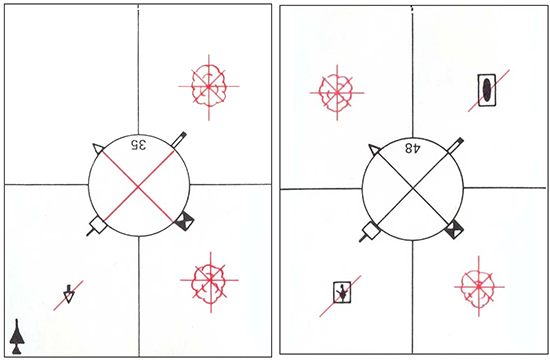
Instruments of misfortune

The cards determine whether weapons systems work (for example, if SSM missiles lock onto a target ship) and what damage is done. Each card is divided into four quadrants with a central circle. Each quadrant contains damage for a specific type of weapon: guns, SSM, torpedoes, and ASW.  It's a bit more deterministic than dice rolling and as the deck decreases, the odds of what will come up keep changing.

We both deployed 1 foot onto the table, which gave about 6 feet separating us. Ranges go up to 16" for SSMs, so we had a bit of sailing to do before contact, although there wasn't much maneuvering. Shooting SSMs at each other is a far cry from gun captains aiming shots over iron sights or directing salvoes from high atop fire control towers.

Charlie's squadron sailing to death or glory

Neither side had much luck with its airstrikes.  Red crashed or aborted all of their take-offs on turn 1. We got four in the air, but lost two to CAP (the ones with Exocets), had another shot down by PD, and the fourth got through the defenses only to miss with its bomb.

Red managed to get a couple in the air on a subsequent turn, but this time our CAP took them down.

The surprise killer weapon of the game was submarines. We left ours guarding home base, but Red took two (and two decoys) into the central sector with them. They were able to deploy these well ahead of their squadrons. They were opposite where Charlie's squadron was advancing. We put up ASW helos to detect them, but they took the "quiet sub" option for them, so we failed to know they were there until we saw fish in the water.

Normally, resolving torpedo fire in a naval game is a complex affair involving calculations that take into account the distance between ships, the sea conditions, angle of deflection, speed of the target and firing ships, aspect, depth of hull for the target, time of day, curvature of the earth, time elapsed since the last grog ration, etc.

Okay, the first torpedo in the spread has missed. Let's calculate for the second...

Not in Seastrike. Mark, commanding the subs, managed to get off four torpedoes with his first salvoes and sunk (i.e., blowed up) two of Charlie's ships. A salvo of four torps intended for the cruiser was momentarily delayed by drawing a system failure card. But only for a turn.

Next turn, the other sub fired its torpedoes along with the first sub getting off its delayed salvo. By the end of turn three, Charlie's squadron was a wreck of burning debris on the water.

The sorrow and the pity

This now left our righthand squadron. Not shirking from duty and unafraid to put our ships in danger, we went ahead full speed at Red's lefthand squadron. I think I figured that (a) we'd only lose by turning about and cutting our losses and (b) We had more and bigger ships in our righthand squadron that Red had in their left. So, obviously we forge ahead. Of course, Red still had their untouched righthand squadron, but we thought it would take a few turns for them to get into the action and by then we might have wiped out the other squadron.

That's what we thought.

We did put a lot of hurt on Red's lefthand squadron, but they gave back nearly as good as they took. That squadron failed morale and had to withdraw, but at the same time so did we. I rolled a "10", which I've always had a talent to do in games where "10" is a very bad thing.

Carnage on the high seas

So ended the game. Neither side had sent ship's to attack the other's home base, so there wasn't another scenario to play.

As in most D.A.N.G. games, both sides play the mini campaign to get all of their forces against all of the enemy's forces. It winds up often being a big battle. It would have been interesting to see what would happen if, as Dave mused afterwards, we'd have been required to put squadron's in all three sectors. We would have played out three smaller battles and learned from all the mistakes we made playing out the first.

And there were mistakes—mostly made by Blue. If we knew what super-killers subs were, we'd have brought a couple, too. I think our squadrons were too big. We put everything into two big buckets and the ships just got in each other's way. We were each given four squadron commanders with quality/morale ratings of 8, 7, 7, and 6. We could make generic squadrons which would be quality/morale 6, but we pretty much opted to benefit from the higher rated commanders. More squadrons would have been more flexible and also would have given each player more to do. With five people in Blue and four in Red, we had nine players and five squadrons in play.

Seastrike was fun to play and we'll definitely need to get a non-D.A.N.G. game in some time in the coming year. It's a vintage game that's very hard to find now and very expensive if you do. Boardgame Geek has an interesting nostalgic review of it from 2007.

Thanks agains to Dave and Lynn for hosting. D.A.N.G. is always one of the significant events of the Christmas season.

Wednesday, December 28, 2016

Sturm und D.(r)A.N.G.


We met at Dave Schueler's house in West Seattle on Boxing Day for Dave's Annual Naval Game (D.A.N.G.) XV. A few of our stalwarts were absent, but we had a good number on hand, including a cameo performance by Paul Hannah, esq. The game this year was a hypothetical crisis in the Caribbean ca. 1903 where Der Huns are trying to bully a port away from Venezuela on the pretext of unpaid debts. Teddy Roosevelt sends in a few naval units to brandish the Big Stick and warn off the sausage-eaters. What could go wrong?

Dave Creager, Arthur Brooking, and I were the Americans. Dale Mickel, Scott Murphy, and Chuck/Charlie X, were the Germans. At the beginning of the mini-campaign, the Germans had already bombarded some Venezuelan ports and had naval units in Puerto Cabello. The Americans were all up at Culebra in the Virgin Islands. The Germans also had naval units in Port of Spain. The victory conditions were simple and exclusive: The Germans had to gain their coveted port in Venezuela and the Americans had to make sure they didn't.

In the end, the Germans' Drang nach einem Hafen turned into a Sturm auf Zee.

Each side had options they could take. For the Americans, our at-start units were a collection of protected cruisers and gunboats. The Germans had some roughly equivalent ships but also three armored cruisers that outclassed anything we had. Since we had the option to take three battleships (Indiana, Massachusetts, and Texas), we did. What's a naval game without 13" guns? The Germans also had the option to add two battleships to their force, but they would be coming from far off and wouldn't be available until day 6 of the mini-campaign. Being impatient Teutonic types, they decided to go with what they had and forego waiting for the big boys. That was perhaps a mistake.

By day 2 of the mini-campaign, we had one squadron at Puerto Cabello only to find that the few German ships that were there at the start had been reinforced with the rest of the German ships from Port of Spain. Our other squadron, containing the battleships, had made for Puerto de la Guaira to act as a blocking force against the Germans coming from Port of Spain, which, however, had already passed through before we got there.

With our squadron at Puerto Cabello outnumbered and outgunned, we stalled for time and sent a dispatch boat to Puerto de la Guaira to bring up the other squadron. Meanwhile, both the Americans and Germans were pressuring the Italian squadron in the Caribbean. The Germans wanted them to join their blockade of the Venezuelan ports and the Americans wanted them to stay out of it. In the end, the Italians let the Germans lead them by the nose into trouble not of their making.

By day 3, the American squadron was assembled. The Germans had one cruiser and a gunboat in the harbor landing troops. We negotiated to have the USS Atlanta (our slowest ship) go into the port and land some Marines to protect American interests. We later attempted to reinforce Atlanta with a gunboat (USS Concord), but that was turned back when the Germans sent another gunboat to block the channel.

At this point the Italians steamed into troubled waters. Our ultimatum to them was to turn about, which they did at first. Then a German cruiser came to escort them back. We fired a shot across their bows, which set the stage for the ensuing naval action of Puerto Cabello.

We used David Manley's rules Fire When Ready! to play the game. They're a nice, quick-moving set of rules for the pre-dreadnought era. Dave's ship models were all Panzershiffe 1:2400 scale.

Each side organized their forces into three squadrons:

American 1st squadron - 3 battleships, 4 protected cruisers
American 2nd squadron - 4 protected cruisers
American 3rd squadron - 3 gunboats

German 1st squadron - 3 armored cruisers
German 2nd squadron - 3 light cruisers
German 3rd squadron - 1 German light cruiser, 2 Italian light cruisers

Out of the main fight were the Atlanta and the German cruiser and two German gunboats who were baring their teeth at each other in the harbor.

The initiative system in Fire When Ready! has each squadron rolling a D6 and adding its squadron command rating to get a number that could run from 1 (worst) to 8 (best). On turn 1, we had universally poor initiative rolls, but that helped. The sequence of play has the best initiative squadron move last and fire first. Loath to fire the first shots, the Germans, who all had priority to fire before the Americans, passed on shooting. We, having already fired a shot across the Italians' bows, felt obliged to open fire on just the Italians when our turn to fire came. The results weren't spectacular. Only the 1st squadron (Arthur and me) had the range and the concentration of fire increasingly obscured subsequent salvoes. But this meant that things would start to happen.

Turn 2 was equally fortunate for us because we got the higher initiative for our squadrons. The German 2nd and 3rd squadrons aggressively moved in to close the range and get their torpedoes in action. We got to shoot first and walloped them. The USS Indiana blew up the lead ship (Gazelle) in the German 2nd squadron (Dale's) and badly mauled the second ship (Niobe) so that it was a burning wreck. 13" guns will do that to cruisers.

Arthur (running the 1st squadron's cruisers) kept up fire on the German 3rd squadron and continued to hurt the Italians. Dave Creager was engaging Chuck's armored cruisers at a disadvantage, though they seemed to be matching hit for hit--except Dave couold take fewer hits before disaster.

On turn 3, I split the battleships off from the 1st squadron and left Arthur to keep at the now badly hurt 3rd and 2nd German squadrons. I figured the battleships needed to get into action against the armored cruisers. Still in range of the other Germans, the battleships lent a hand as Arthur dispatched the Italians and put more hurt on Scott's remaining German cruiser. Dave Creager got a lucky hit against one of Chuck's armored cruisers (Fürst Bismarck), which left it in bad shape.

By turn 4, the Germans were buring or sinking all over the water. Chuck's other two armored cruisers were in good shape, but the American battleships were already in range and shooting, so there was no need to stay around. The Fürst Bismarck was only making three knots and wound up striking her colors. Dale's surviving cruiser and Chuck's two armored cruisers fled away.

In the harbor, the Germans made a failed torpedo attack on the Atlanta and shots were exchanged, but with the general carnage of the German ships outside the harbor, further German hostility was futile. The German forces in the port laid down arms and prepared to be escorted out.

Without the battleships, the Americans would have been doomed. Had the battleships and armored cruisers engaged right off, the battle might have been less lop-sided, but they were on opposite ends of the table. However, despite being damaged a bit, Dave's protected cruisers fought the armored cruisers to a standstill until the battleships arrived. Only Olympia was much damaged, but not critically (yet).

We speculated after the game that this naval disaster for the Germans might have lead to Germany abandoning its aggressive naval program, which might have averted World War 1 and thereby World War 2, Korea, the Cold War, Vietnam...

For another account of D.A.N.G. XV (and piccies) see Dave Schueler's blog Naval Gazing.

Sunday, September 16, 2012

Row better and Live More!


After the first two opportunities to play test my Row Well and Live! ancient naval rules, I've been able to work out some of the more nagging problems and get a better idea of what works well.

We played the third play test at Fix Bayonets, held in Steilacoom, WA in old Fort Steilacoom on the grounds of the Western State Hospital (i.e., insane asylum). This play test went very smoothly and only a few minor changes resulted from it. The overall changes from the first play test to the last are summarized below.

Ramming

Crushing the hull of your opponent's ship is sine qua non for ancient naval battles. In the first game, the ramming wasn't quite right. I fixed it into a worse state in the second game, but gained some insights that made it play out ultimately to produce the exact results I wanted.

My baseline for ramming attacks is that I want the speed, relative size of the ships, and where the target is struck to matter most. This lead me to the initial idea of a Ram Attack Value computed primarily by those factors. For example, a penteres (size 5) striking a trieres (size 3) amidship at seven knots would do 11 points of waterline damage. That's about the right number, but too deterministic. There's no variable that can make the difference between delivering a smashing blow and a somewhat disappointing bump.

Game 1 also introduced the phenomenon of a ship starting forward of its target, but still delivering a midship ram by running parallel and then turning in at the end.

This smacks of cheese
It's not what I intended, but the rules rewarded it. Gamers are ingenious people; they will always find the low-hanging fruit. That is why we play test. We discussed ways to prevent it and the best suggestion to bubble to the top was to count only hexes moved straight before contact. We tested that theory in Game 2 and found it wanting. The biggest problem was that a ship moving at 7 knots and starting one hex away counted only 1 towards its Ram Attack Value, but a ship moving at 3 knots starting three hexes away counted 3. We had some anemic rams that were certainly not what I wanted to see.

John Kennedy suggested some kind of hit-dice solution, which got me thinking. I ultimately came up with a formula that determining the number of ramming hit dice as follows: 1 D6 for each knot of attacker's speed, add or subtract variable D6 based on the size difference between the ships (subtract if attacker is smaller, add if larger), and the position of the target struck (+2 for midship ram, -2 elsewhere). Results of 4-5 are 1 point of waterline damage, results of 6 are 2 points. The only die roll modifier is a -1 for each turn the attacker made in the move to contact.

Saturday's game showed that this was the right stuff. We had one picture-perfect ram that sank a ship. We had a few other dodgy rams that provided some damage, but not enough to even cripple the target. We also saw a few ram attempts that just missed.

I also needed to revise the attacker damage part of a ram attack. Game 2 saw ships hurting themselves worse than their target. That kink seemed to have been worked out in Game 3 as well.

Shooting

One of the features of the rules is the ability of a ship to shoot multiple times during the turn. Most players liked how this worked, but after a few games I thought it was too much. We typically saw ships passing each other and shooting at every opportunity. There is a cumulative -1 modifier for each shot after the first, so ships would deplete their ability to keep shooting after a single pass between ships. In Game 3, I modified it so that a ship can only target another ship once. Ships can still shoot multiple times, but not at the same target. It sped up play and lessened the amount of damage. We saw no wholesale slaughter of deck crews from shooting in Game 3 like we had in Game 1.

I also learned from the first games that I put the shooting values too high. I've cut the chance for inflicting a hit and raised the chance for saving it. I'm also in the process of re-doing the ship cards so that the shooting value for the marines is about 20% of its boarding value.

Grappling and boarding

In Game 1 we saw the phenomenon of ships that were rammed grappling with and taking their attackers by boarding action. This happened in every case. The original grappling rule was that an attempt used 2 x D6 and the result had to be higher than the combined speed of the ships. It worked theoretically for moving ships, but no one ever attempted that. Instead, when there had been a ram and both ships stopped, the combined speed was 0, so any grapple attempt was automatically successful. Again, not what I intended.

On advice from Al Rivers, I worked out an opposed die roll for grappling. Each ship rolls 2 x D6, with the target ship adding the combined speeds. The result in Game 3 worked out well. We had some good boarding actions, but not every attempt succeeded. That's how it should work.

Overall impressions and next steps

It's nice to see a project come to fruition. I conceived these rules while lying sick in a hotel room in California three months ago. They ultimately play the way I conceived them—except that I've discovered that players can manage more ships than I thought and the number of ships in play can safely be set much higher than the dozen or so I initially assumed. (I think I need to make more initiative counters.)

I have 19 ships painted with another seven in the works and several more unpainted (or yet to arrive from the UK). I also have a small archipelago of home-made land bits for the playing area. I am pretty pleased with myself. Most of my projects dwindle and die somewhere between conception and the "Oh look! A shiny thing!" moment when another project pulls me away.

I need to do a thorough edit of the rules and add some ship data and pre-fab ship cards. I also need to do a final version of the quick reference sheet. At that point I'll post the rules somewhere for others to access and play.

I see several opportunities to play in the coming months and perhaps a chance to be picked for this year's D.A.N.G. I also plan to run this at Enfilade! in May. It's eminently schlepp-able and has been declared Enfilade-worthy by no less an authority than Gene Anderson.

Now with this project essentially done, I can get back to dry land and re-focus on my dormant 1672 project.

Thanks

Thanks to my playtesters for their time, patience, and input: Dave Schueler, Kevin Smyth, Gary Greiss, Michael Ng, John Kennedy, Steve Puffenberger, Al Rivers, Scott Murphy, Scott Abbot, Gene Anderson, Damond Crump, and Mike McClellan.

Monday, September 3, 2012

Mayhem on the wine-dark sea


The first play-test of my Row Well and Live! ancient naval rules went surprisingly well. Kevin Smyth, Dave Schueler, Al Rivers, Gary Greiss, Scott Murphy, and I played for about three-and-a-half hours at The Game Matrix in Tacoma. We had the place almost entirely to ourselves and it was a perfect setting for the first game.

I was able to test whether or not the rules were complete crap (thankfully, not), see situations where an enterprising mind could do things I didn't foresee or intend, and get some great feedback.

Last desperate prepping

Samuel Johnson famously said that "when a man knows he is to be hanged in a fortnight, it concentrates his mind wonderfully." With even less than a fortnight to prepare, I found my mind wonderfully concentrated on completing rules, game tokens, ship models, and all the other fiddly-bits needed to put on the game. Even then, it came down to the wire.

Prepping yesterday took me until 12:30 AM this morning, followed by about three hours of sleep, then up with the cats working away at ship cards, ship models, quick reference sheets, and final, hurried rules amendments. Then on the road to 1) tank up at Starbuck's, and 2) drive 60 miles to Tacoma. Home now after all this, I am tired and my mind is much less wonderfully concentrated. More like shriveled.

The set-up and preliminaries

Kevin, Dave, and Scott were one side and Gary, Al, and I were the other. I pretty much evenly balanced the two sides with each having one big hepteres (septiremes) bristling with artillery, two penteres (quinqueremes) with towers and bolt-shooters, and two tetreres (quadriremes). Their side got a third penteres with towers, but no artillery. We got two hemiolas.

The good guys deployed for battle
I took about 10 minutes to walk everyone through a basic outline of the rules. Then I placed out some markers to indicate the set up areas and we deployed our ships.

The game

Al started things off by running one of his hemiolas into the midst of the enemy squadron and ramming Kevin's hepteres. It was a very David and Goliath move and he managed to inflict some waterline damage that kept kevin leaking for the rest of the game.

Al biting off more than his wee hemiola could chew
However, on the way in, he took a lot of missile and artillery fire from the ship he passed and the ship he hit. He lost all of the few marines he had on deck, who gave only desultory fire themselves. Stopped because of the ram, he was easily grappled and boarded by the overwhelming number of marines on Kevin's big ship.

This is what happens when you kick the hornet's nest
In a much more even contest, Kevin sent his tetreres against Al's tetreres and successfully rammed it, Inflicting waterline damage, damaging Al's oars, and—for good measure—getting his ram stuck in Al's ship. Not content with leaving Al leaking and crippled, Kevin then grappled to board his foe, whom he thought to be at bay. However, in the ensuing mêlée, Al took Kevin's ship in a surprising reversal of fortune.

Kevin didn't know when to stop
His prize won, Al never successfully extricated the captured ship's ram from his own, nor stopped taking water, nor repaired his oars.

Al sent his other fast-rowing hemiola screaming across the water to attack Dave's end of the enemy line (opposite me). For his trouble, he missed his ram attempt against Dave's tetreres, got his marines shot up, and got set on fire from incendiary missiles shot by Dave's penteres.

Why does it always end in flames?
I played cagey for a while, but finally roused myself and took up arms. Encouraged by the sight of Al's ship burning, I thought I'd start a fire on one of Dave's ships. However, I rolled the dreaded "1" and set myself on fire instead.

Well, this is embarrassing
While not deadly (I put it out at the end of the turn), it was a nuisance and it affected my shooting.

In the center, Gary made steady progress and ultimately breached the enemy line, setting one of Scott's penteres ablaze en route.

Classic deikplous maneuver!
I wound up getting rammed and damaged by Dave's tetreres, but I was able to grapple and board my attacker making it a nice hat-trick in the game of three successful rams followed by the target vessels taking their attackers.

Analysis

At 3:00 we ended the game and spent some time discussing the rules and people's impression. Overall, the rules were well received. Most of the tweaks and revisions needed became apparent during play.

I was pleasantly surprised that everyone thought the initiative/movement sequence worked well. There was some concern that in a convention setting, having only one ship active at a time might cause conventioneers to fall off. I have to give this more thought. It worked as I hoped it would. I wanted to get away from a turn sequence where all the ships dash about each other in a general movement phase, whether simultaneous, phased, or IGO-UGO, before shooting, boarding, etc. I've played enough naval to feel a sense of disgruntlement at ships passing by each other without exchanging a shot only to be outside to arc or range when the shooting phase comes. The active/passive movement phase lets ships shoot and be shot at by everyone that come by.

However, all that shooting took a toll. Al's hemiolas only had three marine boxes to start with and got hit by some pretty hefty opponents, so it was no surprise to me to see his marines go poof under a hail of missiles. However, the bigger ships also took a lot of marine losses from shooting. Dave's ultimately losing ram against my ship was caused by the number of missile casualties he took in his transit. Gary shot him and I shot him multiple times. When he finally rammed me, he had three marines remaining out of an original 15. I had 10, so taking him was no problem. I need to lessen the effect of shooting and increase the probability os saving hits.

I was surprised that so little fatigue points were lost. My fear going in is that ship's rowers would be exhausted too soon. The only ship that went from "fresh" to "worked" was one of Al's, but that was due to hits on his rowers (which are taken as fatigue loss) and not from exerting themselves.

I have a short list of other revisions to incorporate this week and then send out the draft for review. Come Saturday, I'm running another play-test with a different group up here in Kirkland at The Panzer Depot.


Sunday, September 2, 2012

Game on!


I'm almost set for the first play test tomorrow of my Row Well and Live! ancient naval rules.

It's been a whirlwind of little tasks this last week. Among the many things to finish (mostly within the last few days) are:

  • The rules. These are a full draft, but I've been tweaking and reworking them—including a complete revision of the shooting and boarding rules. I spent a good portion of today going back through and editing heavily.
  • Ship cards. I've been toying with these for a long time and probably even now don't have it right. They've been through several permutations and I've only just gotten an acceptable version. I'm at work now competing them.
  • Counters. So many counters to make for shooting attenuation, ship damage, etc. I print these from Adobe Illustrator, cut them out and glue them to small plywood bases from Litko. Each counter is double sided. I got it down to a system, but it still takes time to cut, glue, trim, and finish each counter.
  • Terrain. I finished another two island pieces beyond the three I posted about earlier. This task, too, is down to a system. With all the foam I have left, I can see making several more islands. (But there is still that storage issue...)
  • Ship models. I've been working on another dozen for some time. These were completed just today—mostly, there are still a few last touches to do in the morning.
  • Checklist. My big fear is that I will rush out to go to Tacoma tomorrow and forget something. I've got it all written down, so I'm set—unless I forgot to write something down.

In the midst of all this game-prep activity are other things like socialization with human beings, work around the house (who was I kidding about a "deep clean"?), and various randomizations.

Many randomizations come from my cats. I live to serve, or so they believe. They also have disdain for my computer time. It is a meaningless exercise from which they try to seduce me every time I sit down to it.

Their main tactic is to walk across the desk as I'm working or to sit on my lap. It's nice to have a cat purring away on one's lap, but it makes working at a computer a little awkward.

Rhiannon's favorite tactic is chair theft. While working this morning on my rules, Rhiannon (a.k.a. Ree, a.k.a. sweet pea, a.k.a. Miss Fussypants, etc.) was ensconced on my lap, but I had to get up. Ree protested this, as she often does (I live not only to serve, but to be a warm resting place whose sittings and risings are ordained by my feline masters). As soon as I got up, she grabbed the chair and would not be moved. Second only to actual leather, pleather retains heat well enough to be a desirable warm spot once the human's rear end has vacated it.


I busied myself with other things, hoping she would move herself once she saw me active elsewhere, but no. The only thing to do was to roll my desk chair away with Ree on it and use my painting table chair, which is smaller and much less comfy.

It also provides no lap-space. A deficiency Maebh (a.k.a. Mavis, a.k.a. Maebh the Merciless, a.k.a. Miss Fluffybottom, etc.) noticed with significant disapprobation. She paced from one thigh to the other, but found no suitable resting place. Eventually, she sat on the desk emitting her squeaky purr, nuzzling my face, and—most importantly—impeding my work.


At long last giving up (or merely executing a devious tactical withdrawal), she wandered off to snuggle with Grendel, who couldn't be bothered to bother me. As the day wears on—and after their dinner—the cats siesta until later in the day. It's the perfect time for getting things done.

My stuff is staged for loading in my inconvenient car:

  • Ships. Two cigar boxes full.
  • Counters. A nice plastic container with 10 compartments.
  • Dice. My love 'em/hate 'em ancient dice. I'm up to 24 now, so I can use them in bucket o' dice games. I also have small dice for marking continuing turns and fire levels.
  • Mat. Rolled around a heavy 5' long cardboard tube I got from Creation Station.
  • Rules. Forgetting these would be a big faux pas.
  • Ship cards. See above.
  • Clown hair. This is actually a red-dyed cotton fluff produced by Flames of War to mark burning things. We typically used it for naval games to mark shipboard fires.
  • Wet erase markers. For use on the ship cards, which are in plastic sleeves.
  • Plastic sleeves. I found 5x8 clear pockets at Office Depot. I know I have some already, but like most things, they're lost somewhere.
  • Terrain. The islands I made and the rocks I bought.
  • Camera and tripod. I want to record the play test no matter how desultory or triumphant.
What else? We'll see tomorrow...

Thursday, August 30, 2012

Land Ho!


In the midst of all the other things I'm doing in my week off, I'm landscaping the sea. More specifically, I'm creating island and shore terrain for my Row Well and Live! ancient naval rules. I've had doing this in mind for some time, but with ships (and the rules) still to finish, I've put if off until I had more time to devote to it.

I tend to hover on projects. I never sit and paint for hours. Instead, I paint a bit, do something else, come back and paint a bit more, do something else, etc. This means that over the course of an evening, I may get an hour or so of work done. On a weekend, I may get several hours.

Another factor in my hovering, is that some tasks in a project require long drying time, so there's an interval between, say, a first coat of paint and a second. During a work week, the standard intervals are a) overnight and b) while I'm away at work. These intervals usually mean that I don't get a lot done quickly. Now that I'm home, the intervals can be an hour or two, so I can do in a day what might tale several days during a normal week.

This is how it's been this week so far and I've definitely done something on everything and seen decent progress (except maybe on the cold fusion thing—perpetual motion I've delegated to Maebh, who seems to never stop).

Store-bought stuff

First the stuff that comes ready-made: A short while ago, I was at The Game Matrix in Tacoma to play some Victorian Sci-Fi and I picked up a pack of rubble piles from War Torn Worlds. These are very nice terrain pieces made out of recycled rubber.


The rubble piles are intended for 28mm scale, but when I saw them, I figured instantly that they would be perfect as rock formations poking up out of placid seas: a convenient place for sea birds to poop and an inconvenient place for ships to wreck themselves.


The rubble piles come pre-finished and flocked with mossy bits. War Torn Worlds produces other pieces that may also be useful, but this pack of rubble is the only pre-made terrain I have so far. Everything else is up to me.

Hand-made stuff

I mentioned earlier that I procured a stash of 2" pink foam insulation, which I had to cut down in the Home Depot parking lot to fit in my car. The high-density foam can be shaped to form hills and islands, provided you have the right tools. For our land-based games, we typically use unfinished, rough-cut foam board over which we lay a felt cloth. For naval gaming, you need to go a bit further and actually terrain the foam. I have done this once before when making hills for DBA/DBM.

For this project, I started by creating 2" hex-grid templates in Adobe Illustrator, which I printed on tabloid paper (11 x 17) and glued to the face of the pink board.


After that I cut out the pieces using a keyhole saw, which has a fairly rough blade. I initially imagined that I could cut close to the grid so that the pieces would exactly fit the grid on the mat. However, I found that once I started sawing, the template didn't stay attached. I made do with getting a shape that is approximately aligned to the hex grid.

I first thought that I could rough-shape the foam using a coping saw and some wood-shaping tools. However, the foam tends to chip if the tools used to shape it are too rough. So I bit the bullet and bought an expensive hot-knife foam cutter at The Panzer Depot. I've had my eye on it for some time because it has a nice heavy blade, unlike other heated foam cutters that use a thin wire.

After getting used to the hot-knife—and getting a respirator mask to avoid giving myself brain damage from the fumes—I roughed out the islands. The result is sort of a melty, blob-ish, burnt lump of pink.


I then took a wood rasp and smoothed out the hot-knife cuts followed by more smoothing with medium and fine sand paper.


Once the island pieces are smoothed, I slathered them in Mod Podge  as a sealer. The islands will eventually get sprayed with dullcote, which will eat into the foam if not protected. The sealing also stabilizes the foam and helps prevent chipping. It also serves as a better surface for subsequent coats and painting later.


After the sealer coat is dry, I did another coat of Mod Podge and sprinkled coarse and fine model railroad ballast on it for texture.


I let the Mod Podge and ballast dry on my kitchen island overnight—trusting that the cats won't get to it. By now they're used to my projects taking up space in their home and tend not to molest my works in progress. Although every now and then I'm awakened by a bit of clatter in the night and come downstairs to find three cats looking like they ate the canary as they watch me mitigate whatever disaster has befallen. Little scamps.

In the morning, I applied two thin coats of a brownish Apple Barrel craft paint as a base color.


I discovered that I don't like the larger ballast that I used. It sticks out too much and may only serve as raised bits to get caught by butterfingered gamers (or, more likely, by me) and cause chipping when it tears off. However, they seem to adhere sufficiently and haven't become detached through the process. The use of Mod Podge rather than white glue also helps. Mod Podge retains a great amount of elasticity after it's dry. Bits that are glued on will give a bit before they break off.

I dry-brushed over the base color with the same color lightened by yellow. I also painted the cliff part of one island using Vallejo Iraqi Sand (which is the same color I use for my ship's decks).

Once the dry-brushed color is dry, I started applying the flocking. For the initial flocking I used Woodland Scenics Earth Blend. After that flocking is dry, I watered down the Mod Podge and daubed it over the Earth Blend-flocked areas to apply multiple coats of Woodland Scenics Green Blend. I always use multiple applications of flocking on my miniatures bases and I find that if I try to brush on a second coat of Mod Podge on top of already flocked areas, it brushes away the flocking already there. Daubing watered-down Mod Podge uses the already flocked surface as a catch (so it doesn't run) and puts a lot adhesive down. Watered-down Mod Podge uses capillary action so it actually creates a thicker covering because the adhesive moves up into the flocking that doesn't actually touch the surface.


I've got three pieces done now. These pieces will feature in my Labor Day game. I have templates glued to the foam board for another two larger islands. I'll get started on these, but go slower. I won't use the coarse ballast in the future. I don't like the look and worked to cover it with flocking.

I still have about 6' of foam board, which I can use for hills or for more islands and shoreline. However, I'm worried about storage. The number of galley games I'm going to play over the next years is nothing compared to the number of days these pieces will sit in my garage, which is already full. If only there were storage options outside the normal bounds of time and space...

Saturday, August 25, 2012

The lazy *last* days of summer


As Labor Day approaches, I'm taking a week off to enjoy the end of summer, work on projects, deep-clean the house (or at least attempt to), get back into a gym routine, write the great American novel, perfect cold fusion, invent perpetual motion, and a few other things I've been meaning to do. In 10 days, I'll report on the success of any or all of the above.

It's nice to be able to take time off. Not being blessed with independent wealth, alas, I have to work for a living. I spent a year as a contractor with my current employer, but didn't take time off because it meant a loss of pay. I got paid better as a contractor than I do now as a full-timer (I also got overtime pay), so it's more a state of mind. Nevertheless, with vacation pay assured, I'm anxiety-free to sleep in, stay up late, go out to breakfast (seeking the perfect Swedish pancake), etc.

I have three upcoming play tests of my ancient naval rules Row Well and Live! on Labor Day and the two following Saturdays. Despite feeling that the rules are just about done, I have a lot to do.

  • I have enough ships to start with, although I have several that are now in progress and which I expect to use in my upcoming games. 
  • I just bought some a pink foam insulation board that I chopped down in the Home Depot parking lot so I could fit it in the ridiculously non-utilitarian back of my 350z. I'll spend a good bit of time terraforming this into islands and shoreline. 
  • My long-awaited 2" hex mat from Monday Knight Productions finally came and it looks great. I want to create markers to indicate starting points for deployment. I have in mind what I want to do, which is similar to the initiative counters I made recently.
  • I need to finish the rules. A lot of ideas swirl through my head, but I'm never where I can jot them down (e.g., in a dull meeting at work). Even when I do, there on bits of paper or in .txt files from Notepad. Basically, I just need to flesh out the grappling and boarding rules and the damage repair rules and (i think) I'm done—as least done enough to see everything go to pieces in the play tests...
  • I need to track down another Padron 1964 Anniversary Series Imperial cigar box. I have just the one and it won't fit all the ships I have in progress. I would ideally like all my boxes to be the same because it makes carrying and storing them easier. (It may also be because I'm just a bit anal retentive about these things.)
Assuming I get a lot done on the ancient naval project, I want to get back to my 1672 project. North Star is going gangbusters with new releases: Swiss musketeers to go with my Swiss pikes, armored cavalry in lobster-pot helmets, figures of young Monmouth and Churchill when they were serving in Louis XIV's army, etc. My work on the ancient naval project has been the diversion I needed to step back from it all and now I'm starting to feel the pull to get back in.

There will also be quality cat-time. I expect about mid-week for them to be trying to push me out the door. With my attempted deep-clean of the house, they will probably find the activity and vacuum cleaner noise intolerable.

Tuesday, August 14, 2012

More Inspiring Cerebral Flatulence


I had been trying unsuccessfully to find some small plastic numbers to use for initiative markers for my Row Well and Live! galley rules. What I intend is to have tokens numbered 1 through whatever to be placed next to the ships in the initiative phase to mark the order or movement.

In the rules, the basic initiative value is a ship's current speed in knots, so that faster-moving ships will move before slower-moving ones. However, players can modify their initiative value with their ship's crew rating and command rating, which they can add or subtract (although poor crews with a negative value must only be subtracted).

I could have just printed out tokens created in Adobe Illustrator, but I wanted something that matched the bases for the ships and that would work best if the numbers were raised above the surface.

I went by Michael's, typically my go-to store for all things crafty, artsy, and fartsy that can be pressed into use for gaming. But Michael's doesn't have any such things as small plastic numbers and had no clue where I could find any. I searched online, but nothing came up.

Then last week, out of the blue, it hit me: clocks! People who want to make their own artsy clocks need numbers for the face. I went by Hobby Lobby, a sprawling new arrival in town selling much of what Michael's does—only less so or more so depending on what you want. I wandered through Hobby Lobby and, while randomly browsing an aisle, turned around to find exactly what I was looking for: 10mm tall press-on numbers for clocks. A single pack contained the numbers needed for two clock faces (1-12) and I bought two packs.


They come in multiple sizes, but the arabic numerals only come in one style (there was also roman, but as the ancients learned, the system is a bit limited and non-versatile).

I cut 3/4 inch squares from some 0.080 plastic sheet. Trimmed the corners to a rounded edge and sanded them down. Then I removed a number from the sprue and pressed it in place on the plastic. A single pack got me up to 20 with one left-over 2.


Using the second pack would only get me to 24 because I'd run out of 2s by then (and that's including the left-over 2 from the first pack). However, I think I'd be crazy to play these rules with even 20 ships. Row Well and Live! is intended for smaller numbers of ships and 20 just about stretches it.

The 6 and the 9 are the same number. Differentiating the two on a clock face is unnecessary and the people who make these numbers didn't imagine free-floating counters. I didn't do anything to distinguish between them, though I did think about it. I don't think the duplication will be a problem.

The plastic numbers are finished in faux gold (or is it faux brass?), which is not the look I want. Also, painting with acrylics on plastic is tricky. To get a better "tooth" for the paint, I sprayed them with Testor's dullcote (of which I now have an ample supply after expending a bit effort to get it).

I wasn't sure what color I wanted the numbers to be, but eventually decided on a natural mottled stone look. It would stand out from the water and look better than some solid color.

After I painted the numbers, I used the same color scheme and finish that I use on my ship bases: Vallejo turquoise with a lightened, thinned version daubed on. Followed by an application of heavy gloss gel medium.


More ships under way

The six penteres that I was working on are completed and nestled with their brethren in my Padron Imperials box. More ships came from Xyston and I've started the remaining ships that I had on hand: two hepteres, two triremes, and a single trihemiola. Completing the hepteres depended on the order coming from Xyston because it contains the bolt-shooters (oxybeles) and catapults (lithobolos) that I've mounted on their decks.


She drifted a dreary wreck

I also got a wrecked trireme from Phil Bardsley. He's begun his own oared navy with one ship so far. He also got one of the wrecks that Xyston offers, which he promptly gave to me. I finished it this weekend, so I'll have at least one wreck to place for now. I'll have to order more so I can account for maybe half the ships in play (eventually) being wrecks.


It was pretty easy to paint. I finished off the base (i.e., the watery bits) like the rest of my seascape bases. It's a nice one-piece model and serves an important function in the game, although with the water swirling about it, it's more reminiscent of The Wreck of the Hesperus than a rammed ship—only without "the form of a maiden fair lashed close to a drifting mast."

Rules play test

After adjusting for schedules, I'm still trying to get a play test of Row Well and Live! organized. I've committed to hosting a game at the Fix Bayonets! game day at Ft. Steilacoom in September. That may be the first time I play it, unless I can get something going on Labor Day weekend.