Showing posts with label Daniel Mersey. Show all posts

Wednesday, February 21, 2018

Ja, it's gut to be der König


John Palmquist ran his long anticipated playtest of Dan Mersey's The Men Who Would Be Kings on Saturday. I played a modified version of these rules when Kevin Smyth ran his America Rampant variant game at one of our local game events.

John is putting together a game for our Enfilade! convention in May. This was this first chance he's had to actually play the rules. Ralph Holloway and I got to the Panzer Depot in Kirkland just after John Kennedy opened at 11:00 a.m. John P. got there much later.  The game didn't start until 2:30 p.m. by which time Wes Rogers had wandered in and joined the game just as we were setting up.

The scenario was a force of German colonial troops rescuing Mighty Joe the prize gorilla from a casbah in some unnamed East African country. No explanation was given for how Mighty Joe wound up in the casbah. No one asked. We weren't sure we wanted to know. In the upcoming convention game, the German force will be rescuing kidnapped missionary children, but those minis are still ohne Farbe.

Mighty Joe and his captors in the casbah

Wes and I were the Germans; Ralph and John P. were the natives. John K. kibitzed.

I had a unit of German marines (Seebattaillon) and a unit of sailors. Both were highly rated regular units. Wes had one unit of regulars and a unit of askaris, who were rated irregulars, but with good stats.

The native forces were all irregulars (no tribal units) with modern rifles, except for a unit of Ruga-Ruga, who had obsolete rifles—but top-notch leadership.

Troublesome Zanzibaris

There were four German units against five native. The natives were both outclassed (regular v. irregular) and only slightly superior in number, so the Germans had a big advantage.

At start, there was one native unit of Zanzibaris in the casbah with Mighty Joe. All other native units came on board if they rolled any doubles for activation. The Germans started on board: Wes was near the casbah and I was farther down the board edge.

Deployment—Alles in Ordnung ist!

My plan was to sweep around engaging the native units coming on board while Wes attacked the casbah and rescued Mighty Joe.

The native units all entered soon after the start of the game. One unit dashed towards the casbah to retrieve Mighty Joe in order to take him off the board. Wes was engaged with shooting at the Zanzibaris in the casbah.

Wes rocking the casbah

I was carrying out my sweep, but wound up splitting my force with the sailors going in through a small cluster of buildings (calling it a town would dignify it too much) and the Seebataillon going off to the left and trading shots with a native unit coming on board. These were Custer's tactics at The Little Bighorn, so I had military precedent to go on.

Splitting my force against superior numbers—very Custer-like

The sailors got to the edge of the building cluster just as the native unit was dashing in to take Mighty Joe away from the casbah. I wanted to get some shots off and possibly pin them, but I came under fire from some Zanzibaris on my left flank and started taking losses.

Gallant stand of the Deutsche Mariner

The effect reminded me of Kipling's words about the "Kurrum Valley scamp," who

...being blessed with perfect sight,
Picks off our messmates left and right.

The Zanzibaris had the range and the sailors were in a bad spot. I never suffered a lot of losses with any single shot, but I was eventually down to almost half strength. Also, I kept failing my pinning tests. I managed to rally every attempt, but then got shot and pinned again. That meant that they were pretty ineffectual as the natives were attempting to whisk away Mighty Joe from the casbah.

Mighty Joe whisked away

The Seebataillon was slowly shooting to pieces a native unit on the far left, which meant that I was basically out of the action where it mattered.

Feuer!

With the native unit reduced to 3 figures and utterly pinned, I decided it was time to marsch vorwärts! to glory—or more particularly, to go teach the Zanzibaris a hard lesson about pinning down my sailors.

Hup! Hup! Hup!

John managed to get the natives into the casbah and then out again with Mighty Joe in tow. Wes managed to get a couple shots at the group (risking hits on Mighty Joe, but killing the unit's leader), which pinned them in place so he could charge in and take the monkey.

Zanzibaris pinned and at bay

There was a lively skirmish as Wes won the combat and freed Mighty Joe only to have to defend him against an attempted counterattack from the Zanzibaris pouring out from the casbah.

Mighty Joe is rescued!

By this time, the Seebattaillon was shooting chunks out of the Zanzibaris who'd been shooting chunks out of my sailors. This gave the sailors a respite, which enabled them to rally and then start shooting—at close range—at the native units swirling around Mighty Joe, which now included the Ruga-Ruga, whose shorter range (obsolete rifles) put them at a big disadvantage against the sailors and their Mausers.

Wes defeated the counterattack and was able to get clear control of Mighty Joe. The natives swirling around trying to take Joe back disappeared in a few fusillades from the regulars.

My final act was to charge the Seebataillon into the thick of the Zanzibaris, who by now were badly pinned and much diminished. It was short work. Deutschland über Alles and all that.

Angreifen!

Joe was safe and the natives got a lesson in messing with Kaiser Bill's boys. Back to base for sausages and beer!


Postmortem

I liked how TMWWBK plays. The rules are straightforward and the game flows easily. I'd read the rules only once when I first bought them (ever so long ago), but they were easy to pick up again.

The rules are definitely Merseyoid in flavor, though a bit different than the Lion Rampant style of game. Shooting is one D6 per figure and a target at short range in the open suffers one figure lost for each hit, which is typically 5+ on a D6 or 4+ for sharpshooters. Bad shots are 6s. It can mean a lot of losses suddenly. When my long-suffering sailors got a shot at short range against the Ruga-Ruga in the fracas surrounding Mighty Joe, they decimated them, even though they shot with just seven figures.

Because shooting can be so deadly, the game relies a lot more on cover. Shooting at long range reduces the effect to 1 figure lost per two hits. Soft or hard cover further increases the number of hits needed to remove a figure. Crossing the deadly ground is a lot deadlier in TMWWBK.

Regulars, which are basically European units, have advantages over irregulars in leadership and discipline. They can also form close order, which gives them an advantage defending against an attack and also enables them to volley fire.

I've heard from other players that European regulars vs. other European regulars is a very deadly game. A few European regulars vs. hordes of native/tribal units seems to be more the type of scenario the rules were designed to represent. I think this scenario is a good balance, but maybe there needs to be a greater disparity between the number of European and native units.

I think the Germans might have been too well-rated in the game. The rules stipulate that no unit can be modified higher than 9 points. The Seebataillon was regular + elite + sharpshooters + fierce, which would make them 10 points. Of course in a scenario game, you can do anything and it didn't bother me too much to command Teutonische Übermenschen. In the convention game, I expect, too, that there will be many more natives coming on to harsh the Germans' high.

I have, as I mention frequently, altogether too many irons in the fire. That won't stop me from being tempted to paint units for this period. I've never painted colonials before. There's just nothing jumping out at me in terms of minis for this period except maybe the lovely Indian Mutiny figures produced by Iron Duke Miniatures. These figures really are a treat, so we'll have to see where the passion goes. I'm not sure if I can lure anyone else into the Indian Mutiny and I'm not inclined to undertake another project where I'm painting multiple forces for both sides suitable for hosting convention games (like I'm doing now with the Irish Project).


On other fronts

Speaking of the Irish Project, I just today got another package from Timeline/Hoka Hey! in the UK. After painting all the Irish I had, I figured I needed more. What arrived today will be another pike unit, two shot units, and four commanded shot units of kern with calivers—60 figures in all.

Also arrived today was part of the order I made to The War Store for Perry Miniatures AWI, to be used with the upcoming Mersey/Leck Rebels and Patriots rules. I got some Southern militia cavalry, riflemen, and part of the militia troops I ordered. The rest (more militia) is backordered from Perry in the UK and will be sent as soon as they come in to The War Store.

Kevin Smyth turned me on to the four volumes of Nothing but Blood and Slaughter, which are a really informative narration of all the actions big and small (and even the really, really small) that took place during the AWI in the Carolinas (and Georgia, too). There are a lot of OOBs in these accounts, so it will be easy to create historical scenarios. It's ironic that just a few years ago, I sold a lot of unpainted Perry AWI that I thought I'd never have a use for. Let this be a lesson to me in parting with things that I might later want to have kept.


Friday, January 5, 2018

And the resolutions begin to unravel...


Well, that was quick. It's only January 5th and I'm already contemplating the abandonment of my New Year's resolutions. This may be a record.

I said in my New Year's post that "I really, really would like 2018 to be a year of buying no new minis." I meant it. And then Michael Leck had to post the news on his excellent Dalauppror blog that he and Dan Mersey are conspiring again to release a new "Rampant" style game for early 2019 to be called Rebels and Patriots.

So, there goes that resolution.

Not that it's distressing me. I can rationalize a lot. For example, "this was an unforeseen development, yadda yadda." So that's my line and I'm sticking to it. I won't be sidetracked again—unless a shinier thing comes along.

The period covers the French 'n' Indian War through the War of Crushing the Slaveholding Secessionists. There's a lot of American history in that time span. I've started (and aborted) several projects for this period. I have a pile of unpainted Dixon ACW minis that I bought nearly 20 years ago. Kevin Smyth and I have discussed doing ACW using a variant of Dan Mersey's The Men Who Would Be Kings. These rules open another possibility.

Our country forever, hurrah, boys, hurrah!

Kevin has already done, and is expanding, projects using a variant of TMWWBK (America Rampant) for Spanish on the American frontier ca. 1800.

I've also had a long hankerin' to game the Texas War of Independence. Old Glory produces a range for this conflict and I already have some of those minis.

You can all go to hell. I am going to Texas.

Old Glory also produces figures for the Mexican War, but as a skirmish game, I think the Texas War of Independence is more interesting.

But, I think my first effort will be the AWI. I've tried my hand at this period a few times now. Once, way, way back, I got started when Front Rank released their 28mm range. I also painted some Old Glory AWI minis. More recently, but not too recent, I had some Perry Miniatures. I love the Perry range. It started small, but is now probably the most extensive 28mm AWI range. The figures are beautiful.

The Southern campaigns in the AWI appeals to me more that the fighting in the North—although Trenton and Princeton are quite interesting battles. I'd likely buy and paint minis for that theatre. They're cool and the uniforms are simpler. I had some earlier, but gave them to Kevin, who has a massive collection of AWI.

Advance from tree to tree, pressing the enemy and killing and disabling all you can.

One other subject that's just a bit outside the stipulated period is the Plains Indian Wars. I've had a pile of Wargame Foundry US cavalry sitting around (unpainted) for years. I've always wanted to do some gaming for the Plains Wars and Rebels and Patriots may be just the set. Although I imagine it could be done using TMWWBK as well, which has the advantage of already being published.

Let's go kill them with their boots on!

I could refrain from buying in 2018. After all, the rules come out in early 2019, which probably means February or March. I could wait until a year from now and get the figures I want right at the first of the year. But that means not actually having painted armies in hand the day the rules are released. And where's the fun in that?

But I at least won't buy any new minis for this project until after Enfilade! in May. Probably.

Wednesday, April 6, 2016

Quetzalcoatl Rampant


Kevin Smyth has talked about adapting Daniel Mersey's Lion Rampant skirmish rules to an Aztecs v. Conquistadors setting. This is my stab at that adaptation. Similar to my take on adapting Lion Rampant to 3rd c. Rome, it's basically seeing how the historical types fit into Daniel's existing types in Lion Rampant, adding a few new types, and then concocting a few special rules to cover the unique situation.

It's been a long time since I spent any time studying the Spanish conquest of Mexico. Back in the 1970s(!), I read several books on the subject. My friend Ron Towler and I were keen to game it using Minifigs' old Aztecs range, though nothing came of the project, we did have a lot of the figures. Most of that range, by the way, is still technically available. I ordered one of each figure last year, but they never came and I gave up trying to get them to send them to me. It's nearly impossible to get Minifigs any more...

The impression one gets from reading on the subject of the conquest of Mexico is that the Spanish were supermen who could whip many times their own numbers of Mesoamericans. They certainly had some material advantages: steel weapons and armor, gunpowder, and horses. They also seem to have had a huge advantage in the intangibles like leadership and training. The Spanish also had the advantage of being a mystery to the Aztecs, who initially thought that Cortés was the god Quetzalcoatl, whose coming had been foretold.

There is also the indomitable will of Hernán Cortés to consider. A man of lesser drive or ruthlessness would have failed at any of the crisis points Cortés seemed to have taken in stride: He hijacked the expedition after he was removed from its command, ignored a recall from the governor of Cuba, burned his boats at Veracruz, fought two battles against a huge number of Tlaxcalans and won—eventually making them allies—survived a crushing defeat at Tenochtitlan, defeated and then recruited into his army a Spanish force sent to arrest him, hijacked/seduced into joining him other Spanish forces that strayed into the area, then with his reinforced forces and Tlaxcalan allies, re-took Tenochtitlan and razed it.

Setting out from Veracruz - Tenochtitlan ho!
My ideas behind the adaptation can be summed up as follows:

Comparative values - The Spanish soldiers simply outclassed their Aztec opponents. I've reflected that by pumping up the values for Spanish types that would be much less formidable in a European context. For example, the Spanish caballeros that came with Cortés were not mounted men-at-arms, but when the best the Aztecs could field against them were men dressed in feathers with obsidian-edged clubs, their effect was as much, if not more, than the best chivalry of the old world.

One advantage for the Aztecs in this lopsidedness is that their points are generally lower than typical for units in Lion Rampant and the Spanish are higher.

Holy Huitzilopochtli! What is that!? - The Aztecs had no prior knowledge of horses, steel, or gunpowder. It's as if the Spanish came from outer space, like in Mars Attacks!, but there was no Slim Whitman music to make their heads explode (and in 1520 they would have found it hard to get batteries for their boom-boxes anyway). I've added some special rules to reflect the shock and awe value of Spanish technology.

We few, we happy few - This is one of Kevin's ideas, actually (hence the Henry V reference). In consequence of pumping up Spanish troop values, I've made their unit sizes smaller. All Spanish units are 6 figures.


Los Españoles

Rodeleros
Rodeleros were the famous Spanish sword and buckler men, who made up the majority of Cortés' force. Armed with a fearsome Toledo blade and protected by an assortment of steel plate armor, mail, leather, heavy quilting, and a stout shield, rodeleros were more than a match for many Aztecs. By comparison, they are much like foot men at arms compared to even the best Aztec warriors. The Spanish forces also included men armed with halberds. These should be treated as rodeleros and units can contain a mix of both.

Unit Name: RodelerosPoints: 6
Attack5+Attack Value3+
Move5+Defence Value4+
Shoot-Shoot Value-
Courage3+Max. Movement6"
Armor3Special RulesFerocious,
close order
  • Models per unit: 6
Special rules:
  • Ferocious: Same as in the LR rules.
  • Close order: Similar to the schiltron rule in LR. but is formed by placing two or more figures in side-by-side contact. Units in close order get a +1 to their armor for fighting but not against shooting. Close order can be formed even if the unit is reduced to two figures. The rule represents the advantage the Spanish had in fighting in formation versus the Aztec practice of fighting as individuals in open order.
¡Andele, rodeleros!
Caballeros
The horse was unkown in the Americas before the Spanish came. In addition to the natural advantages a horse had over opponents unequipped to face it, the Aztecs were simply frightened by stomping, snorting, charging war-horses. Even though the mounted men Cortés brought to Mexico weren't the gendarmes of the battlefields in Italy, their effect was as great, or greater, on the native warriors.

Unit Name: CaballerosPoints: 6
Attack4+Attack Value3+
Move5+Defence Value4+
Shoot-Shoot Value-
Courage3+Max. Movement12"
Armor3Special RulesCounter-charge, Fearsome
  • Models per unit: 6; limit one unit per retinue
Special rules:
  • Counter-charge: Same as in the LR rules.
  • Fearsome: Native units charged by caballeros must test for courage at -2.
Oh crap. Horses.
Crossbowmen
Most of the Spanish missile troops with Cortés were crossbowmen. Still a potent weapon even by European warfare standards, the steel-tipped bolts shot at high velocity would have had a much greater impact against native warriors who had no protection against it.

Unit Name: CrossbowmenPoints: 4
Attack7+Attack Value6
Move5+Defence Value4+
Shoot6+Shoot Value5+ / 18"
Courage4+Max. Movement6"
Armor2Special Rules-
  • Models per unit: 6
Special rules:
  • None
Arquebusiers
There were only about 30 arquebusiers with Cortés when he landed at Vera Cruz. Narváez brought 80 more with him in 1520, which were incorporated into Cortés' force for the final attack on Tenochtitlan. The Aztecs had never seen gunpowder and were rather disconcerted by the smoke, noise, and whirring pellets of death.

Unit Name: ArquebusiersPoints: 4
Attack7+Attack Value6
Move5+Defence Value4+
Shoot7+Shoot Value6 / 18"
Courage4+Max. Movement6"
Armor2Special RulesHoly smoke!, Bang!
  • Models per unit: 6
Special rules:
  • Holy smoke!: Aztec and Tlaxcalan units fired at by gunpowder weapons must take a courage test even if there are no casualties. If testing for casualties from gunpowder weapons, they incur an additional -2 modifier.
  • Bang!: Units hit by gunpowder weapons have their armor value reduced to 1 (but any protection from terrain still applies).

War dogs
Cortés brought a pack of war dogs with him to Mexico. Although dogs were already known in the new world, the Aztecs had the Xoloitzcuintle (or Mexican hairless), they weren't bread for war. The Spanish mastiffs weighed up to 150 pounds and wore spiked collars and quilted armor.

Unit Name: War dogsPoints: 4
Attack5+Attack Value4+
Move6+Defence Value4+
Shoot-Shoot Value-
Courage4+Max. Movement8"
Armor2Special RulesFearsome
  • Models per unit: 4-6 (handlers plus three/four dogs); takes 6 hits: limit one unit per retinue
Special rules:
  • Fearsome: Native units charged by war dogs must test for courage at -2.
No es un perro de la guerra

Cannon
If the arquebus was unsettling to the Mexicans, the cannon was much more so. Cortés brought several cannon with him and Narvaez brought even more in 1520.

Unit Name: CannonPoints: 4
Attack7+Attack Value6
Move7+Defence Value6
Shoot6+Shoot Value5+ / 36"
Courage5+Max. Movement4"
Armor2Special RulesHoly smoke!, Bang!
  • Models per unit: 1 cannon plus crew (2-4 figures); takes 6 hits; limit one unit per retinue
Special rules:
  • Holy smoke!: Aztec and Tlaxcalan units fired at by gunpowder weapons must take a courage test even if there are no casualties. If testing for casualties from gunpowder weapons, they incur an additional -2 modifier.
  • Bang!: Units hit by gunpowder weapons have their armor value reduced to 1 (but any protection from terrain still applies).
Here's some BOOM for ya
Jinetes
Jinetes were the traditional light cavalry of Spain, which developed during the long wars with the Moors. Cortés had no jinetes with him when he invaded Mexico, but later Spanish conquistadors used them in the continuing conquest.

Unit Name: JinetesPoints: 4
Attack7+Attack Value5+
Move5+Defence Value5+
Shoot6+Shoot Value5+ / 12"
Courage4+Max. Movement12"
Armor2Special RulesSkirmish, Evade 
  • Models per unit: 6
Special rules:
  • Skirmish: Same as in the LR rules.
  • Evade: Same as in the LR rules.

Los Aztecas


Warfare was a primary responsibility for men of the upper classes. Although there was no standing army per se, most Aztec men were trained from their youth to fight. A warrior would serve in battle only after he turned 20 years old. 

Aztec warriors were classified by experience, which was measured in how many captives a warrior took in battle. Capturing enemies was preferred to killing them (see your beating heart below) and it was expected of every warrior. The rank and military attire a warrior was allowed to wear depended on how many captives they had taken. As their count increased, so did their prestige and distinctions in dress. Warriors who failed to take a captive after three or four campaigns were increasingly shamed until they did what was expected. The classifications are:

Telpochcalli - Youths training for war.  They had yet to take a captive in war.

Tlamanih - Warriors who had taken one captive.

Cuextecatl - Warriors who had taken two captives. They wore a distinctive conical cap.

Papalotl - Warriors who had taken three captives. They were entitled to wear a distinctive banner.

Quachicqueh - Warriors who had taken four or five captives.

Otomitl  - The highest rank were those who had taken more than six captives. Otomitl wore a distinctive hair style.

Fight on the Tenochtitlan causeway
It's a bit murky how warriors of varying experience were deployed in battle. My working hypothesis is that they were mixed together except for the eagle and jaguar warrior societies and the Quachicqueh and Otomitl - although, there is evidence that even these were mixed in with less experienced warriors as a kind of "stiffening."


Eagle and Jaguar warriors
This type represents the elite warrior societies like eagle and jaguar knights. They were a religious elite who lived in a society within the court of the Aztec ruler. Eagle and jaguar knights were from the nobility and dedicated to this service, but there is some evidence that commoners could rise to membership in the society.

Unit Name: Eagle/Jaguar KnightsPoints: 4
Attack4+Attack Value4+
Move5+Defence Value5+
Shoot-Shoot Value-
Courage3+Max. Movement8"
Armor2Special RulesFerocious, Wild charge, Your beating heart
  • Models per unit: 12
Special rules:
  • Ferocious: Same as in the LR rules.
  • Wild charge: Same as in the LR rules.
  • Your beating heart: An important aspect of Aztec warfare was the capture of enemies for sacrifice. However satisfying it may be to dispatch one's enemy in the field, it was deemed even more satisfying to offer his still-beating heart to Huitzilopochtli. Whenever the unit scores casualties against an enemy unit by fighting, they can instead attempt to capture those casualties. For each casualty scored make a courage test. If the test is passed, the casualty becomes a captive instead. If the test is failed, the casualty is returned to its unit. Figures lost as captives count as -2 in courage tests for the losing unit. In addition, a unit that takes captives adds +1 to its courage tests for each captive it's taken.
Upgrades:
  • Atlatl @ +1 per unit: Add shoot at 7+, 6/12" range to represent the dart throwers that were common among all Aztec warriors.
Where the wild things are

Veteran Warriors
These represent the quachicqueh and otomitl, who were the most experienced and distinguished Aztec warriors. They had shown their valor by taking many captives and by other acts of bravery.

Unit Name: Veteran WarriorsPoints: 4
Attack5+Attack Value4+
Move5+Defence Value5+
Shoot-Shoot Value-
Courage4+Max. Movement8"
Armor2Special RulesFerocious, wild charge, Your beating heart
  • Models per unit: 12
Special rules:
  • Ferocious: Same as in the LR rules.
  • Wild charge: Same as in the LR rules.
  • Your beating heart: An important aspect of Aztec warfare was the capture of enemies for sacrifice. However satisfying it may be to dispatch one's enemy in the field, it was deemed even more satisfying to offer his still-beating heart to Huitzilopochtli. Whenever the unit scores casualties against an enemy unit by fighting, they can instead attempt to capture those casualties. For each casualty scored make a courage test. If the test is passed, the casualty becomes a captive instead. If the test is failed, the casualty is returned to its unit. Figures lost as captives count as -2 in courage tests for the losing unit. In addition, a unit that takes captives adds +1 to its courage tests for each captive it's taken.
Upgrades:
  • Atlatl @ +1 per unit: Add shoot at 7+, 6/12" range to represent the dart throwers that were common among all Aztec warriors.

Warriors
These are the normal Aztec warriors who had not yet distinguished themselves as much as veteran warriors, though many would have served in multiple campaigns and taken captives.

Unit Name: WarriorsPoints: 3
Attack6+Attack Value5+
Move7+Defence Value6
Shoot-Shoot Value-
Courage5+Max. Movement8"
Armor2Special RulesYour beating heart
  • Models per unit: 12
Special rules:
  • Your beating heart: An important aspect of Aztec warfare was the capture of enemies for sacrifice. However satisfying it may be to dispatch one's enemy in the field, it was deemed even more satisfying to offer his still-beating heart to Huitzilopochtli. Whenever the unit scores casualties against an enemy unit by fighting, they can instead attempt to capture those casualties. For each casualty scored make a courage test. If the test is passed, the casualty becomes a captive instead. If the test is failed, the casualty is returned to its unit. Figures lost as captives count as -2 in courage tests for the losing unit. In addition, a unit that takes captives adds +1 to its courage tests for each captive it's taken.
Upgrades:
  • Atlatl @ +1 per unit: Add shoot at 7+, 6/12" range to represent the dart throwers that were common among all Aztec warriors.

Skirmishers
These warriors attacked with sling, arrow, and darts thrown from atlatls. These units are best represented like bidowers in LR. No differentiation is made between slingers, archers, and dart throwers, so a unit can contain a mix.

Unit Name: NovicesPoints: 2
Attack7+Attack Value6
Move5+Defence Value6
Shoot7+Shoot Value5+ / 12"
Courage5+Max. Movement8"
Armor1Special RulesHard to target, Skirmish, Evade, Fleet footed
  • Models per unit: 6
Special rules:
  • Hard to target: Same as in the LR rules.
  • Skirmish: Same as in the LR rules.
  • Evade: Same as in the LR rules.
  • Fleet footed: Same as in the LR rules.

Los Tlaxcaltecas


The Tlaxcalans were the main allies of the Spanish among the Aztecs' neighbors. They were never subsumed by the Aztec empire. According to the Tlaxcalans, this was because they were successful in thwarting the Aztecs' imperial ambitions. According to the Aztecs, this was because they needed an enemy state within reasonable marching distance from Tenochtitlan to supply them with captives in war as fresh victims to their gods. In either case, the coming of Cortés and company was a godsend. Although enemies at first, the Tlaxcalans saw the Spanish as the means for destroying the hated Aztecs and remained firm allies through thick and thin.

The following are mostly the same as comparable Aztec types, except for the Your beating heart rule. The Spanish encouraged their allies' conversion to Christianity, but in any case they weren't keen on human sacrifice.

Veteran Warriors
These represent the quachicqueh and otomitl, who were the most experienced and distinguished Tlaxcalan warriors.

Unit Name: Veteran WarriorsPoints: 4
Attack5+Attack Value4+
Move5+Defence Value5+
Shoot-Shoot Value-
Courage4+Max. Movement8"
Armor2Special RulesFerocious, wild charge
  • Models per unit: 12
Special rules:
  • Ferocious: Same as in the LR rules.
  • Wild charge: Same as in the LR rules.
  • Atlatl @ +1 per unit: Add shoot at 7+, 6/12" range to represent the dart throwers that were common among all Mesoamerican warriors.

Warriors
These are the run in the mill Tlaxcalan warriors who had not yet distinguished themselves as much as veteran warriors, though many would have served in multiple campaigns.

Unit Name: WarriorsPoints: 3
Attack6+Attack Value5+
Move7+Defence Value6
Shoot-Shoot Value-
Courage5+Max. Movement8"
Armor2Special Rules-
  • Models per unit: 12
Special rules:
  • None
Upgrades:
  • Atlatl @ +1 per unit: Add shoot at 7+, 6/12" range to represent the dart throwers that were common among all Mesoamerican warriors.

Archers
The Tlaxcalans were noted for uniformly-armed units, including units that were entirely made up of archers. This unit type allows the Tlaxcalans to use massed archery as opposed to the general barrage of missiles thrown, chucked, hurled, shot, propelled or lobbed that commonly burst forth from most eclectic Mesoamerican warrior groupings.


Unit Name: ArchersPoints: 4
Attack7+Attack Value6
Move6+Defence Value6
Shoot5+Shoot Value5+ / 18"
Courage5+Max. Movement8"
Armor2Special Rules-
  • Models per unit: 12
Special rules:
  • None

Skirmishers
These warriors attacked with sling, arrow, and darts thrown from atlatls. These units are best represented like bidowers in LR. No differentiation is made between slingers, archers, and dart throwers, so a unit can contain a mix.

Unit Name: SkirmishersPoints: 2
Attack7+Attack Value6
Move5+Defence Value6
Shoot7+Shoot Value5+ / 12"
Courage5+Max. Movement8"
Armor1Special RulesHard to target, Skirmish, Evade, Fleet footed
  • Models per unit: 6
Special rules:
  • Hard to target: Same as in the LR rules.
  • Skirmish: Same as in the LR rules.
  • Evade: Same as in the LR rules.
  • Fleet footed: Same as in the LR rules.

Figures 'n' stuff
I started out buying some of the Eureka eagle knights. There's a lot to like about the Eureka figures. The detail is very good. The feathered texture of the eagle knights' suits is very well defined. Eureka makes figures for Conquistadors that goes beyond the conquest of Mexico.

However, I also had some of The Assault Group's Spanish and had available to me a lot of their Aztecs and Tlaxcalans. (John at The Panzer Depot used to be a distributor for them and has a lot of stock that he's been clearing out at discount prices.)

I picked up as much as I could and made an order to TAG in the UK.Ordering from TAG is much easier than ordering from Eureka, plus TAG offers free shipping if you buy a certain amount (which isn't much). Eureka always charges shipping, though the figures are cheaper.

At this point, I'm committed to building my retinues with TAG figures. I'm kind of a stickler for uniformity. But there are other ranges that have promise. Gringo 40s makes a 28mm range of Aztecs, conquistadors, and Mayans. The figures look beautiful, although there is little variety in the poses; basically they have just one pose per type.

Outpost Wargame Service has figure ranges for Aztecs, conquistadors, Tlaxcalans, Mayans, and Incas. They also have Huaxtecs and Tarascans. Outpost figures look a bit chunky and there is a variety of poses for each type.

I'm starting to think about terrain for a fight into Tenochtitlan: causeways, islands, built-up areas, and big towering temples. Cortés also has several barques for the final battle at Tenochtitlan in order to control the lake. (The Spanish had suffered terrible losses in their earlier retreat from the city, La Noche Triste, due to the canoes filled with warriors who assaulted them continuously while they withdrew across the causways.)

Tuesday, January 12, 2016

Fearsome Boomsticks of War


Second only to my love of slingers, I have a strong affinity for those crude, awkward, smokey, fearsome boomsticks of war: the medieval handgonne. I think they share with slings that aura of primitive ersatz simplicity.  As the first hand-held gunpowder weapons, they're direct ancestors of today's small arms. We've gone from handgonne to S-Mart's top of the line and it only took about six centuries.


The Handgonne at War

Gunpowder came into European warfare in the 13th century. Where it came from is still a matter of debate. Conventional wisdom in the 19th c. claimed that it originated in China and came through Middle East trade routes or perhaps in the Mongol invasion ca. 1240.

Unconventional wisdom in the 18th c. had it that gunpowder was discovered accidentally by a German monk/alchemist named Berthold Schwarz who was trying to cook up something else when the crock-pot exploded. However, there is no evidence that Berthold Schwarz ever existed.
Brother Berthold discovers gunpowder, to his dismay
Roger Bacon's treatise De Secretis Operibus Artis et Naturae is the first mention in writing of the formula for gunpowder. Bacon's formula was 7 parts saltpeter, 5 parts sulfur, and 5 parts charcoal, in case you're dying to know. That works out to 41.2% saltpeter, 29.4% sulfur, and 29.4% charcoal. By comparison, the gunpowder the British army used in the 18th c. is 75% saltpeter, 10% sulfur, and 15% charcoal, which is near to the ideal formula. Bacon's formula burns too slowly and doesn't provide enough propulsion.

It's the propulsive properties of gunpowder that sparked a revolution. Artillery was invented first, but ribauldequins, which were carts mounting several very small cannon, inspired the handgonne, which was simply one of these small cannons, mounted on a short pole that could be managed by one man. Ten guys with handgonnes were tactically more versatile than one ribauldequin with ten barrels.

The majority opinion is that a handgonne was a terribly inaccurate weapon due to it lacking any aiming features, as well as the need to hold it in one hand while using a fuse held in the other hand to ignite it. But modern reenactors have shown that the opinion is mostly false and pointed out that other hand-held missile weapons, such as bows, crossbows, slings, and javelins, lack aiming features also but users can achieve incredible accuracy nevertheless.

Swedish reenactors shooting a handgonne
Early handgonnes were nothing more than a metal tube with a touch-hole at the breech end mounted on a wooden pole (called a tiller). The ignition came from a slow-match or hot wire being applied to the touch-hole, which set off the main charge. Projectiles were arrows or crossbow quarrels, lead or clay bullets, or small rocks. No patching was used, so the propulsion was diminished and the muzzle velocity attenuated quickly. However, a hit at close range (about 25 paces) could easily penetrate armor. Though much is made of the smoke and noise being a fear factor, the reality is that once troops were seasoned, they would be less afraid. Still, gunpowder and gunpowder weapons were considered something dark for quite a while after their introduction to warfare.

Death shoots a pale handgonne
As the technology advanced, handgonnes began to look more gun-like. Later handgonnes had something more like true gunstocks, rather than tillers, and sported serpentine levers that enabled the user to mechanically apply the match to the touch-hole. The development continued up until in the late 15th c. when the handgonne had essentially become the arquebus.

The slow rate of fire made handgonners particularly vulnerable to attack when they were used in the open field. For this reason, hangonnes were most effective when used in sieges (attacking or defending) or in defending field works. Gonzalo de Córdoba's great victory at the Battle of Cerignola in 1503 marked the point when firearms started to replace earlier hand-held missile weapons en masse and the start of the long-held dominance of the Spanish pike and shot tactics.

Painting Handgonners

Inspired by my new painting velocity using The Miracle Dip™, I've been looking at a handful of abandoned projects to kick-start back into life. One of these projects goes back more than 20 years when I bought a few packs of Grenadier fantasy figures.

The old Grenadier fantasy range had, in addition to orcs, elves, dragons, goblins, etc., a line of humans that were modeled after 15th c. Burgundians—the army of Charles the Bold. These are very nice figures, sculpted by Mark Copplestone in the '80s. The whole range included all kinds of variety with multiple poses for each type: mounted and dismounted knights, mounted men-at-arms, pikemen/spearmen, longbowmen, crossbowmen, halberdiers/billmen, artillery, and handgonners. Charles would approve.


I bought my packs at the now out-of-business American Eagles when they were in Ballard, WA. They only had a few packs and I bought 'em all, which netted me: 10 halberdiers/billmen, 10 handgunners, 2 large handguns with 2 crew each, a small bombard with 2 crew, and some command figures. At the time Grenadier in the US was going under and it was hard to get the figures anywhere in the benighted, insular, pre-Interwebs days. I started painting what I had, but couldn't do much with them, few as they were. I completed the giant handguns (but later sold them at a swap meet). The other figures sat partially painted in a box that traveled with me through three house moves over 20 years. Every now and then, I'd run across them while looking for something else and I'd think that I should get to work and finish them.

Just before Christmas, I resolved to finally do it. Only instead of finishing what I'd started, I was going to strip them and start over. I've only done this a few times. It's not pleasant. I use the Pine-Sol soak 'n' scrub method. I do it the manly man way without gloves, which is supposed to ruin my hands, but so far not. Nevertheless, I'm still prepared to stop if I see a finger dissolving.

The first step was to pry them off the thick plastic bases I'd put them on. Though I recall that when I started painting them, they were just glued to cardboard squares for better handling. I put them on the 20mm x 25mm plastic bases when I was doing a late medieval variant for Tod Kershner's Pig Wars skirmish rules. One of the reasons I hate rebasing is that I base so thoroughly that it's a tough go to de-base the figures. I have sold armies of painted figures rather than rebase them.

Once off their bases, I put the lot in a plastic food container and drowned them in Pine-Sol. The Pine-Sol doesn't dissolve the paint, but it breaks it down so that scrubbing with a firm toothbrush will remove the paint. Theoretically.

Pine-Sol bath
Sometimes it takes a bit more elbow grease and a second (or third) soak 'n' scrub to get it all. Eventually, and at great risk to one's hands, you get a nice pile of bare, clean, shiny, scrubbed minis to start over with.

First scrub (more to do)
I've started for now painting the 10 handgonners (because they're who I love). Grenadier had one pack of five different figures. I got two packs, which still allows for variety, especially since I paint each figure differently. It takes longer to make each figure unique, but block-painting is still pretty fast. I just wind up switching colors a lot on my palette.

Block painting complete; ready for the satin enamel spray
After the block painting is done, I gave them a spritz of clear satin enamel as a prep for brushing on the Minwax stain.

Once I've completed the dip, I give them a spray of Testor's Lusterless (i.e., dullcote) as the penultimate sealer before basing and flocking.

Dipped and dullcoted
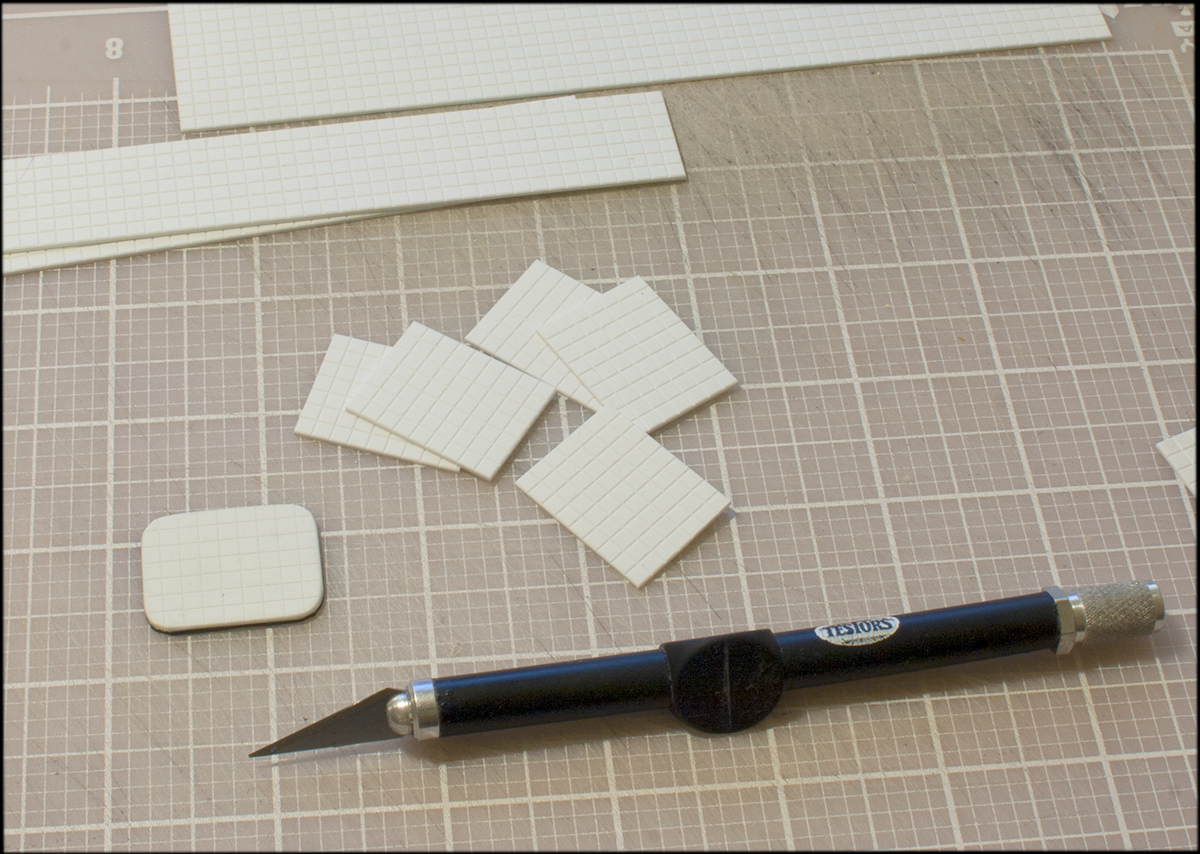
Because I'm using the figures for skirmish gaming, the single bases don't need to be any specific size. Typically I use 20mm x 25mm bases for 28mm figures (the William Stewart Standard Base Size™). For my ECW skirmish figures (Renegade and Bicorne), I used larger bases (25mm x 30mm) because the figures are "heroic" 28mm figures with a large footprint. The Grenadier figures are less heroic than the Renegade, but have big footprints. I compromised and used some 1/8 inch tile sheet styrene. I score the tiles at 7/8" x 1 1/8". The resulting base is a bit more narrow and very slightly less deep than the ECW bases.

Cutting bases from 1/8" tile sheet styrene
The tiled sheet styrene makes it easy to cut bases to the right size and also facilitates rounding the corners for a more skirmishy-looking base. I affix the cut bases to the sticky side of some magnetic sheet material from Litko, and then trim off the extra, round the corners, and sand everything smooth with fine grit sandpaper.

I glue the figures to the base using Gorilla super glue and then slap some Golden coarse pumice gel around to hide the rather thick base that comes on the casting. I learned the coarse pumice gel trick from Kevin Smyth. I apply the medium with a palette knife and let it dry for 12-24 hours. The surface is rough and lends itself well to painting and drybrushing.

I had a small pumice crisis to overcome first. I used to get the medium from Michael's, but every store I tried didn't have it. I was afraid it might be a discontinued item (that happens to me a lot). I finally went to Aaron Brothers art supply and got a 8 oz. jar at half price, as well as several Windsor Newton University Series 233 brushes in 000 and 00 sizes in their 1¢ sale (buy one, get one for 1¢). I've used these brushes for years to do my detail painting. Nothing else works for me as well.

When the medium is dry, I trim off the excess with an X-Acto knife. I use slightly thinned Vallejo Mud Brown as my base color and after that dries, I drybrush Vallejo Yellow Ochre over it to bring out the rough texture of the pumice gel medium.

I flock the bases with Woodland Scenics Earth Blend blended turf, leaving patches of 'bare ground.' Then I apply a second layer using Woodland Scenics Light Green coarse turf. After the glue is well dried for the coarse turf, I use some tweezers to pluck it short. The desired effect is a rough surface; tweezing reduces the puffiness of the turf. (I also need to tweeze out the bits of cat hair that get into my flocking, otherwise the bases might look like they have the kind of wispy beards that older women get.)

When the turf is all right, I go over the base edges with some Vallejo Mud Brown, and then give the figures a final spray of Krylon Matte Finish. The Krylon matte is a not-quite dullcote, but not quite a satin either. It leaves just a glint of satin finish on the figure that softens the harsh lusterlessness of the Testor's dullcote.
20 years in the making! Handgonners completed.
Lion Rampant

I'll use the figures I have as seed for one or more Lion Rampant retinues. I wanted to get medieval earlier, but nothing came of it because I couldn't really find a set of rules that I liked and that I could reasonably expect to find other people willing to play (and contribute to by painting minis). Lion Rampant changed that. It's very popular around here. The Tacoma gamers have regular Lion Rampant game days.

Early gunpowder weapons didn't make the cut in Daniel Mersey's published rules. Mersey did, however, provide some stats for them on a Boardgame Geek forum. because, as he notes, "there are some lovely models available for early handgunners." (As we see above.)

Below is a formatted version of the handgonne rules from the forum post.

Unit Name: HandgonnersPoints: 4
Attack7+Attack Value6
Move6+Defence Value6
Shoot8+Shoot Value6 /12"
Courage4+Max. Movement6"
Armor2Special RulesBang, Panic
  • Models per unit: 6
Special rules:
  • Bang: All units count as Armour 1 against Shooting by this unit (Armour 2 if in cover).
  • Panic: When this unit Shoots, the target unit must take a Courage test regardless of the number of hits inflicted.
Unit upgrades:
  • Pavises @ 2 points per unit. As for Crossbows.
Also, one poster to the forum suggested an option for having a handgonne blow up. Like the "lucky blow" rule,  when the handgonners shoot, roll 2 x D6. On a double-one, remove one handgonner. 

Grenadier Lives!

More good news is that Grenadier Models aren't dead and gone. Mirliton in Italy produces the full range. Packs of 5 foot figures or 2 mounted run about €8,16 (about $8.86 USD). The kicker is shipping. They charge a small fortune to ship. Unless you're ordering a lot of figures, you're getting soaked. Happily, Mirliton offers 10%, 15%, or 20% discount based on the amount of the sale. That makes shipping costs easier to swallow. At some point this year I'll use my tax refund to make a big purchase so I can get several units for Lion Rampant, enough for two retinues or to be able to mix 'n' match to make a lot of variations on one retinue.

I'm not aware of any US distributor for Mirliton. There is a UK distributor, but their prices are nearly twice the Mirliton prices, plus shipping costs from the UK.

Update 6/3/2020 - Grenadier has crossed the ocean!

There is a source for Mirliton/Grenadier minis in the US, so you can avoid the huge shipping costs from Italy and/or the UK. It's Noble Knight Games. They've had them for years, and I've known they've had them for years; I'm just getting around to updating the info here.