Wednesday, December 28, 2016

Mayhem in the maize


On December 17 Kevin Smyth and I ran another test play of our Quetzalcoatl Rampant variant of Dan Mersey's Lion Rampant skirmish rules. We'd played a game with the other two Daves at Meeples Games in West Seattle in August. Kevin also ran a game at the NHMGS game day at the Boeing Museum of Flight in November. For that game he revised some of the values for the troop types to give the Aztecs a bit more of a fighting chance. In both games the Spanish never even broke a sweat while beating Montezuma's minions like rented mules. After the second game, he revised things further. (I've updated the values in my Quetzalcoatl Rampant blog post.)

Saturday's game was still a bit of a walkover for los Españoles, but that may have been due to my extraordinary dicing--a talent I notably lack in most of my gaming adventures.

Kevin and Bailey played the Aztec horde and I played the Spanish. We each had 30 point retinues. I had one unit of caballeros, two units of rodeleros, one unit of arquebusiers, one unit of war-dogs, one Tlaxcalan skirmisher, and one unit of basic Tlaxcalan warriors. (We're toying with some kind of point limit for Spanish units in "Spanish" retinues to make them use more allies.)

The Spanish deployed, caballeros in reserve
Kevin and Bailey's force, as far as I recall, was maybe four skirmisher units, two basic warrior units, two veteran warrior units, and a unit of fearsome eagle knights.

The terrain was a couple houses, some wooded bits, and some maize fields. The terrain worked against the Aztecs because it let the numerically inferior Spanish dominate in the tight spots between blocking or hindering terrain and kept them from being enveloped by the Aztec horde.

I started out cagey. The Aztec warriors are better in attack than in defense (and the Spanish are correspondingly worse at defense than attack). I wanted to be the one attacking, so I hung back with my rodeleros out of 6" range of his troops waiting for him to move within my charge range. I held back the caballeros as a reserve strike force. I used my arquebusiers and Tlaxcalan skirmishers to good effect. I forced one of Bailey's skirmisher units to run (and keep running) on my first shot. The Aztecs didn't really have much luck with their courage rolls, nor with their own shooting.

Improved fearsome boomsticks of war
In our various combats, I managed to roll 11 hits against units a couple times. Maybe that's not too surprising when I'm hitting on 3+, but it has devastating effect on units with "2" armor. Coupled with poor courage rolls, the Mexica were soon in a world of hurt. The vaunted eagle knights rolled so low on their courage test that they clean buggered off the field.

Successive waves of Aztec nastiness
My war dogs were successful, but they'd lost half their number by game's end. I lost two caballeros and, I think, three rodeleros, and a couple Tlaxcalan skirmishers My arquebusiers and the Tlaxcalan warriors were untouched. (The Tlaxcalan warriors never got engaged, actually.)

My initial thoughts for this variant, as I mentioned in the original Quetzalcoatl Rampant post, were that Aztec numbers would offset Spanish quality. However, the disparity is still too significant, I think. I've been pondering some more things that might boost Aztec performance. In brief, these are:
  • Give the Aztecs (and Tlaxcalans) an 8" movement rate. This change would put the Aztecs in better position to charge the Spanish and get the benefit of their Attack combat value (and reduce the Spanish to their Defense combat value). For example, warrior knights or veteran warriors versus rodeleros would be 4+ Attack vs. 4+ Defend. The sole Spanish advantage is a "3" armor compared to the Aztec "2" armor. Things could get a bit more dangerous for the Conquistadors--especially since the Spanish units are 6 figures and the Aztecs are 12. This change might also prompt the Spanish rodeleros to use their Close Order rule and increase their protection to a "4" armor.
  • Give the Aztecs and Tlaxcalans a 12" range if they take the Atl-Atl option. The option costs 1 point, but is pretty useless with a 6" range. In fact, it's unusable since Aztec warrior knights and veteran warriors have the Wild Charge rule. If they're within 6" they can't shoot, they must attempt to attack.
Our next scheduled game is the Drumbeat game day in Seattle on February 4, but I think I'd like to sneak another game in before then to give these new ideas a try. Our ultimate plan is to run a few big games of this at Enfilade! in May. Until then, I have a lot of painting to do...

Sturm und D.(r)A.N.G.


We met at Dave Schueler's house in West Seattle on Boxing Day for Dave's Annual Naval Game (D.A.N.G.) XV. A few of our stalwarts were absent, but we had a good number on hand, including a cameo performance by Paul Hannah, esq. The game this year was a hypothetical crisis in the Caribbean ca. 1903 where Der Huns are trying to bully a port away from Venezuela on the pretext of unpaid debts. Teddy Roosevelt sends in a few naval units to brandish the Big Stick and warn off the sausage-eaters. What could go wrong?

Dave Creager, Arthur Brooking, and I were the Americans. Dale Mickel, Scott Murphy, and Chuck/Charlie X, were the Germans. At the beginning of the mini-campaign, the Germans had already bombarded some Venezuelan ports and had naval units in Puerto Cabello. The Americans were all up at Culebra in the Virgin Islands. The Germans also had naval units in Port of Spain. The victory conditions were simple and exclusive: The Germans had to gain their coveted port in Venezuela and the Americans had to make sure they didn't.

In the end, the Germans' Drang nach einem Hafen turned into a Sturm auf Zee.

Each side had options they could take. For the Americans, our at-start units were a collection of protected cruisers and gunboats. The Germans had some roughly equivalent ships but also three armored cruisers that outclassed anything we had. Since we had the option to take three battleships (Indiana, Massachusetts, and Texas), we did. What's a naval game without 13" guns? The Germans also had the option to add two battleships to their force, but they would be coming from far off and wouldn't be available until day 6 of the mini-campaign. Being impatient Teutonic types, they decided to go with what they had and forego waiting for the big boys. That was perhaps a mistake.

By day 2 of the mini-campaign, we had one squadron at Puerto Cabello only to find that the few German ships that were there at the start had been reinforced with the rest of the German ships from Port of Spain. Our other squadron, containing the battleships, had made for Puerto de la Guaira to act as a blocking force against the Germans coming from Port of Spain, which, however, had already passed through before we got there.

With our squadron at Puerto Cabello outnumbered and outgunned, we stalled for time and sent a dispatch boat to Puerto de la Guaira to bring up the other squadron. Meanwhile, both the Americans and Germans were pressuring the Italian squadron in the Caribbean. The Germans wanted them to join their blockade of the Venezuelan ports and the Americans wanted them to stay out of it. In the end, the Italians let the Germans lead them by the nose into trouble not of their making.

By day 3, the American squadron was assembled. The Germans had one cruiser and a gunboat in the harbor landing troops. We negotiated to have the USS Atlanta (our slowest ship) go into the port and land some Marines to protect American interests. We later attempted to reinforce Atlanta with a gunboat (USS Concord), but that was turned back when the Germans sent another gunboat to block the channel.

At this point the Italians steamed into troubled waters. Our ultimatum to them was to turn about, which they did at first. Then a German cruiser came to escort them back. We fired a shot across their bows, which set the stage for the ensuing naval action of Puerto Cabello.

We used David Manley's rules Fire When Ready! to play the game. They're a nice, quick-moving set of rules for the pre-dreadnought era. Dave's ship models were all Panzershiffe 1:2400 scale.

Each side organized their forces into three squadrons:

American 1st squadron - 3 battleships, 4 protected cruisers
American 2nd squadron - 4 protected cruisers
American 3rd squadron - 3 gunboats

German 1st squadron - 3 armored cruisers
German 2nd squadron - 3 light cruisers
German 3rd squadron - 1 German light cruiser, 2 Italian light cruisers

Out of the main fight were the Atlanta and the German cruiser and two German gunboats who were baring their teeth at each other in the harbor.

The initiative system in Fire When Ready! has each squadron rolling a D6 and adding its squadron command rating to get a number that could run from 1 (worst) to 8 (best). On turn 1, we had universally poor initiative rolls, but that helped. The sequence of play has the best initiative squadron move last and fire first. Loath to fire the first shots, the Germans, who all had priority to fire before the Americans, passed on shooting. We, having already fired a shot across the Italians' bows, felt obliged to open fire on just the Italians when our turn to fire came. The results weren't spectacular. Only the 1st squadron (Arthur and me) had the range and the concentration of fire increasingly obscured subsequent salvoes. But this meant that things would start to happen.

Turn 2 was equally fortunate for us because we got the higher initiative for our squadrons. The German 2nd and 3rd squadrons aggressively moved in to close the range and get their torpedoes in action. We got to shoot first and walloped them. The USS Indiana blew up the lead ship (Gazelle) in the German 2nd squadron (Dale's) and badly mauled the second ship (Niobe) so that it was a burning wreck. 13" guns will do that to cruisers.

Arthur (running the 1st squadron's cruisers) kept up fire on the German 3rd squadron and continued to hurt the Italians. Dave Creager was engaging Chuck's armored cruisers at a disadvantage, though they seemed to be matching hit for hit--except Dave couold take fewer hits before disaster.

On turn 3, I split the battleships off from the 1st squadron and left Arthur to keep at the now badly hurt 3rd and 2nd German squadrons. I figured the battleships needed to get into action against the armored cruisers. Still in range of the other Germans, the battleships lent a hand as Arthur dispatched the Italians and put more hurt on Scott's remaining German cruiser. Dave Creager got a lucky hit against one of Chuck's armored cruisers (Fürst Bismarck), which left it in bad shape.

By turn 4, the Germans were buring or sinking all over the water. Chuck's other two armored cruisers were in good shape, but the American battleships were already in range and shooting, so there was no need to stay around. The Fürst Bismarck was only making three knots and wound up striking her colors. Dale's surviving cruiser and Chuck's two armored cruisers fled away.

In the harbor, the Germans made a failed torpedo attack on the Atlanta and shots were exchanged, but with the general carnage of the German ships outside the harbor, further German hostility was futile. The German forces in the port laid down arms and prepared to be escorted out.

Without the battleships, the Americans would have been doomed. Had the battleships and armored cruisers engaged right off, the battle might have been less lop-sided, but they were on opposite ends of the table. However, despite being damaged a bit, Dave's protected cruisers fought the armored cruisers to a standstill until the battleships arrived. Only Olympia was much damaged, but not critically (yet).

We speculated after the game that this naval disaster for the Germans might have lead to Germany abandoning its aggressive naval program, which might have averted World War 1 and thereby World War 2, Korea, the Cold War, Vietnam...

For another account of D.A.N.G. XV (and piccies) see Dave Schueler's blog Naval Gazing.

Sunday, November 20, 2016

We like pike!


After a long hiatus since our last Pike & Shotte game, we played some 30 Years War on Saturday at the Panzer Depot in Kirkland, WA. Mike Lombardi and Troy Wold provided all the figures. Mike provided the brains, too. The rest of us pushed lead (and plastic) and rolled dice.


Mike wanted to try the Mercenary Captains campaign in The Devil's Playground supplement for Pike & Shotte. The campaign pits coalitions of players in a mini-campaign of four scenarios. At the start of the campaign, the players roll dice to determine the character of their commander and the forces he commands. The commanders start as average, the troops start as a bit below average. As the campaign progresses, the quality of both may rise.


I rolled up a force whose commander was rated as "popular," which modified my die rolls for my troops but also gives my opponents an advantage in their command rolls in the games (although we forgot to do this...). My units came out to 4 x musketeers, 2 x pike blocks, 1 x reiters, 1 x dragoons. At eight units, I had the biggest force on the board—not that it counted for much.

One of my battalia deployed with musketeers forward supported by pikes
There were four forces in the game. Troy and I played one side, Brett and Paul played another, while Mike adjudicated and kibitzed. The object was to hold a small town in the center of the board. The scenario in The Devil's Playground calls for a 4' x 4' playing area. We were on a 6' x 8' area. We started just 12" in from the edge, so we actually had more ground to cover to get at each other. Instead of being just 24" apart at the start, we were 48" apart. The medium guns that Troy and Paul had were out of range on turn 1.

Troy's Bavarian horde on my left
Troy had one battalia of 2 musketeers and a pike block, another battalia of just one musketeer unit and a pike block, a medium gun, and a unit of militia scum. He deployed opposite the town with the intention of rushing in and occupying it first.

Brett countered by charging his cuirassier unit against one of Troy's musketeer units, but just failed to contact. The next turn Troy managed to shoot it up with muskets and close range artillery, which sent it packing when Brett rolled snake-eyes on his courage test.

Bavarians in the village defending against Brett's Proddies
Troy got a musketeer unit into each of the village areas and managed to hold them against attacks by Brett's pikes on one side and Paul's pikes on the other. Troy was helped against Paul by the intervention of his commander who was rated as 'bloodthirsty', a characteristic that gave him extra combat dice.

Troy's 'bloodthirsty' commander inspires his troops to hold the farm
I slowly advanced on the right against Paul's forces. For both Paul and I our command rolls didn't let us make huge sweeping movements. It wasn't until turn 3 that I got into musket range of any enemy, though Paul's gun was popping away (without effect) on my musketeers from turn 2.

The highwater mark of my advance
My musketeers managed to pepper Paul's pike block that had been repulsed by Troy's hedgehog. I pushed him into shaken status, which left him in a delicate state. Shaken, he couldn't do much except sit and take fire or attempt to rally, but that option had its own peril. All our units are rated 'mercenary', which means that a failed attempt to rally from being shaken will cause the unit to retire ("They don't pay me for this!").

While onr village area was secure, Troy and Brett remained locked in combat for the second. Brett lost a musketeer unit in the fight, but his pikes remained stuck in against Troy's musketeers in the buildings.

Brett's pike assail the village
On the other side, my other battalia was advancing towards Paul's gun and militia. My dragoons were on the far left (mounted) with the reiters behind them. There was one point where I hoped to fling the dragoons against Paul's militia, but I failed the command roll (they were at -2 because they were out of range of my commander).

My second battalia and commander stride confidently forward
By now we'd completed six turns: end of game. Starting so far apart kept us from getting at each other sooner. There was also a lot of blocking terrain that obscured fields of fire and hindered movement. On the plus side, I didn't lose any units, which is beneficial to the campaign.

After the game we rolled dice to see how we improved. Because we held the town, we were the winners, which could factor into the results. The three things we checked for were 1) commander upgrades, 2) unit skill upgrades, 3) reinforcements.

I managed to get a commander upgrade that give a +1 in combat to any of my troops within 12" of my commander. All my units got plusses to either their shooting (musketeers) or combat (pikes). My dragoons got increased stamina (I'd rather they shot better). I had a chance at getting up to two more units, but flubbed it on a die roll of "1" and got no reinforcements.

Troy managed to get another gun and milita unit, Brett recovered his lost cuirassiers, but got no reinforcements leaving him minus one musketeer for the campaign. I don't recall how Paul fared. I think at least one player got a command boost to "8" (we all started at "7").

We decided we liked the campaign and we'll stick with it. It's a good encouragement to finish painting my 30 Years War figures that I started nearly a year ago. (Longer, actually, because December is when I completed painting my first batch of figures. I'd started them much earlier than that.)

Wednesday, September 21, 2016

Of all the shelters in all the towns in all the world...


I've pondered the question over the years whether I would adopt other cats after my trio (or any of the trio) died. With Grendel's cancer and death, the question became more acute.

My trio, Grendel, Rhiannon, and Maebh, have been such an intimate part of my daily existence for 10 years (or 9½ considering that Maebh came six months after I adopted Rhiannon) that I could never imagine any other pet situation than them. I figured at first that I would wait until all had died before I reconsidered a new cat (or cats). Then, after Grendel died, I figured I would wait a few months at least.

But like the serendipity of adopting Grendel, it seems that destiny took a hand.


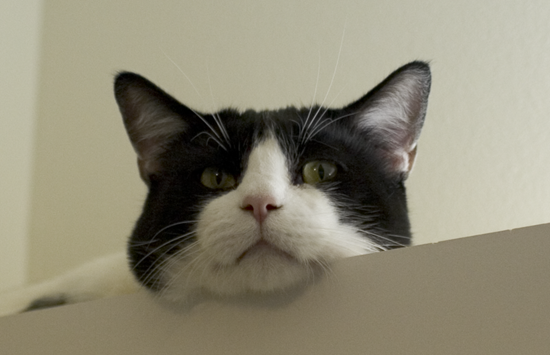
I adopted Grendel from PAWS Cat City in Seattle in 2006. I went to their website to look for information about sponsoring a cat kennel in Grendel's honor. While there, I looked at the adoptable cats (as one must). There I saw a familiar-ish face. One of the cats was a 2 year old cow cat name Onyx, Jr. The face was vaguely Grendeloid, as if he were a son or younger brother. I was intrigued, even if I wasn't ready.

I wanted to stick with my idea of waiting at least a few months (or not adopting at all). I thought the girls might bond better if there were just the two. I wondered too if my career as a standard-issue bipedal humanoid cat-minder unit was on the wane and I should just let it run out. (But then I'd have to rename my blog I Lived with Cats.)

I halfheartedly decided to go down to Seattle on Saturday and take a look at Onyx, Jr. He sounded nice from the description on the website and I wanted to see him, even though I figured he may not even be there when I came.

After mass on Saturday, I stopped by for a bite of breakfast at Alexa's Cafe in Bothell, WA. The shelter didn't open until 11:00 and I had time to kill. While there, a friend of mine from the parish showed up unexpectedly and we ate breakfast together. She commented on Grendel's death and mentioned  her own cats. I didn't know she was a cat person until then. I told her about my intentions and misgivings about adopting again so soon. She provided just enough encouragement to get me to the shelter.

I was not disappointed. Onyx, Jr. was there, but before I could visit with any cat, I had to fill out a form and be interviewed by a shelter volunteer. I told the volunteer about Grendel (and cried), and about my remaining two. Apparently, they found me worthy.

Onyx, Jr. turned out to be a sweet cat. I found him lounging comfortably with a few of his fellow felines in one of the small cat rooms. It was hard. I found myself wanting to take him home, but still conflicted. I wasn't sure how the girls would react to a newcomer, I wasn't sure if I was ready for a new cat, I felt that adopting so soon after Grendel's death might be either a betrayal of him or an impetuous action resulting from my grief (Onyx, Jr. looked so much like Grendel).


I asked if they would put a 24-hour hold on him while I made up my mind. They would and I arranged to return early Sunday afternoon.

I went home and started sort-of preparing my den to be where he'd be isolated from gen-pop while he acclimated to the new home. I was still just 80% sure about this. I also spent a lot of time thinking it through. I was afraid that Rhiannon would go ballistic, but I was also confident that Maebh would love a new pal. She'd been such good friends with Grendel.

After mass on Sunday, I headed back down to Seattle still in my Sunday-go-to-meetin' clothes. I went in to visit with Onyx, Jr. a bit more and all doubts were dispelled. He was a sweetheart and I figured that everything had come together so well that it was kismet. Just a short while later and I was headed home with a cat in a box.

I'd been sussing out a name for the new cat. I thought about sticking with a name from medieval literature. I thought about branching out to other sources and considered "Bonaparte" or "Charlemagne," but they sounded a bit hifalutin'. Finally, I decided on "Bogart." It took a few days to settle with me, but it fits him now, even if he still doesn't respond to it.

My fears about Rhiannon proved to be unfounded. While she didn't exactly welcome him, her reaction was more of cool indifference, i.e., no drama. My expectations about Maebh proved to be equally fallacious. She took one sniff of Bogart and deemed him unfit for feline companionship.

I kept him isolated for most of the first few days. Whenever he was out, Maebh would dog him growling and hissing. Her hostility made me wonder if I shouldn't have named him Cú Chulainn. She's come down a bit and Bogart's out in gen-pop now whenever I'm home, but it can still be dodgy.

Otherwise, he's settling in. He's found some favorite places, but he has yet to get cuddly with me, even though he's very affectionate. When I work at my desk upstairs, he loves to sprawl right in front of me in classic Grendel fashion.


He took to the high ground right off and I've fixed him a bed up there.


He's made a pretty thorough inspection of the house. He approves the library.


He loves the big glass door (one of Grendel's favorite places).


His full personality has yet to appear. So far, he's sweet and gentle, but Maebh's hostility has him a bit apprehensive. He loves to play. He tries to make nice with the girls, but so far without luck. He has a quiet little squeak for a meow. Once Maebh has settled down and accepted him, things will move forward. I'm looking forward to how things turn out.

And then there were two...


Grendel died on September 6.

In the six weeks from when his sickness started to his death, my life was in turmoil. Multiple vet visits and attempts at cancer-fighting supplements didn't slow anything down. It was hard to get him to take anything other than his prednisolone, which he eagerly downed in a pill pocket. He wouldn't touch food that had anything added to it and the capsules were too big to make him swallow. In the last days, he wouldn't even take the prednisolone. I had to crush it, liquefy it, and fight to give it to him orally with a syringe.

Grendel was a fighter. The cancer was already terminal before it was discovered. He'd suffered with it for a while without ever giving on that he was sick. Even in his final days, he seemed so determined to carry on as if nothing was wrong. He so wanted to be back to normal, but his body wouldn't cooperate. I thought he'd fade away until nothing remained but a shell, but it was the opposite. Indomitable to the end, Grendel remained strongly present; it was the shell that faded away.

He was terribly bloated from the cancer. He could walk only in short spurts. He lost nearly all of his prodigious appetite; by the end he would only lap a bit of milk from a saucer.

I'd resolved to let him die naturally at home, but by the afternoon of Labor Day, he was hunkered down just under my bed, where he'd been all day. I knew he was in pain. I lay there next to him weeping and praying and found myself crying out to God, "I don't want him to suffer any more." Later that evening I found someone who could come to my home in the morning and put him to sleep. I couldn't bear the idea of taking him away to die on a cold table at the vet's. It was the first time I admitted to myself that he could die.

I awoke Tuesday morning with foreboding. Grendel had gone downstairs during the night. I'd been unsure that he would even live through it. The morning was a bit rainy - weeping like me - and cold. I made a fire and to my surprise Grendel lay down by it for a bit. Maebh came and sat with him for a while. I'm glad they had a chance to say goodbye. She loved him and they often snuggled by the fire.


When the vet, Sarah, came, Grendel had gone down to sit in the foyer. I wept as I carried him upstairs. Sarah asked where I wanted us to be; I wasn't sure. I brought him to the couch where we used to sit together so often, but Grendel crawled back to the fire. I think he chose the place. He loved being by the fire. I have so many pictures of him there.


I wept and held him when Sarah gave him the sedative. I told him how much I loved him. I thanked him for choosing me. I thanked him for all the joy (and trouble) he'd given me for 10 years. When he was out, Sarah gave him the drugs and I held him until his heart stopped.

I can't begin to describe all that he meant to me or the desolation his death has been. I never realized how much he filled the house until he was gone from it. There are memories of him in every room, every nook and cranny. It's no consolation that I can now eat unmolested.

Grendel loved me as much as I loved him. My ex-GF Lorrin told me how he would watch me as I moved around the house and how he'd sit and stare at me while I wasn't looking. When I sat on the couch with my left elbow propped up on some cushions, he would come and curl up in my left arm and purr unceasingly. Those were moments of bliss I'll never forget.

He was always excited to see me come home. He knew the sound of my car and I would often be driving up and see him pop into the window of the den upstairs, stare at me wide-eyed, and then pop down and be at the door three floors below by the time I opened it. Even if I took him by surprise, I'd no sooner step in the door than he'd be running downstairs going, "Wah wah wah wah wah!"

We'd play hide 'n' seek. I'd see him peering at me from around a corner and I'd slowly move towards him until I got close when he'd run off to another corner to hide and peer. I'd do the same with him. When he saw me peering around a corner at him, he'd come running at me.

He gave me presents. I have two cat toys that are long, snaky fabric thingies on a wand. They were the first cat toys I got for him. He'd lost interest in actually playing with them years ago, but he used to carry them around and place them near where I was or where I would be. I could hear him coming to me through the house meowing with one in his mouth. It was a strange, muffled wa-AUUUGH sound that he'd make. All through the years I would come home to find them left at the top of the stairs or I'd get up to find them at the bedroom door or they'd appear outside my den while I was there working.

There was never a cat like Grendel. There never will be again. My world is diminished by his loss.


Goodbye Grendel. Goodbye old friend. You were gone too soon from my life, but you will always be in my heart even as the memories of you grow more distant.

Postscript

We are again three. Much to my own surprise, I adopted a new cat a week after Grendel died. But that's a story for another blog post.

Wednesday, August 3, 2016

And the long goodbye begins...


My world suddenly went turvy last week when my beloved cow-cat Grendel was diagnosed with cancer.

He caught a sudden, severe cold on Sunday afternoon and by Monday he was listless, withdrawn, and had lost all interest in eating.

A few vet trips later, the results of an ultrasound last Thursday confirmed that he had cancer. It's inoperable and untreatable with chemo. The vet said he had maybe a few weeks or few months to live.

I've been devastated since then. I can't imagine losing him. His outsized personality and beguiling charm simply can't disappear forever. I'm not prepared for this and I've had more than a few good cries over it.

Since the diagnosis, he's rallied back. The cold affected him badly; as he recovers from it, he seems as much himself as ever. If I didn't know otherwise, I'd swear he was the vision of health. The old behaviors that vanished last week have slowly come back: He's back on my bed before dawn tormenting me to get up and feed him, he's back to snuggling with me on the couch, he was down at the door greeting the pizza man with me this afternoon, he's pestering Rhiannon, mewling loudly to be let into the garage, etc.

But a lot of anxiety remains. I notice things that aren't quite the same, or maybe just seem not quite the same. I wonder if he always slept so much or that I never considered it before. Is he less playful? Is he less troublesome and insufferable? I don't know, but every perceived change worries me that he's winding down. I expect more of these observations and worries as time goes on.

The vet put him on prednisolone, which is basically a steroid. I have friends who swear it's a miracle drug. One friend's cat was at the vet to be put down because it showed no signs of quality of life. They put her on prednisolone and six months later she's going strong. My vet told me that her childhood dog was diagnosed with cancer and given just a few weeks to live. The dog lived another five years on prednisolone. There's hope.

I took him to the vet this morning for a follow up. She was amazed to see how much he'd recovered from his sorry state last week. We talked about supplements and what I can do to keep up his quality of life. I'll have a plan in place soon.

With Grendel back to normal, more or less, I'm optimistic that he can go on for a long time despite the cancer. I want him to live on with the same quality of life he's always had. But I know the clock is ticking now. I've had to face losing him, which is something I never wanted to face before.

And Grendel isn't my only cat. He's 12 now. Maebh is almost 13. Rhiannon is 15. They're all getting on in years. The girls seem to be in great shape, but so did Grendel. My world can unexpectedly go turvy all over again for them. It seems like only yesterday that I brought the cats into my life, but it's been 10 years. I hope that they'll all live to be 20 or older. I can't imagine my home being home without them. But I know that I have to start preparing myself for losing them.

I don't know if it's possible to love my cats more than I already do. But in the years to come, I will take them less for granted. I'll savor every moment with them and store them in my heart for the years after they're gone. It's a long goodbye that will outlast them and never end until I do.

The days that will never end

Monday, July 18, 2016

Two-dimensional Banzai


I got around a bit on Saturday. I meant to start earlier and be even more adventurous, but this Saturday I needed a little more easing into the day than usual. I'd arranged with Dave Schueler to play Guadalcanal at Meeples Games in West Seattle, starting at 10:00, just when they open. Plan A was to go to 8:00 Mass at Blessed Sacrament in Seattle, then a bagel and coffee at Eltana Bagels. However, I was too lazy to get moving this morning, so I went with Plan B, which involved rushing out the door with barely enough time to get from Lynnwood to West Seattle.

Col. Ichiki was not entirely successful

The Guadalcanal scenario we played was the Battle of Alligator Creek. This was the first Japanese counterattack on land in the battle. Japanese destroyers landed an advanced detachment of about 900 men 21 miles east of the Marine perimeter. The intent was to pierce the Marine defenses and overrun Henderson Field, the Marine airfield (completed on what had been an unfinished Japanese airfield) that was the central point of the fighting on Guadalcanal. It had to have been conceived as a suicide mission. There was the whole 1st Marine division ("The Old Breed") landed on Guadalcanal. Even though its 11,000 men were spread out in a perimeter, there were 3000 Marines of the 1st Regiment on point at the Tenaru River. (The Marines names it "Alligator creek" even though it wasn't a creek and there were no alligators in it.)

The 900 men landed by the Japanese navy were supposed to be followed up by another 1200, but the commander of the Japanese troops, Col. Kiyonao Ichiki, was impatient to sweep away the Marines, whose numbers he greatly underestimated. Ichiki was a bit of a fire-eater. As a company commander in Manchuria Manchukuo, he was involved in the "Marco Polo Bridge Incident," which started the Sino-Japanese War of 1937-45.

The Japanese attack started at about 2:00 AM with a rush of about 100 men over the sandbar at the mouth of the river. The Marines were dug in on the west side of the river with a 37mm anti-tank gun, well-supplied with cannister rounds for anti-personnel shooting, and a platoon of machine guns. This attack was wiped out by intense Marine fire. A second wave of about 200 men met the same fate.

Attack across the sandbar
At this point the Japanese stayed on the east side of the river and engaged in a firefight with the Marines until daybreak, when the Marine 1st battalion counterattacked in an envelopment that brought them south and east of the Japanese positions. Five M3 Stuart tanks trundled across the sandbar to join the fray and the Japanese troops were pretty much annihilated. In all the Japanese lost more than 700 men to the Marines' loss of 43 men. Col. Ichiki died in the battle, but it's not clear if he died in action or committed suicide because of his failure.

The Tenaru today. No sandbar and the runway of  the Honiara International Airport
 (formerly Henderson Field) extends right up to where the Marines were deployed on August 21.
The attack at the Tenaru was the ground offensive for Operation Ka, which was the Japanese riposte to American seizure of Guadalcanal. It was a complete failure. In his report to higher command, Col. Ichiki's superior admitted only that the attack was "not entirely successful."

The refight

Dave opted to play the Japanese, so I played the Marines. Initial set-up locations were determined by the scenario. The Japanese first wave was massed just east of the sandbar; my Marines were spread out covering the length of the river.

The scenario was 6 rounds with the first three rounds being night. Initial visibility for round 1 was 2 hexes. For rounds 2 and 3, we rolled a D6 with the result being the visibility for that round. I rolled a "1" on both turns. I was frustrated that my visibility was hampered, but the low visibility probably hurt Dave more than me. He had no recourse but to move up close, which gave me an advantage in close-range shooting.

The course of the game pretty much followed the historical fight, except Dave managed to overrun the 37mm gun position that covered the sandbar. I managed to take the position back in the next round, so it was a short-lived triumph. That was with the first wave. The subsequent waves that came on board rounds 3 and 4, did not make massed close assaults. My round 4 reinforcements came on the south edge of the board and by round 5, I had two Stuarts rampaging across the sandbar into Japanese territory.

It was touch and go for a while. Dave made good use of his little grenade launcher units. They don't have much pop, but they negate covering terrain. Combined with other units in a group fire, they can be very effective against units you thought were safely hunkered down in deep jungle. But Marine firepower won in the end. I lost 5 counters (both my 37mm guns plus three rifle squads), while Dave lost all but two of his units. I was lucky in my die rolls; Dave was lucky, initially, in pulling "no hit" counters for hit results, but his die rolls were pure poo.

It turns out, too, that we counted points wrong. The scenario gives 2 points to the Japanese for each Marine unit eliminated and 3 points for possession of each of the control hexes. That meant only five fewer points for me, which wouldn't have changed the outcome

Dave hadn't played the Conflict of Heroes system before. I hadn't played in a few years. Even then, there were some new rules for this expansion that took getting used to. Unlike previous games, the hit counters for the Japanese and Marines are different. The Japanese can have up to five "no hit" counters that do no damage (there were four in this scenario). The Marines have none.

Bushidō points didn't factor too much in the game. Positive points were gained for getting units across the Tenaru river and negative were incurred whenever a Japanese infantry unit started its activation not as part of a group action. Dave gained a few in the initial rounds, but then lost them again after his losses chopped up cohesion. He never fell below his initial CAP allowance because the Japanese don't lose CAP for unit losses, only the Marines do. (Too bad they don't have gung-ho points for the Marines...)

Closing thoughts

I like the nuances to the system for Guadalcanal. It's not a paradigm shift, but there's some adjustment to make if you've been playing previous Conflict of Heroes games.

The scenarios do a good job at making the Japanese behave historically. Had Dave been able to just sit back and engage in a firefight, he might have out-gunned me. But his need to get units across the Tenaru, perform group actions, and take (and/or hold) the control points forces him to move en masse and get in close. The limited visibility of three night rounds also inhibits his ability to sit back and shoot until he's lost enough units to give the Marine's a big advantage after their reinforcements come in. (Also, if he sits in place too long, the Marine artillery barrages can hurt.)

I didn't use my artillery well in the game. The first rounds I either forgot to plot a barrage or the barrage I plotted missed because the Japanese didn't wind up being where I'd plotted the barrage to land. The single success came on round 6 when Dave's remaining units were clustered around the control point in the palm grove on is side of the river.

The 37mm guns were pretty crappy. The game has a cannister card that gives the guns a little bit more effectiveness (but not much). However, the scenario doesn't give them. So the 37mm gun, which is the only unit holding the key bunker/control point has its wee +2 pop. In the hitorical accounts of the fighting, the 37mm guns shooting cannister did a huge amount of damage to the waves of attacking Japanese.